
Back in 2000, I started my journey into Jewish Family Education by attending the Whizin Institute (z’l) held in LA on the American Jewish University campus (now a Milikin campus). One of the moments I clearly remember was a story that Rabbi Eddie Feinstein and Harlene Appleman z’l told in a breakout session. It goes something like this:
A woman is hired to be a full-time nanny in the home of a young Jewish family with two kids. She had started for them in the Fall, coinciding with the start of the school year, and a little before Passover, the parents sit her down to explain that in a few weeks, they will be observing a Jewish holiday called Passover and the family will not be eating bread/leavened products during that week. The nanny sits with her mouth gaping open, cocks her eyebrows and says, “You are Jewish? I can’t possible work for Jews. I quit immediately. Please mail me my wages.” She gathers her things and leaves.
What is the first reaction you have? If you are like me and most folks that were in that room, you are angry that she’s such a JewHater that she quits the moment she finds out the family is Jewish. But then Rabbi Feinstein and Harlene pull us all back to reality with this question …. How could this woman work for this family, in their home, for six months and not know they were Jewish?!?!
They proceed to ask the group – what other holidays should this woman have seen the family prepare for/experience? What ARTIFACTS should she have seen in and around the home that would have told her from day one that this family is Jewish? What language/words would most Jewish families integrate into their every day lives that she would have heard?
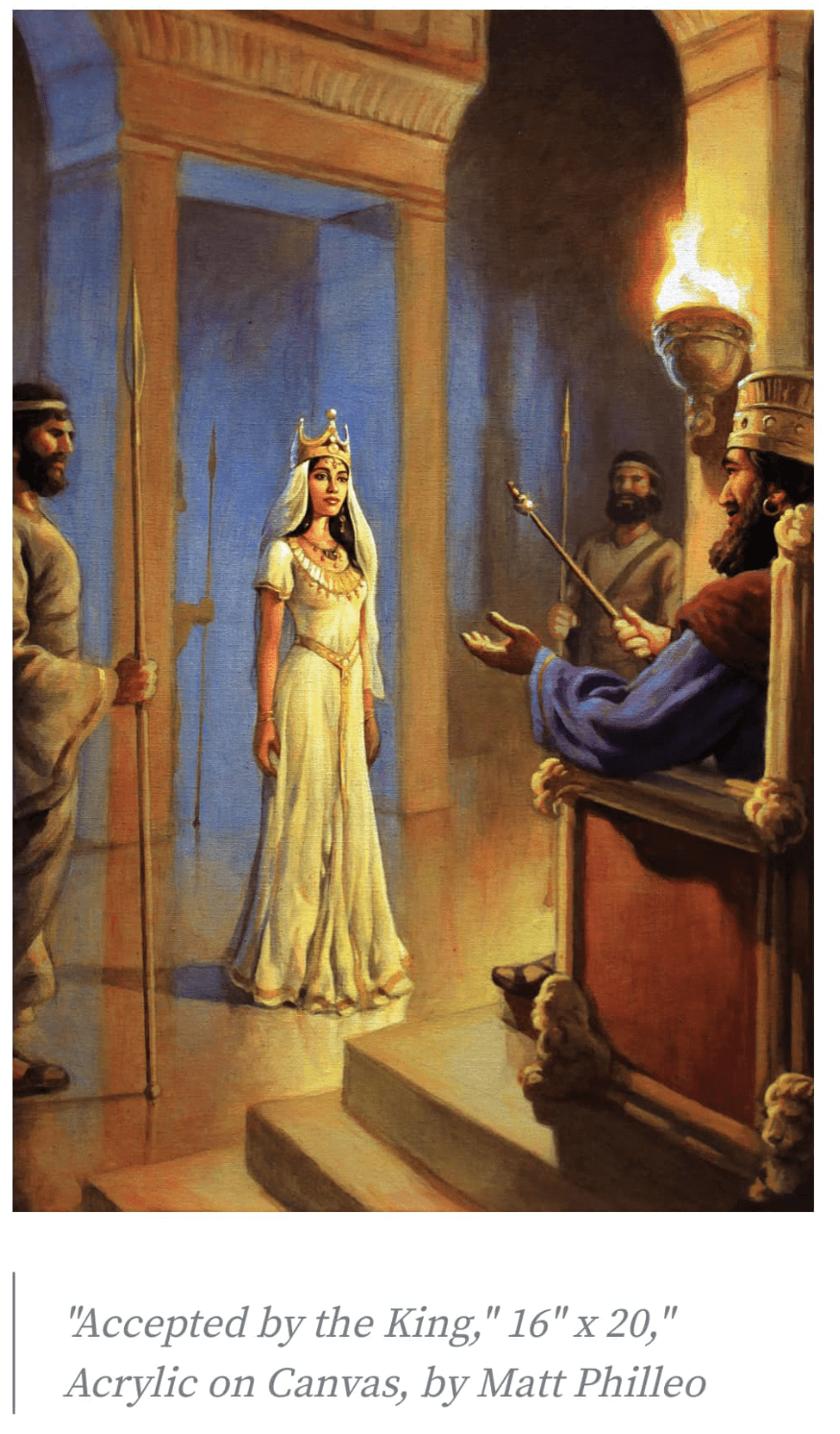
This story, and its AHA moment, bring me to the focus of my thoughts about Queen Esther and the story of Purim. Each year at Purim we tend to focus on the role Esther played in saving the Jews from the hands of the villainous Haman.
But for me, one of the most troubling parts of this story is assimilation, hidden identity and it took Esther to “come out” as Jewish for the King and others to know her faith tradition.
How is it that she’s married to a man who doesn’t know her background? What does that say about her lack of living Jewishly every day? About her lack of Jewish expression through any means of practice, observance, culture, etc?
Let’s start with their first meeting … maybe wearing jewelry of Jewish expression isn’t a trend back then, but the real audition for queen was believed to be a sex act (or more than one). Would a practicing Jew with any pride agree to that? We don’t know the sexual norms for the Jewish community of that time (at least I don’t) and some might argue that she would surely have been put to death if she didn’t comply. Let’s ponder this.
It would seem that this time frame is one of some level of hostility towards Jews, not by the King, but by all sorts of leaders in the cities and some citizens even bribing Persian governors to oppress the Jews. Achashverosh was known to be heavily influenced by those in lower authority roles and even described as “King Achashverosh proceeded to rule with an iron hand, never hesitating to persecute those he suspected of treason.” Would he have seen a denial of this audition on the basis of religious commitment a form a treason? Perhaps. Should Esther have taken the death sentence over the violation of random sex with the King? Do we think Esther weighed those options? The Talmud (a more modern text than Book of Esther) has some guidance for this dilemma, and I hope that when teaching this story to older learners that this might be explored.
Moving on, she becomes Queen. But, how does Esther last so long in the castle, as his wife and he has no idea that she is Jewish? No slip of an “oy! vey!?” No request to observe a single Jewish celebration or holy day? No ownership of a Jewish text of any sort or any Jewish ritual item?
When I engaged in my dissertation research, I chose a research methodology called Portraiture. One of the reasons I chose this method was to be able to go into the homes of the teen participants and see for myself what was the Jewishness of their home, their rooms, their personal belongings. How did they express their Jewish identity through music on their playlists to posts in social media? Were they surrounded by Jewish artifacts (a mezuzah on the door? Jewish art in the home? Jewish ritual objects on display? etc.)? If you were to do a quick mental inventory of your own home, your car, your body, what would be the obvious signs that scream “JEW RIGHT HERE!”?
I find it very rare that Jewish leaders are in the homes of our community members. What would it look like to build home visits into the norms of early childhood, day school, and synagogue educators? Clergy? Communal educators? Sometimes we can turn to non-Jewish education exemplars and in this case I spotlight KIPP and that their classroom educators are obligated to conduct home visits. How could the story of Esther living in the palace with her Judaism unnoticed be a catalyst for those working with Jewish families to help them consider how their home tells part of their Jewish identity story?
I think it is imperative to challenge educators, clergy, and other Jewish leaders to consider how they are teaching THIS aspect of the Purim story.
Another aspect of the Esther story that is supremely relevant in our lives today as diaspora Jews face intense JewHatred around every corner on the streets and on social media, is how quickly Esther chose to reveal herself in order to stand up for the Jewish people. The text of Esther 4:13-14:
Mordecai had this message delivered to Esther:
“Do not imagine that you, of all the Jews,
will escape with your life by being in the king’s palace.
On the contrary, if you keep silent in this crisis,
relief and deliverance will come to the Jews
from another quarter, while
you and your father’s house will perish.
And who knows, perhaps you have attained
to royal position for just such a crisis.”
The last 157 days (as of today) have been really horrible for our people. For global Jewry. For Am Yisrael (B’nai Yisrael, K’lal Yisrael). And yet I wonder how many Jews across the globe are sitting on their couches, watching the news report as JewHatred in the diaspora get out of control and scroll social media reading news of Israeli soldiers dying in combat. And … do nothing. Sigh, cringe, roll their eyes, bitch to their closest family and friends. And … do nothing. Now is the time to read Mordechai’s words and take them to heart. Now is the time to teach that Esther was brave in this moment and stood up for her people. She was reminded by her cousin (uncle, maybe) that she had an obligation to not stay silent as her kinfolk were murdered. He told her the hard truth at if she kept silent, she would have some culpability. Now is the time to hold each other accountable – to lobbying, to protesting, to confronting JewHatred in our communities, to financially support the organizations doing the front-line work, to volunteer to help them in their efforts. Esther (and Mordechai) remind us that we cannot remain silent.
I think it is imperative to challenge educators, clergy, and other Jewish leaders to consider how they are teaching THIS aspect of the Purim story.
I once read this commentary on a piece of Talmud (Megillah 2a) that was authored by the Baal Shem Tov and it resonates with me so much regarding these lessons:

If you read the story of Esther and of her people, of the rise of Haman and his own self-destruction, of secret heroes and hidden miracles…
…if you read all this as though it was all a backstory —something that occurred a long time ago and now provides only historical context —you haven’t read the story.
Purim is so much more than Oznei Haman (hamentaschen), groggers and costumes. We cannot afford to water down the narrative and not teach other core lessons from this cornerstone master story of our people. There is no reason to not engage learners (age appropriate) in some of these bigger lessons … yes, Be Happy, It’s Adar. But also, dig deep into text and make it hyper-relevant to your life and those around you
 JewishGPS
Leave a comment