
Back in 2018, while working on my doctoral pursuits, I wrote this blog about how Jewish identity cannot be framed in the Christian construct of “Religious or Spiritual” and began developing a framework based in lived Jewish experience. During that process, with feedback and a few iterations, I landed on a version released in this blog three months later in which I asserted that Jewish identity could not be reflected upon if it didn’t include a person’s relationship to Jewish values. There was a nice little connection between Six Aspects of Jewish Identity and the six points on a Jewish star (Magen David). However, the last two+ years since 10/7 have forced me to reconsider the framework and to shift some things around.
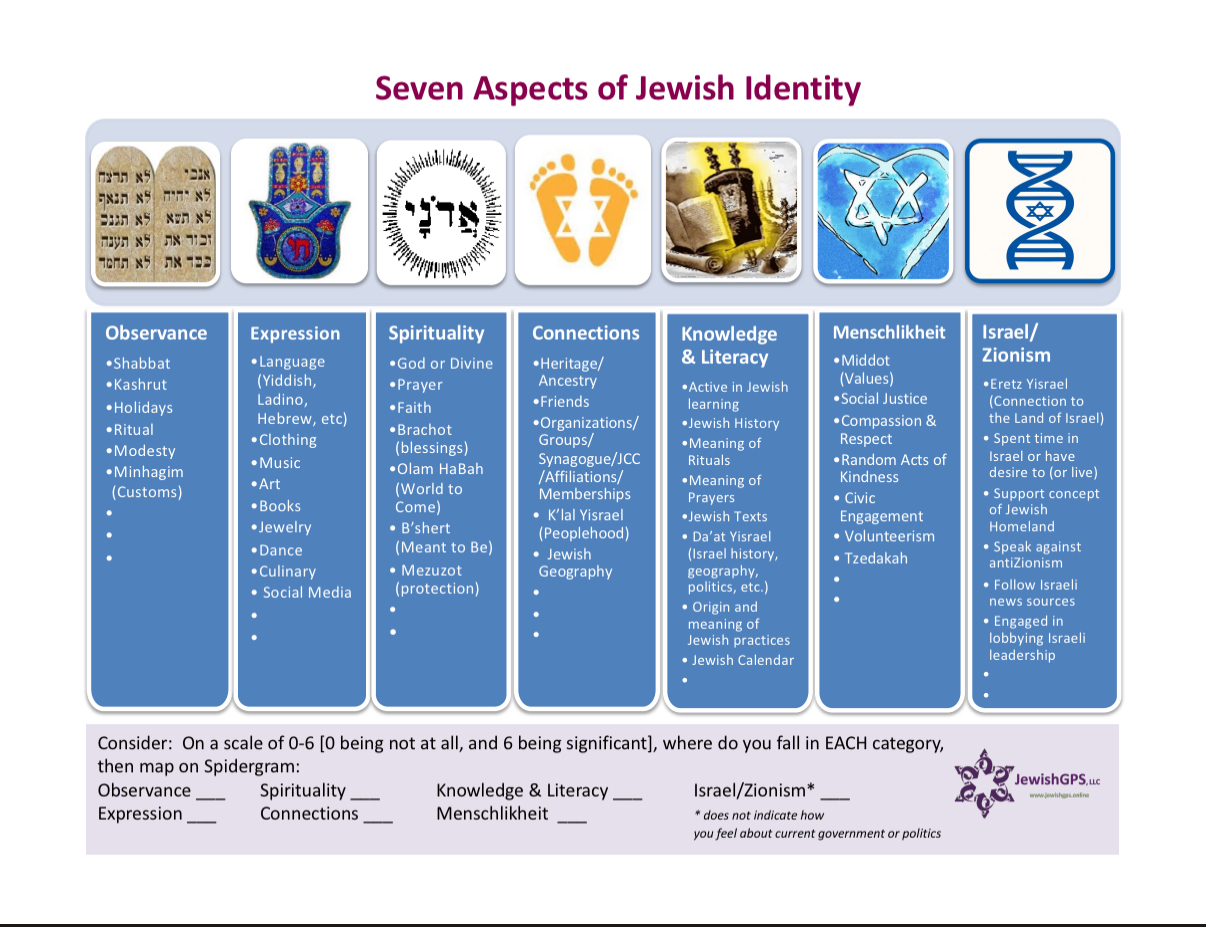
The six aspect version integrated concepts related to Israel across a few categories. However, the rise of Jewish folks who have expressed a disconnect with Israel (some framing it as antiIsrael, others as antiZionism), made me realize that Israel was too important to hide within other categories and it needed to sit on its own as a seventh aspect of Jewish identity. This separation also forces those who are using the tool, to express their relationship to Israel on it’s own merit and not camouflage it under a collective lower ranking in other categories. (Note: as stated with an asterisk on the chart, this does NOT reflect your feelings towards current Israeli government nor policies.) (Another note: my thoughts about Jews who try and uncouple Zionism from Judaism can be read here.)
So now I present the newest version of my Jewish Identity reflections matrix with seven aspects.
Seven: the days of the holy week. Seven: the number marking the way many Jews observe Sukkot and Pesach. Seven: the derivative of the 7×7 days of the Omer. Seven: the days of Jewish mourning. Seven: the cycle of Shmita and 7×7 the cycle of the Jubilee year. Seven: the branches on the Menorah of The Temple. Seven: the dimensions of Kabbalah and spiritual growth. Seven: a sign of wholeness and completion.
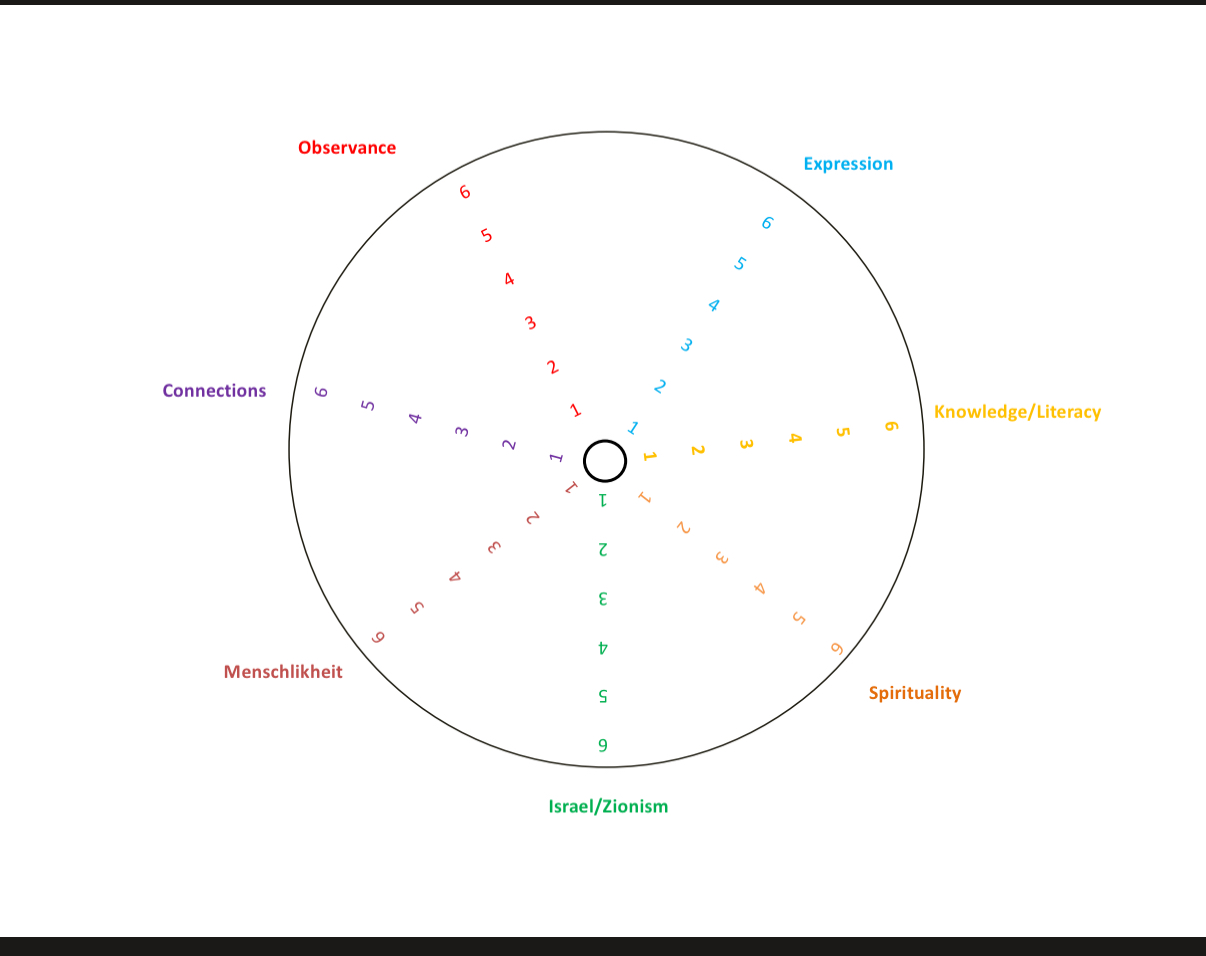
As a refresher, or if you a new to my work, the idea is to take your self-reflected numerical assignment to each category and drop it into this Spidergram.
Sometimes Jewish folks get caught into a trap of explaining themselves as “more or less Jewish” rather than just expressing and connected to Judaism differently than someone else. This is an excerpt from a paper I wrote during my doctoral work and it’s included in this blog post:
In her paper, “The Sixites: The Calm Against the Storm, or, Levels of Concern,” Maxine Greene (2000) spends some time examining Paulo Freire’s view of “internalized oppressors,” (p. 308). These oppressors begin with how people are trained to accommodate the stratifications within a society. Within the greater Jewish society, the elevation and stratification of certain kinds of Jewish expression and engagement sometimes leads to a perceived low self-worth within Judaism for those without those skills or observances. This often gets expressed as being a “bad jew,” (Marcus, 2007). Marcus writes, “Often people will say to me … ‘Rabbi, I’m a bad Jew.’ After hearing this so many times, it got me thinking…there is a plague afflicting many Jews: low Jewish self-esteem.”
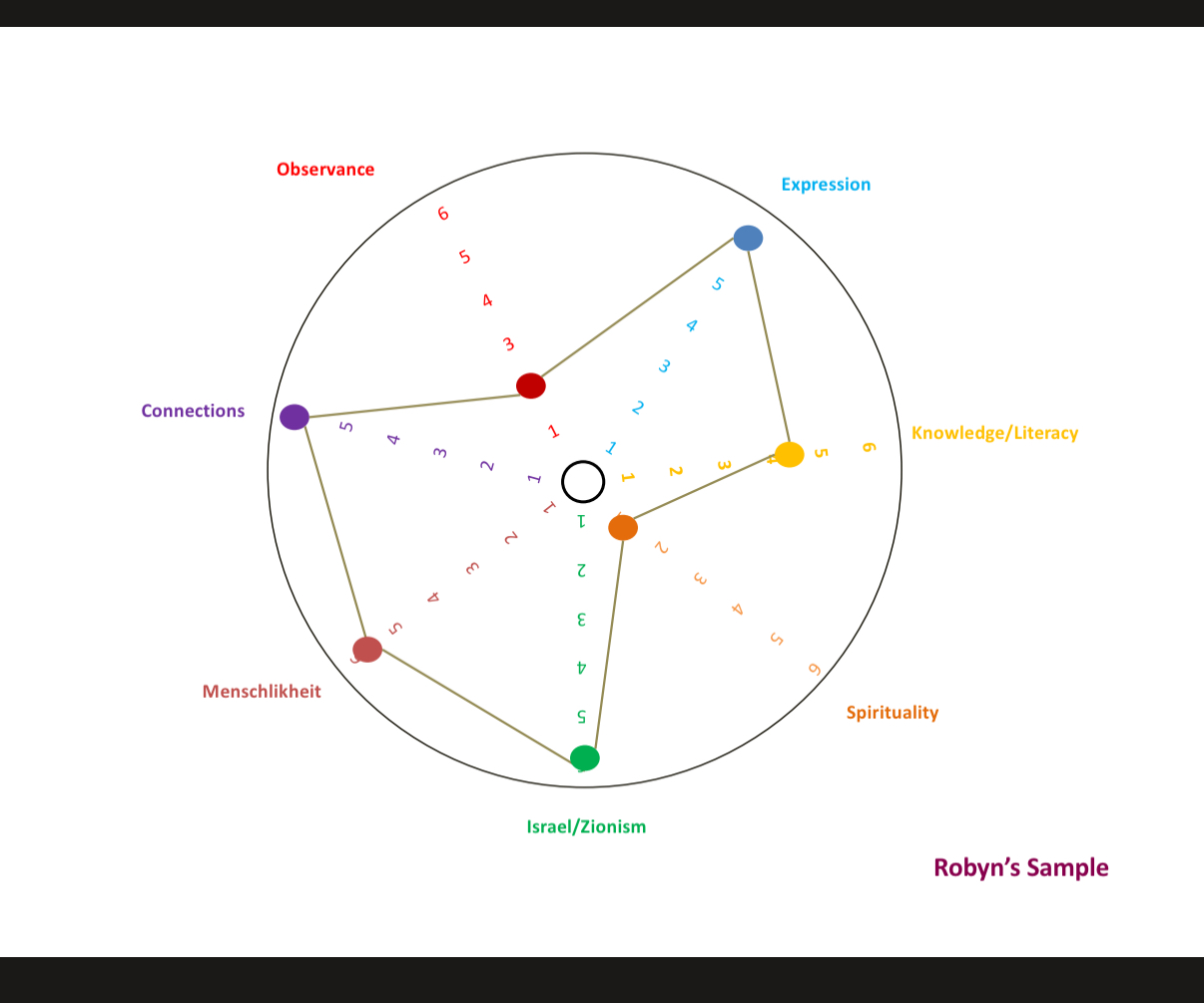
By creating a tool that translate a person’s Jewish identity (and identification) into a shape, rather than a bar chart, it invites us to not use the terms “more or less” or “higher or lower.” It suggests that each of us holds our Jewish shape differently, and also that sometimes, our shape shifts with time, experience, knowledge, and more reflection.
As any good education leader, I won’t ask participants/learners to do something I haven’t done, so here I share with you the snapshot of my Jewish identity as it sits today.
I invite folks to use the matrix and the spidergram as a way talk about your own Jewishness with both Jews and non-Jews. As a way to shift the way we talk about our very personal, very unique Jewish selves.

 JewishGPS
Leave a comment