

In recent days, the Atlanta Jewish Film Festival has found itself at the center of a significant and very public communal rupture. [AJFF is recognized as the largest Jewish film festival in the world, often attracting over 38,000 attendees annually.]
The Israeli Consulate in Atlanta announced that it was withdrawing its partnership and financial support after learning that a student juror had previously shared antisemitic and anti-Israel content and participated in anti-Israel campus encampment activity. The Consulate stated that providing a credible platform within the Jewish community to someone who had engaged in the spread of misinformation and antisemitic rhetoric undermines the integrity of the festival.
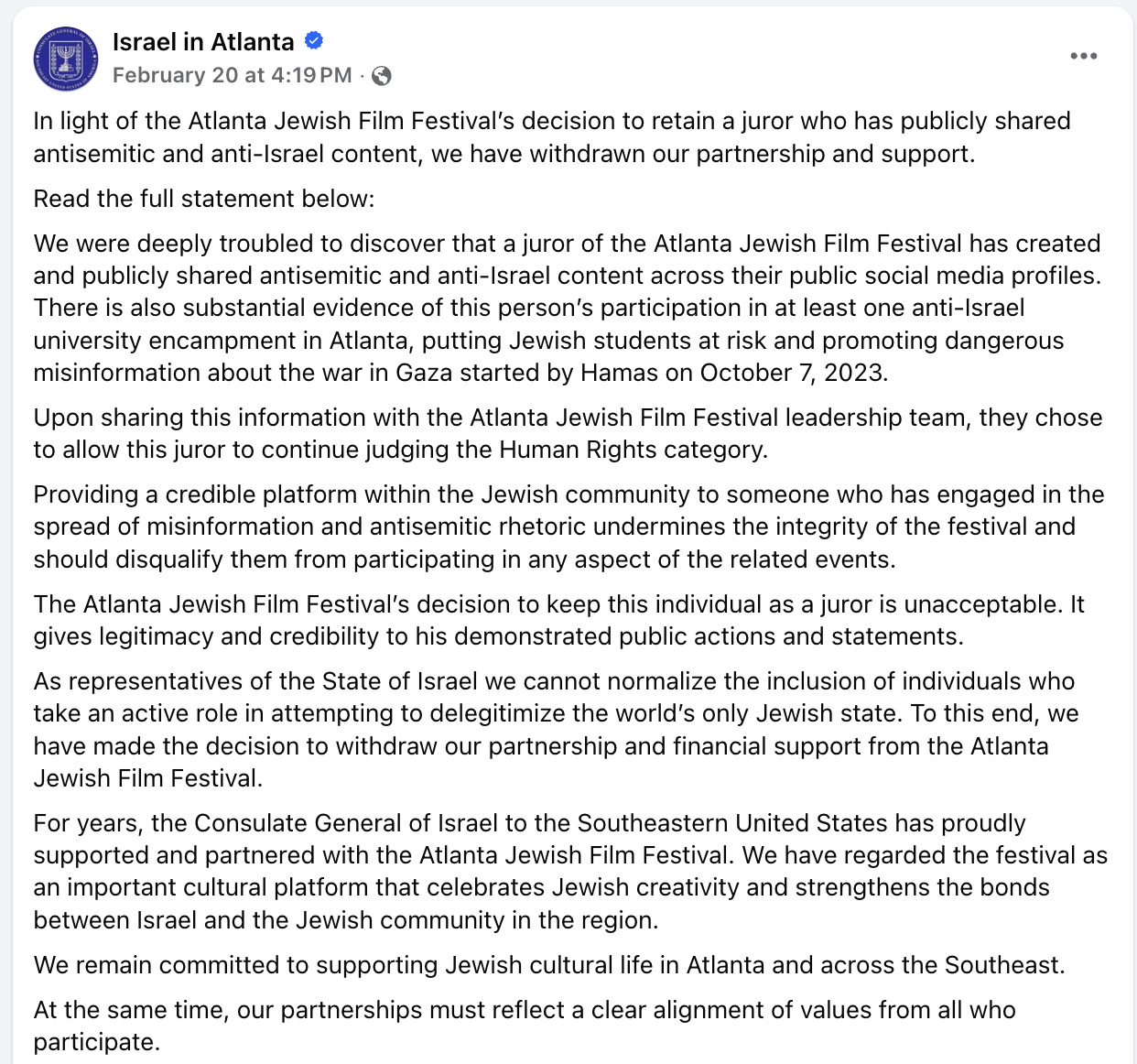
“Upon sharing this information with the Atlanta Jewish Film Festival leadership team, they chose to allow this juror to continue judging the Human Rights category.”
The public reaction was swift and emotional. Longtime attendees expressed anger and disappointment. Some stated that they would not attend despite already purchasing tickets. Others questioned how such a decision could have occurred at all.
A small sampling of publicly available responses included statements such as:
- “Why are we tolerating the intolerant and hateful, and even worse inviting them into our sacred spaces?”
- “This isn’t about politics. It’s about moral clarity.”
- “Make future funding contingent upon actual policy changes and rigorous vetting. Accountability is key.”
For those who wish to understand the broader range and intensity of community response, a limited compilation of publicly available comments is available here.
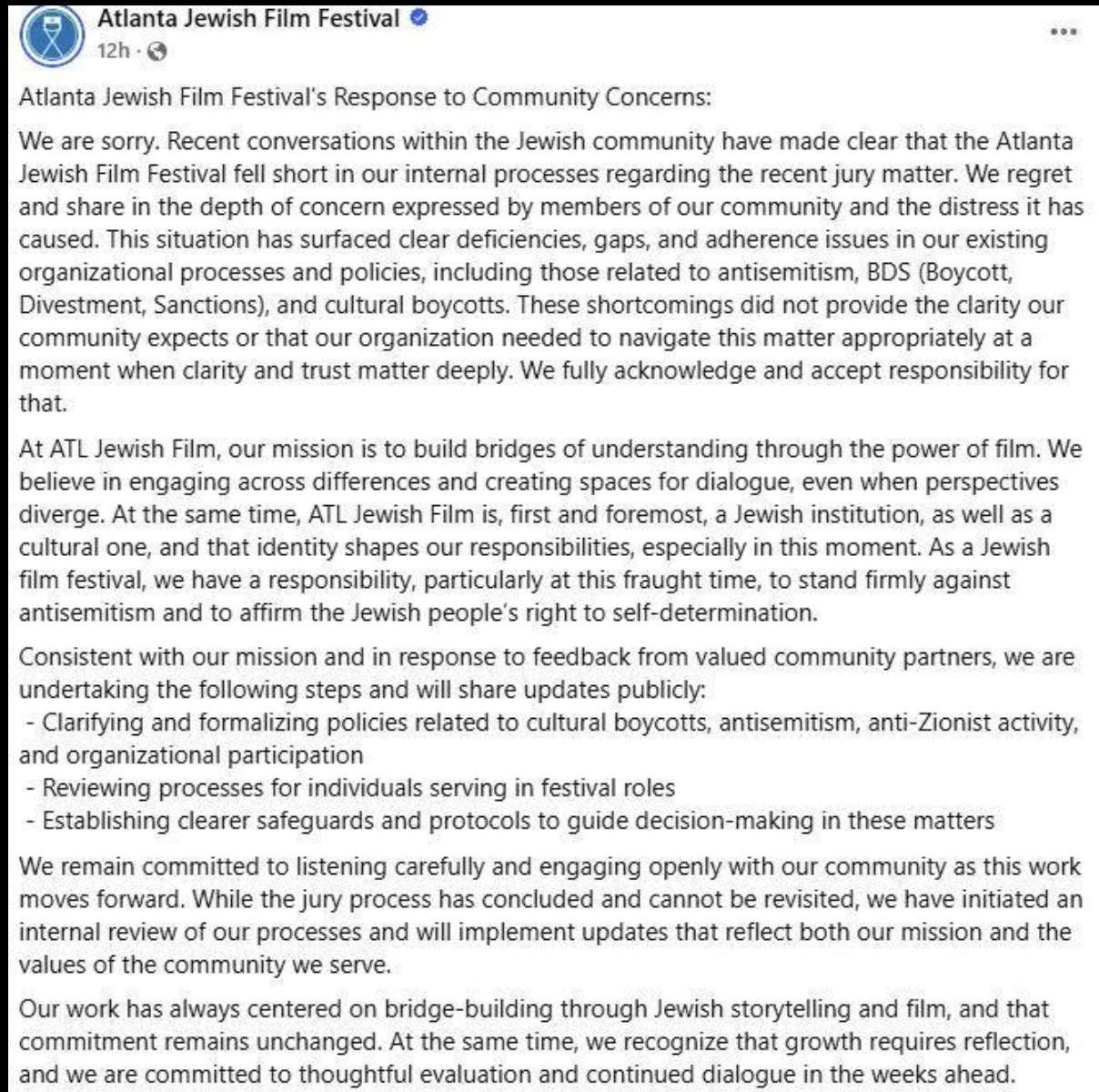
“At ATL Jewish Film, our mission is to build bridges of understanding through the power of film. We believe in engaging across differences and creating spaces for dialogue, even when perspectives diverge. At the same time, ATL Jewish Film is, first and foremost, a Jewish institution…”
AJFF responded with a public apology. The organization acknowledged that it had fallen short in its internal processes, identified deficiencies and gaps in its policies related to antisemitism, BDS, and cultural boycotts, and committed to reviewing and strengthening its procedures. The festival reaffirmed that it remains “first and foremost, a Jewish institution,” with a responsibility to stand firmly against antisemitism and affirm Jewish self-determination.
At the time of this writing, the apology post from AJFF did not allow for public comments, and much of the community conversation has unfolded in external spaces (one example) rather than within a structured forum hosted by the organization itself.
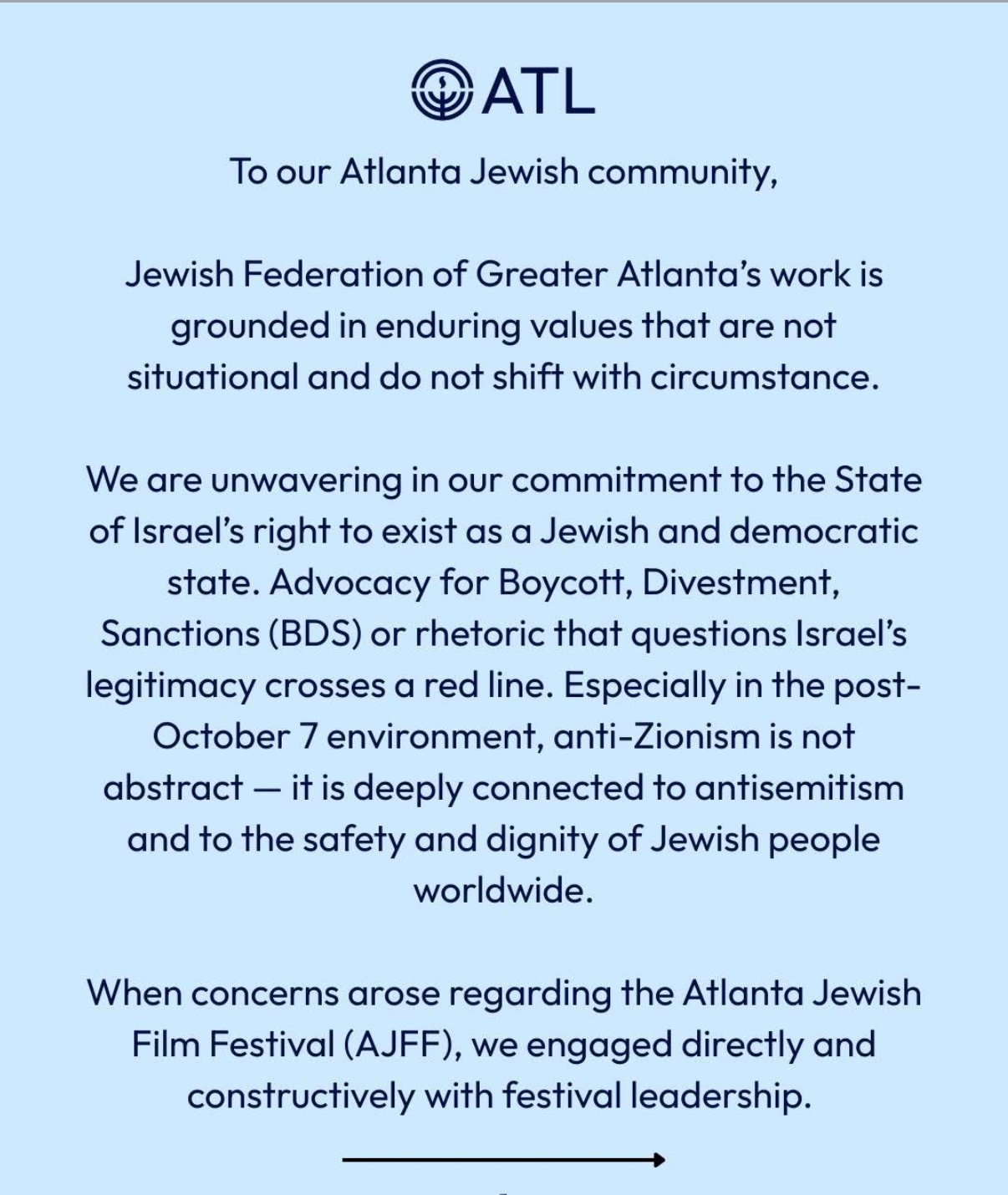
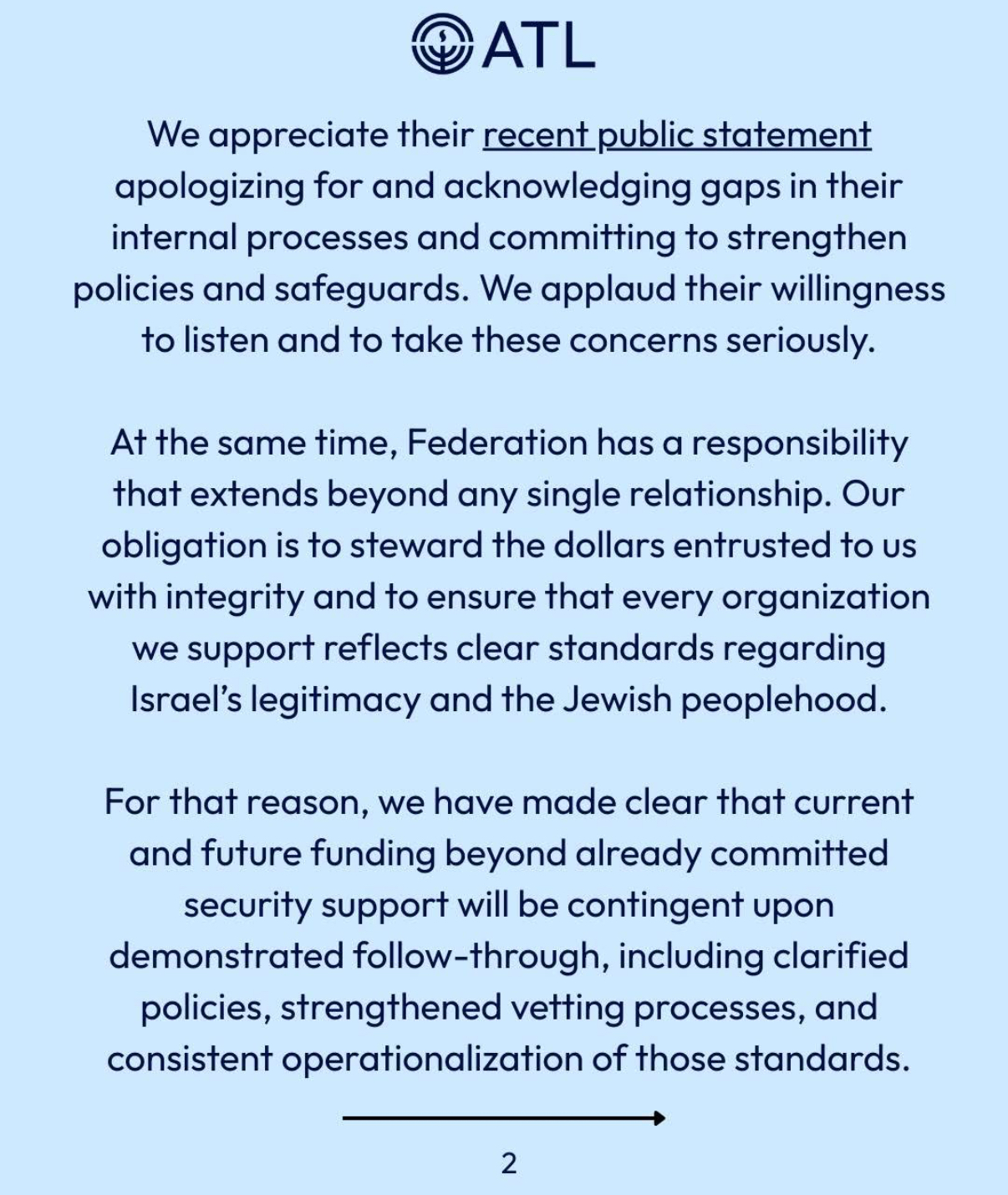
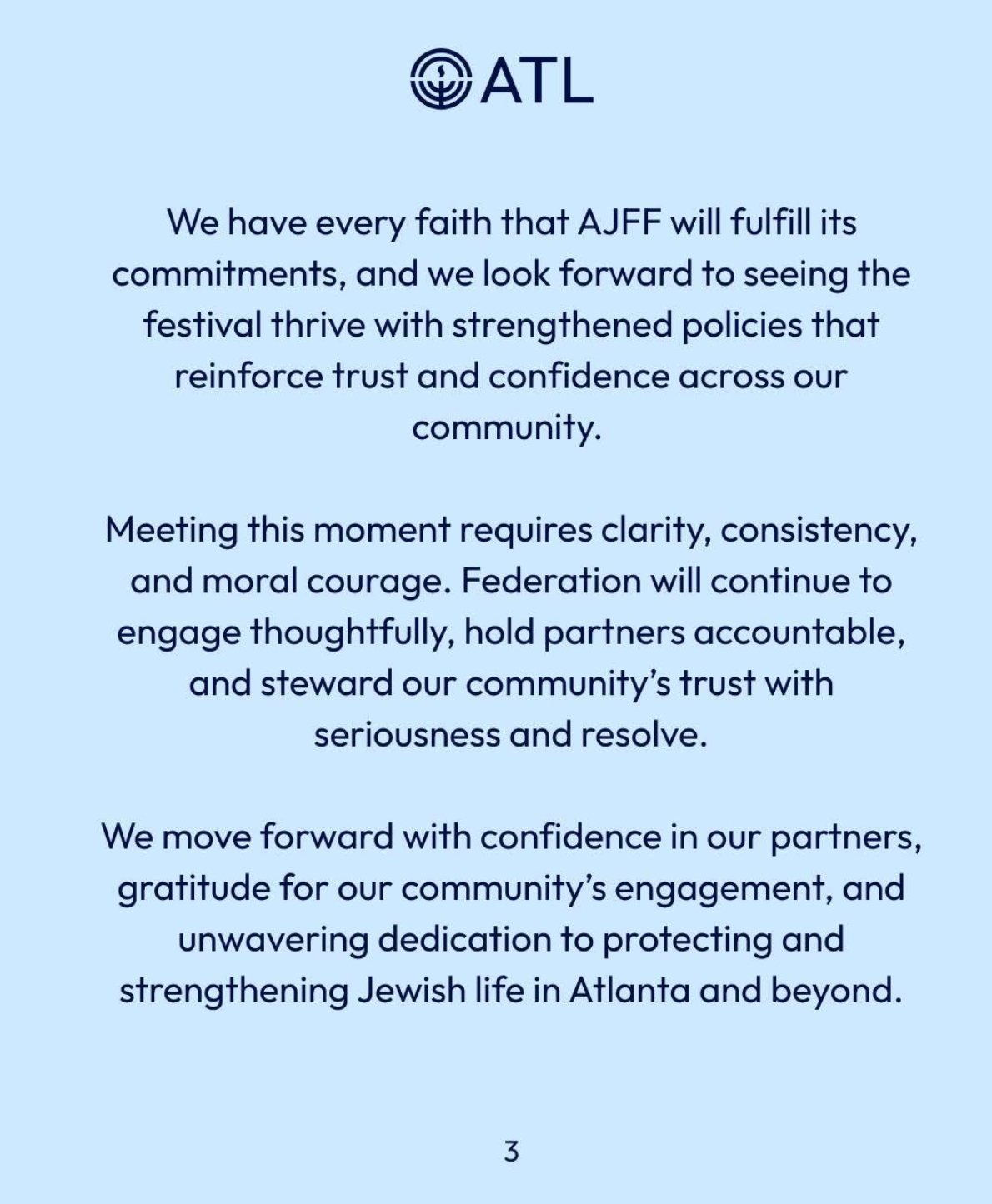
The Jewish Federation of Greater Atlanta followed with its own statement. While acknowledging AJFF’s subsequent apology and commitment to review its processes, Federation made clear that future funding beyond already committed security support would be contingent upon clarified policies, strengthened vetting processes, and consistent operationalization of those standards.
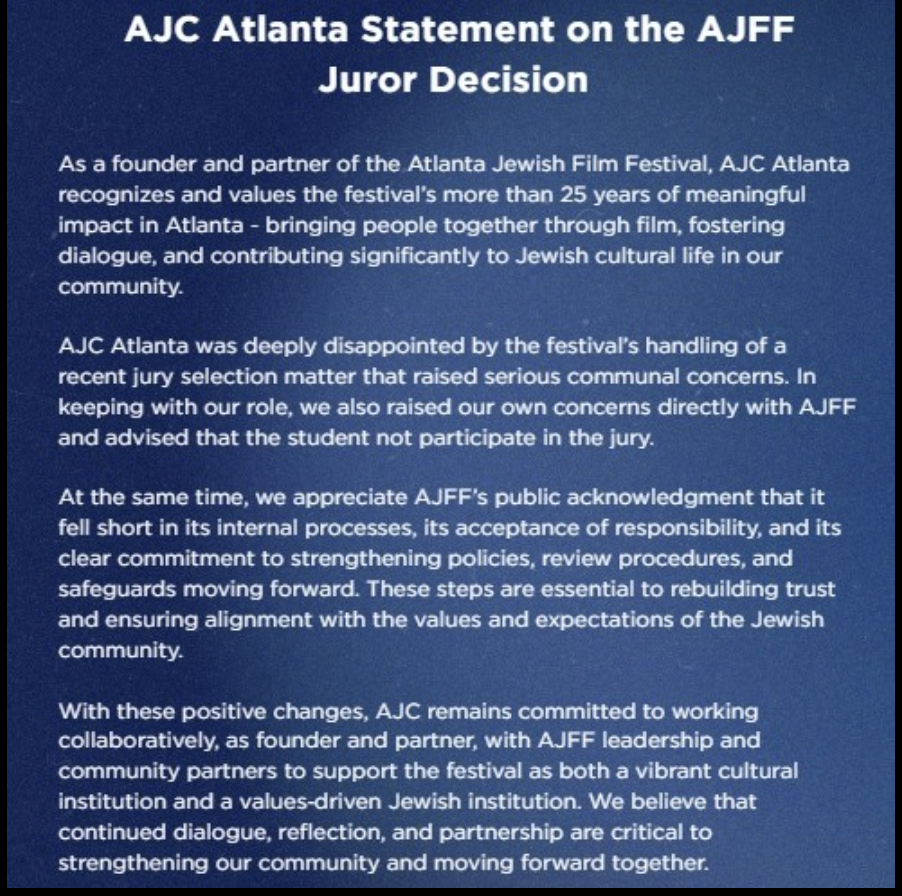
AJC Atlanta then also issued a statement (see below). As a founder and partner of the festival, AJC expressed deep disappointment in the handling of the jury selection matter, shared that it had raised concerns directly with AJFF leadership and advised that the student not participate, and emphasized the importance of strengthened policies and safeguards moving forward. At the same time, AJC affirmed its commitment to continued partnership and dialogue.

Now, national social media accounts have amplified the controversy (see above) and people from all over the globe are now weighing in (see here for some sample comments). Much of the community conversation has unfolded across social media channels.
This moment is no longer about a single juror. It is about institutional alignment and trust.
This Is Not an Isolated Problem
It would be easy to treat this as a discrete incident. That would be a mistake.
Jewish cultural institutions across the diaspora are navigating a difficult and altered landscape. October 7 changed communal vulnerability. JewHate (and the way it is shielded by claims of legitimate anti-Zionism) are not theoretical debates. They are lived experiences for students, families, and institutions. Bridge-building is more complicated. Red lines feel sharper.
In this environment, institutional ambiguity carries a cost.
When a rupture of this magnitude occurs, it is rarely the result of a single procedural oversight. It is usually the visible manifestation of accumulated drift of organization values, goals, and leadership.
What This Moment Reveals
AJFF has long described its mission as building bridges of understanding through the power of film. That mission is meaningful. Cultural institutions matter. Art matters. Dialogue matters.
But bridge-building without clearly articulated boundaries can create confusion. Confusion erodes trust.
When a Jewish institution selects jurors, board members, speakers, or partners, it is not making a neutral decision. It is signaling values. It is defining who represents the Jewish communal space. The intensity of reaction suggests that many stakeholders experienced this decision as misaligned with what they believe it means to be a Jewish institution. Strong institutions do not evaluate decisions solely by whether they can be technically defended. They evaluate whether those decisions reflect shared commitments.
This situation surfaces at least four structural questions.
1. What Does “Jewish Institution” Operationally Mean?
AJFF has stated that it is “first and foremost, a Jewish institution.” That statement requires operational clarity.
How are JewHate in all forms (including anti-Zionism, BDS, and cultural boycotts) defined in policy? What constitutes disqualifying public conduct for official roles? Where are the red lines, and who sets them?
Values that are not operationalized remain aspirational. In moments of communal stress, aspirational language is insufficient.
2. Governance Culture and Leadership Alignment
Institutional culture is shaped over time. Staff decisions, board recruitment, leadership pipelines, and committee structures influence decision-making norms.
When controversies surface, they often expose deeper questions. Has governance intentionally remained aligned with the organization’s stated identity? Are recruitment criteria explicit about the lived vulnerability of Jewish communal life? Are oversight mechanisms clear and empowered?
This is not about individual identity. It is about institutional intentionality.
Drift rarely happens overnight. It accumulates.
3. Stakeholder Expectation Alignment
For AJFF, stakeholders come in many forms. Boards, staff, funders, volunteers, longtime season ticket holders, partner organizations, hosting theaters, and occasional ticket holders, all may carry different assumptions about red lines. If those expectations are not surfaced and aligned, misalignment eventually becomes visible.
JFGA’s decision to condition future funding on clarified policies reflects a demand for structural clarity rather than apology language alone.
Trust is rebuilt through visible alignment.
4. Crisis Infrastructure
AJC indicated that it advised against the juror’s participation. The Consulate withdrew. Federation conditioned funding (and it is likely that behind the scenes, other funders already withdrew future funding or threatened it). Public reaction escalated.
This sequence suggests that internal review pathways may not have been sufficiently clear or effective. Institutions operating in volatile environments require defined escalation processes and transparent communication strategies.
Without them, conversations spill into uncontrolled spaces.
Why This Matters to Me
I have attended events of the Atlanta Jewish Film Festival for almost 20 years. It has been a pillar of Jewish cultural life in Atlanta and across the Southeast. It has brought Israeli filmmakers, global Jewish narratives, celebrity attention, and meaningful conversation into our communal space.
This is not abstract.
I am also a professional who has spent more than three decades guiding Jewish organizations, engaged deeply in interfaith initiatives, and multi-racial coalitions through moments of conflict, identity tension, and governance reform. I have participated in and facilitated Muslim-Jewish dialogue. I have led boards through values clarification and structural realignment. I have seen how quickly trust erodes when ambiguity persists, and how powerfully institutions can recover when alignment work is approached with transparency and rigor.
This moment is painful. It is also an opportunity.
Handled defensively, it deepens polarization and accelerates donor and audience disengagement. Handled with structure and seriousness, it can strengthen clarity and restore confidence.
The difference lies in process.
What Institutional Repair Requires
Repairing trust after a rupture of this scale requires more than statements.
Responsible institutions typically engage in structured alignment work that includes:
- Confidential stakeholder listening across professional and lay leadership, funders, volunteers, and audience members
- Explicit articulation of core values and red lines
- Governance review and board recruitment criteria examination
- Strengthened vetting and oversight mechanisms
- Defined crisis protocols
- Transparent communication about implemented changes
Jewish institutions today operate in a world where moral clarity is not optional. It must be operationalized. Intentions do not substitute for adherence to structure.
A Constructive Path Forward for AJFF
This moment calls for a structured, professionally facilitated alignment process.
Not to assign blame. Not to re-litigate a single decision. But to ensure that mission, governance, and stakeholder expectations are aligned moving forward.
As another community leader observed, the boundaries feel “existential” and how we go about creating them matters. Staci Brill wrote, “Dialogue and thoughtful deliberation will resolve this challenging moment.”
A possible framework could include:
Phase One: Stakeholder Listening
Confidential interviews and small group conversations with board members, senior staff, major funders, Federation leadership, volunteers, longtime attendees, and communal partners.
The goal would be to surface expectations, concerns, and perceived misalignments, and to synthesize themes without attribution.
Phase Two: Values Clarification
After reporting out the listening campaign data to senior staff and board members, engage them (and perhaps some key funders including JFGA), in an exercise of organizational values clarification.
Phase Three: Boundary Definition
Facilitated learning with lead national organizations and scholar experts, to articulate operational definitions of JewHate and to create an organizational statement with clear definitions (to later be released publicly).
Phase Four: Governance and Policy Alignment
Working sessions to define red lines for leadership and juror participation; and to clarify the relationship between artistic exploration and communal responsibility. The group needs to examine board recruitment criteria, committee structures, vetting processes, oversight mechanisms, and crisis protocols.
The objective would be alignment between stated values and decision-making structures. The output would be an explicit guiding principles document.
Phase Five: Implementation and Public Communication
Finalized policy updates, internal education for board and staff, public communication outlining reforms, and a defined accountability timeline.
This work requires facilitation that is calm, experienced, and grounded in Jewish communal dynamics. It requires the ability to hold tension without inflaming it and to translate abstract values into operational systems.
The work is available to be done.
An Opportunity for Strength
AJFF is not beyond repair. It is a beloved institution with decades of impact. The intensity of reaction reflects how much people care about its integrity and what it offers the Atlanta community.
The path forward cannot be silence. It cannot be reactive defensiveness. It cannot rely on aspirational language alone. It must be intentional alignment.
If approached thoughtfully, this moment can lead to clearer mission articulation, stronger governance, renewed donor confidence, and restored audience trust. It can also serve as a model for other Jewish cultural institutions navigating similar tensions across the diaspora.
When trust fractures, institutions face a choice. They can defend the past. Or they can build a more aligned future.
The future requires clarity, structure, and leadership.
(Note: Shameless plug … This is work that I am available to lead)
 JewishGPS
Leave a comment