
Over the past several years, there has been a significant and necessary investment in helping Americans learn how to disagree better. Organizations like Constructive Dialogue Institute, The One America Movement, Living Room Conversations, Builders Movement, and Braver Angels have built thoughtful frameworks designed to strengthen civic discourse, deepen listening, and sustain relationships across difference. This work reflects a serious response to polarization and a recognition that civic life depends, in part, on our ability to remain in conversation with one another.
And yet, even at its best, dialogue alone cannot repair civic culture.
The underlying premise of many of these efforts is that deeper understanding will lead to more humane behavior. In some cases, that is true. But understanding that is not paired with shared responsibility often remains abstract. It shapes perspective, but not necessarily practice.
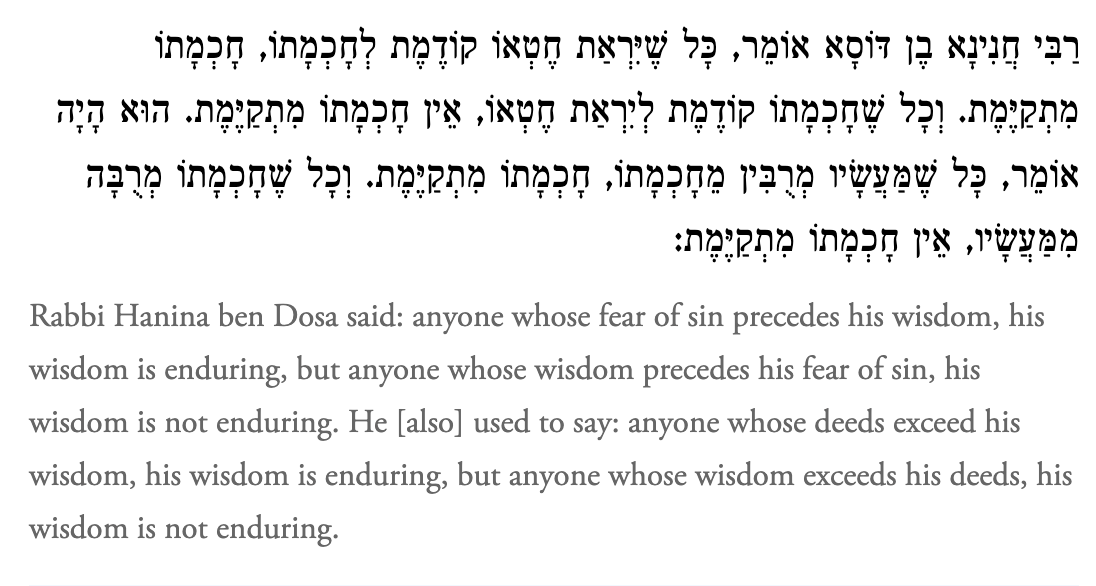
Jewish tradition captures this tension succinctly: “One whose wisdom exceeds his deeds, his wisdom will not endure” (Pirkei Avot 3:9, 3:17) . Insight, on its own, is insufficient. It must be accompanied by action. If we are serious about rebuilding trust, we need more than better conversations. We need shared work.
Service-Learning
Service-learning offers a different model, one that integrates action, reflection, and responsibility into a single framework. It is not volunteering as an isolated act of goodwill, but a structured approach that connects experience to meaning and meaning to sustained engagement.
My own approach to this work is shaped by a framework I first encountered nearly twenty years ago at a national training for Jewish educators convened by the organization then known as PANIM: The Institute for Jewish Leadership and Values. There, I was introduced to a model developed by Rabbi Jason Kimelman-Block and Geoffrey Menkowitz, co-authors of Just: Judaism. Action. Social Change, which outlined multiple pathways through which people engage in social change. Their work reflects and builds upon broader service-learning frameworks that similarly articulate multiple pathways to civic engagement.
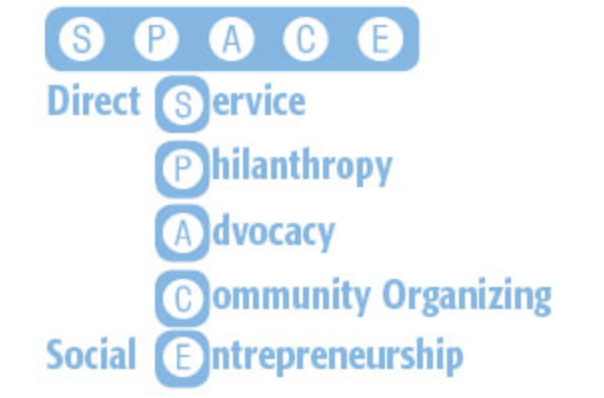
Their model used the acronym SPACE, reflecting a set of interconnected approaches including service, philanthropy, advocacy, community organizing, and social entrepreneurship.
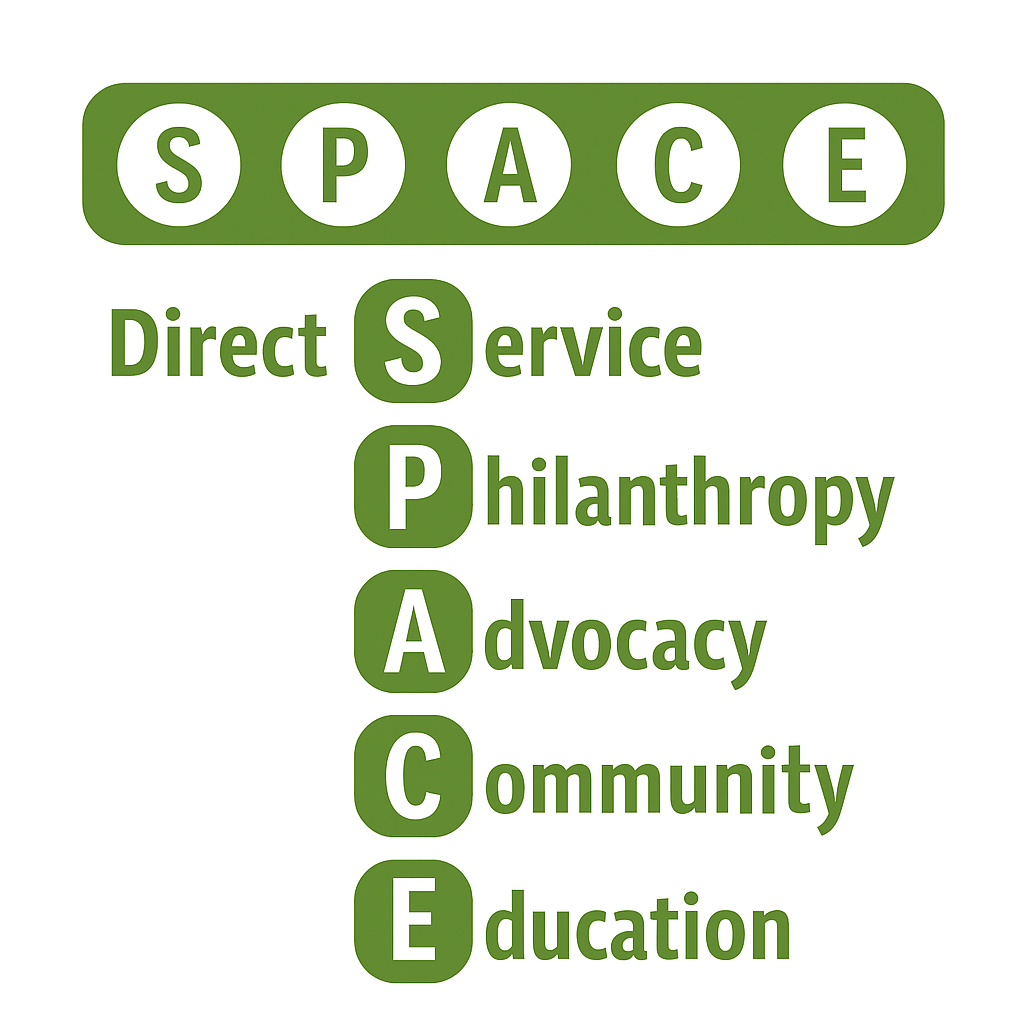
In 2009, PANIM was incorporated into BBYO, and in 2016 I received permission from leadership at BBYO to adapt and further develop this framework within my own work. Over time, I retooled the SPACE model into: Service, Philanthropy, Advocacy, Community Engagement, and Education.
The categories reflect both continuity with the original framework and a reorganization shaped by my work in curriculum design and leadership development. In my own practice, education became the integrating function that connects and sustains the other elements over time.
JEWISH Service-Learning
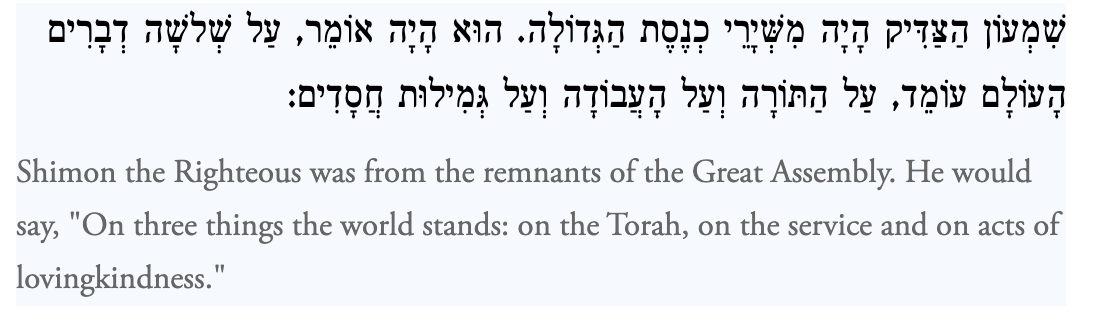
What has become increasingly clear to me is that this framework is not simply compatible with Jewish tradition. It reflects a set of enduring patterns about how responsibility is understood and practiced and a broader understanding embedded in Jewish thought that learning, service, and ethical action are interconnected. “The world stands on three things: on Torah, on service, and on acts of kindness” (Pirkei Avot 1:2) . These are not separate domains. They are mutually reinforcing.
Service reflects the expectation that care is enacted, not just felt. Rabbinic tradition describes a set of actions that define what it means to show up for others: clothing the naked, visiting the sick, comforting the grieving, and accompanying the dead (Sotah 14a:4). The emphasis is on behavior. Responsibility takes the form of concrete action, and service-learning creates structured opportunities for people to practice those behaviors in real contexts.
(See paragraph above)

(See paragraph below)
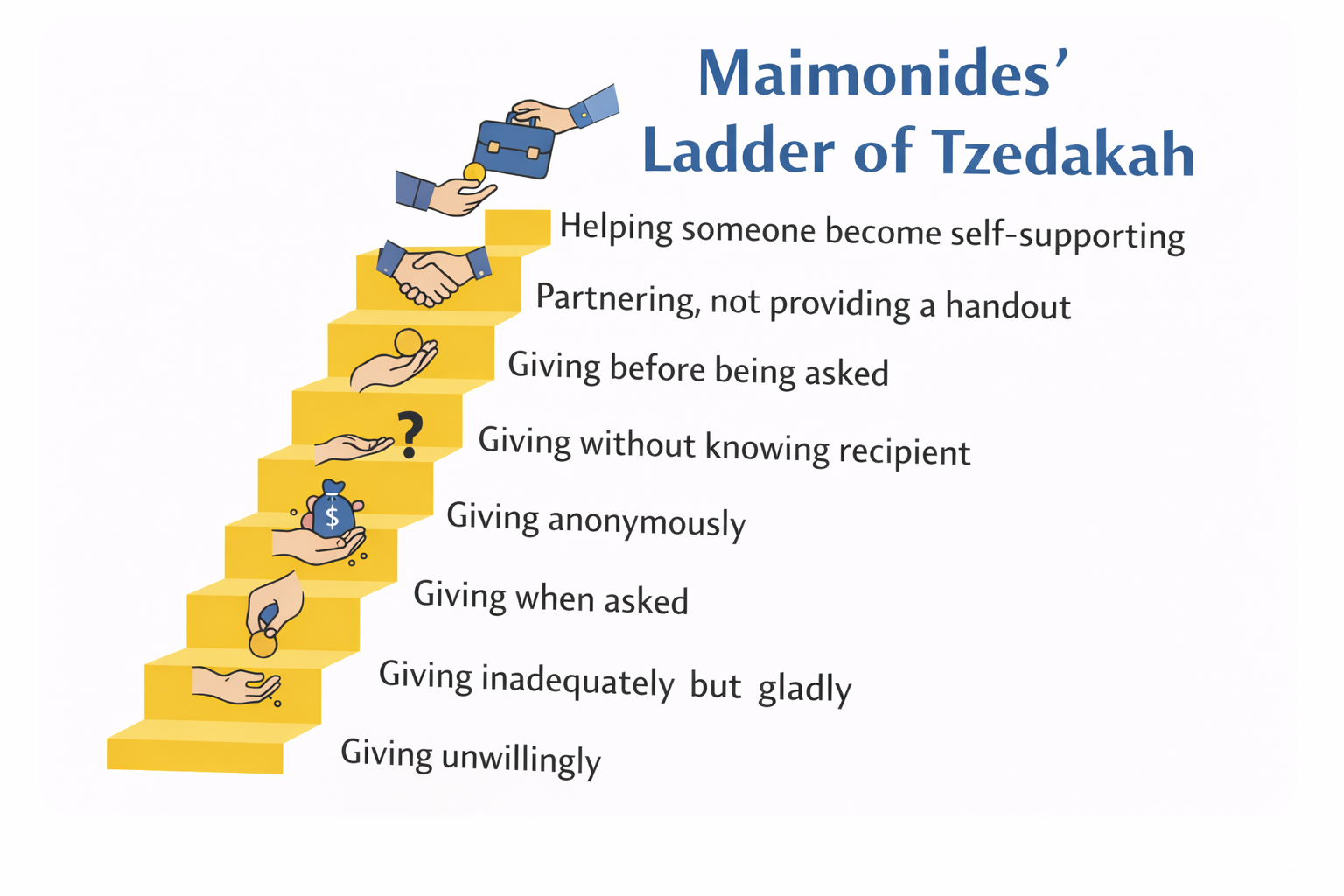
Philanthropy extends that responsibility into questions of dignity and long-term impact. The word tzedakah shares its root with tzedek, meaning justice, and there is no direct equivalent for “charity” in Hebrew. Giving is not framed as optional generosity, but as responsibility. This is reflected in classical teachings such as Maimonides’ hierarchy of giving, which prioritizes forms of support that build independence and agency, including partnership or employment, rather than short-term relief. In this framing, philanthropy becomes less about generosity and more about design, inviting participants to consider not only how they respond to need, but how they reduce it over time.
Advocacy introduces a dimension of responsibility rooted in response and presence. “Do not stand idly by the blood of your neighbor” (Leviticus 19:16) establishes that witnessing creates a need to act. At the same time, “Do not judge your fellow until you have reached their place” (Pirkei Avot 2:4) reminds us that action must be grounded in awareness. Together, these texts suggest that engagement requires both intervention and humility. Advocacy, in this framing, is not only about advancing issues, but about developing the capacity to respond responsibly within complex human contexts.

וְאַל תָּדִין אֶת חֲבֵרְךָ עַד שֶׁתַּגִּיעַ לִמְקוֹמוֹ
Do not judge your fellow man
until you have reached his place.
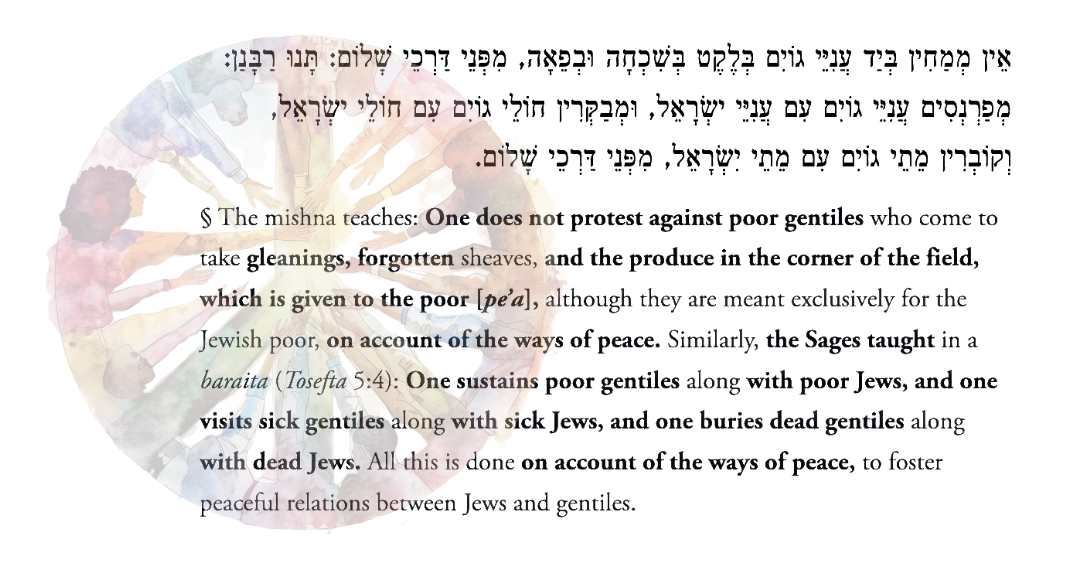
Community engagement expands responsibility in a few ways. The first by extending our commitment and reach beyond familiar boundaries. The Talmud teaches that care extends across communities, including supporting the poor and caring for the vulnerable beyond one’s own group, “for the sake of peace” (Gittin 61a:5) . This frames cross-community partnerships as a necessary condition for a functioning society, not an optional extension of it. In a pluralistic context, shared responsibility becomes a bridge across difference.
The second context for community engagement is centered on distributed leadership, like the lessons we learn from Yitro in Exodus 18. We must create systems and opportunities for others to engage in the work alongside us. Sometimes that translates to training them on specific tasks that further the work or delegating smaller pieces of a bigger initiative.



Education centers on participants learning about core, systemic issues that lead the challenges our society faces. It demands research on historical contexts, data analysis on current statistical implications, and it requires us to engage with (truly listen to) people who have lived experience within the social ills we are attempting to address in our service-learning.
Within Jewish settings, we then layer our ancient and modern wisdom onto each of the community-based justice issues so learners have a Jewish lens through which to explore the work. (These are samples I contributed to creating for a national youth philanthropy curriculum.) The act of teaching robust information about the issue and then framing it in Jewish contexts is itself obligated in our canon:

“You shall teach them diligently to your children” (Deuteronomy 6:7) reflects an expectation that what is learned is carried forward.
In the context of service-learning, education transforms action into reflection and reflection into sustained practice. It is what allows individual experiences to become part of a broader culture of responsibility and ensures that these experiences are not isolated moments.
Taken together, these elements form more than a framework for programming. They describe a system through which people learn how to participate in communal and civic life. They move individuals from isolated acts of contribution toward a more durable sense of responsibility that is practiced across multiple domains.
And yet, even as this framework captures a broad range of pathways, the current moment exposes where it needs to grow.
New Modifications
One of the most important aspects of who I am as a scholar-practitioner, is to sit within my own learning-feedback-adaptation loop – in essence engaging in action research on my own methodologies. This method “aims to simultaneously investigate and solve an issue.” We are currently living in a moment where the deep divides in our society have resulted not just in disagreement, but in tragic outcomes of hate speech, political violence, broken relationships among family and friends, distrust, misinformation spread via propaganda rhetoric, and an overall disintegration of societal norms. So as I have delved deeply and continuously into understanding different approaches to “disagreeing better” and repairing the wounds, I have determined it is necessary to expand the service-learning scaffolding that I have utilized for years.
First, the “A” must expand. Advocacy alone is no longer sufficient language for the kind of civic participation this moment demands. While advocacy focuses on advancing issues and influencing systems, allyship emphasizes showing up in relationship, particularly alongside those who are vulnerable, in ways that are sustained and accountable.
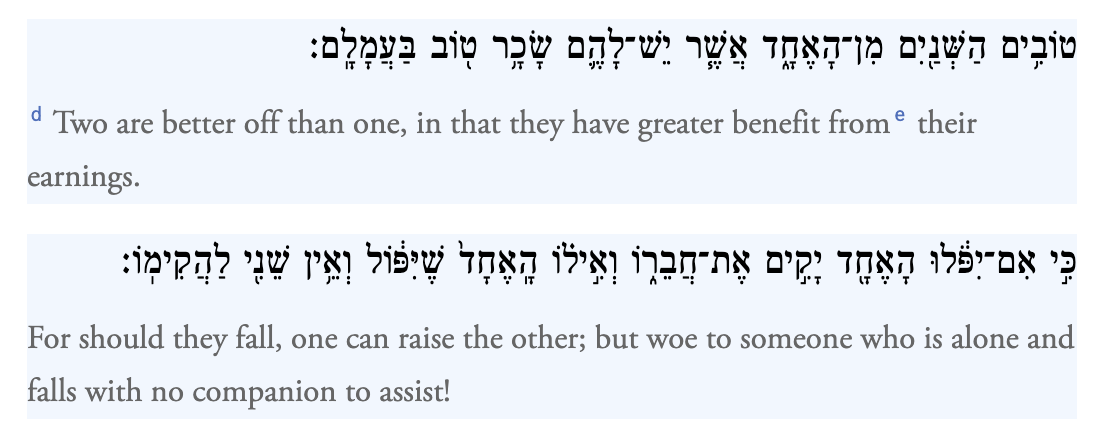
Kohelet (Ecclesiastes) 4:9–10
Advocacy and Allyship are interconnected, but not interchangeable, and both are necessary. Our ancient writings of Kohelet 4:9–10 impress upon us the need to unite with others who are “fallen” and assist them.
The second change to the SPACE model that this moment requires, is that we must name what has too often been assumed rather than taught: dialogue itself.
The framework now evolves into SPACED.
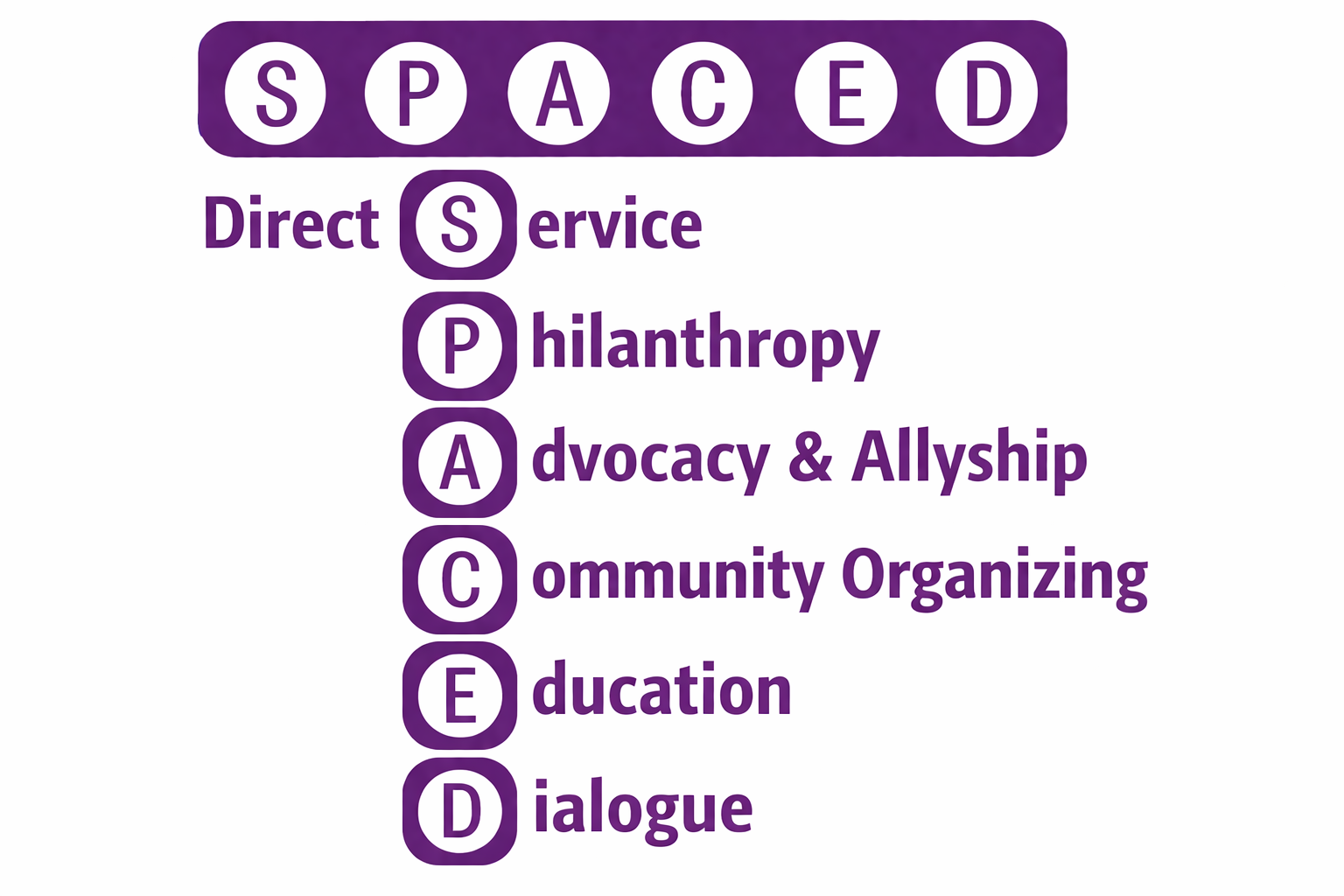
While dialogue has always been adjacent to this work, it has too often been treated as intuitive rather than as a skill set that must be intentionally developed. The addition of “D” reflects the need to explicitly teach the capacities required to engage across difference. This includes nuance, critical thinking, and the ability to hold multiple perspectives without collapsing into binary or zero-sum thinking. It includes learning how to engage in difficult conversations, discern connotations of terminology and develop shared definitions, vet sources and information, distinguish between opinion and fact, and build toward shared understanding without requiring agreement.
There is a powerful narrative in Jerusalem Talmud Berakhot 4:2:1-8 where we learn about the prayers Rebbi Neḥoniah ben Haqqanah and Rebbi Eleazar would pray before entering the Beit Midrash (the house of study) and upon leaving. Excerpts of the prayers include these lines:
“May it be Your pleasure, o Eternal, my God and God of my fathers, that I should not be offended by my colleagues and my colleagues should not be offended by me…”
“… For I toil and they toil, I am diligent and they are diligent.”
“May it please You, o Eternal, my God and God of my fathers, that nobody should come to hate us in his heart nor should we hate anybody in our hearts…”
There is a strong impact on both the process and the outcome when one enters into an environment where there is an expectation to debate and disagree with an intent to not be hurtful during that deliberation.
Our Jewish wisdom comes from many sources. The Be’er HaGolah (“Well of the Exile”) is Rabbi Moses Isserles’ companion work (16th century) to the Shulchan Aruch, identifying sources and grounding Ashkenazic legal rulings in earlier texts. In Be’er HaGolah, Well 7:5, he writes:

“It is proper, out of love of reason and knowledge, that you do not [summarily] reject anything that opposes your own idea, especially so if [your adversary] does not intend merely to provoke you, but rather to declare his beliefs. And even if such beliefs are opposed to your own faith and religion, do not say to him, “Speak not and keep your words.” Because if so, there will be no clarification of religion.
Just the opposite, tell him to speak his mind and all that he wants to say so that he will not be able to claim that you silenced him. Anyone who prevents another from speaking only reveals the weakness of his own religion, and not as many think, that by avoiding discussion about religion you strengthen it. This is not so! Rather, the denial [of the right to speak] of one who opposes your religion is the negation and weakening of that religion… For the proper way to attain truth is to hear [others’] arguments which they hold sincerely, not out of a desire to provoke you. Thus it is wrong simply to reject an opponent’s ideas; instead, draw him close to you and delve into his words.”
If we want people to serve together, we must also teach them how to learn from one another and think together.
Data-informed Impact
The research reinforces what this framework suggests. Studies synthesized by the Search Institute demonstrate that young people who engage in structured service experiences tied to reflection show increased empathy, leadership, and long-term civic participation. Similarly, research from Tufts University’s CIRCLE (Center for Information & Research on Civic Learning and Engagement) finds that students who participate in high-quality civic learning experiences are more likely to collaborate across difference. Educational authors Kinsley & McPherson indicate that service-learning goes beyond community service because service-learning experiences “connect students to their communities, enrich students’ learning, and help them develop personally, socially, and academically” (1995, p. 1).
SPACED for Impact
What distinguishes the SPACED approach is not simply that people are doing something together, but that they are doing something that requires them to rely on one another. In that process, they develop habits of shared responsibility. Contribution becomes a practice rather than a principle, and relationships are built through reliability and follow-through. Over time, this is what generates trust. If we want to rebuild our society and strengthen civic life, we need to create conditions in which people take responsibility alongside one another.
SPACED offers a framework for how that learning happens. It is not a sequence or a checklist, and service-learning is not linear. These elements function as an ecosystem, each reinforcing and deepening the others. Dialogue informs action. Action generates reflection. Reflection reshapes engagement. Engagement expands responsibility.
The shift we need is not away from disagreement. Disagreement is inevitable, and often necessary.
The shift is toward shared purpose.
From attempting to disagree better
to serving together
and learning how to do both.
 JewishGPS
Leave a comment