
Years ago (MANY years ago), I began to teach “Hot Topics” to teens, using Jewish text and context (ancient and modern) to frame discussions on everything from Interfaith Relationships to LGBTQ+ Relationships to Death Penalty. When I started getting requests to teach these same topics to adults, I decided to open every discussion by first teaching what is known as “Eilu v’Eilu.”
(keep reading for more about their work).
Rabbi Sarah Weissman explains this concept:
Two Jews, three opinions as the saying goes. Jewish tradition sees disagreement not as a negative, but as healthy, and even as holy. In one famous story from the Talmud, two rival houses of scholars: Beit Shammai and Beit Hillel, disagree for three years on certain matters of halakha (Jewish law). Finally, a Divine Voice calls from heaven, “Eilu v’eilu divrei Elohim chaim hen – these AND these are the words of the living God, and the halakha shall follow according to Beit Hillel” (Er. 13b). Judaism values a plurality of opinions while also acknowledging the need for standards and rules that the whole community abides by. Both Beit Shammai and Beit Hillel’s rulings are divinely inspired, but the law is according to Beit Hillel. This story captures an inherent tension in Jewish community: we need diversity and harmony, conflict and resolution.
I wanted to set the parameters for a healthy (and sometimes potentially heated) learning debate through a lens of respect (kavod) and to create space for those who come to these learnings with a dissenting opinion – honoring their presence and their opinions. I ALSO set a baseline that if you “other” people, degrade an entire vulnerable population or minority, use dog-whistle stereotypes, I will cut you off and redirect. For me, there is no holiness or divinity in degrading humans simply based on their differences.
This concept of “Eilu v’Eilu” is truly one of the founding principles of my educational philosophy and is rooted so deeply that I articulate it as the first of my Signature Pedagogies. (See previous blog on this and how I was challenged by a right-leaning teen in one of my sessions.) I not only teach through this framework, but I try and live my own life in congruity with it.
Reflecting on my past, I want to share a little story with you about the best days of my college life. I attended Drake University for undergrad (before I pledged a life of Professional Jew, I had pledged a life in mass communications and publication design). Drake had a really special program called Peer Mentors where sophomores thru seniors who were chosen as leaders moved onto campus a little over a week before everyone else, and then a few days after they moved in, they assisted the new students (freshmen and transfer students) in moving in, orienting them to campus, facilitating icebreakers, etc. The night the freshmen class moved in, a girl on my floor (whom I met in passing while helping folks during the day) knocks on my door in hysterics of homesickness and fear of what’s ahead. This moment led to what is now a very deep and valued friendship of almost 28 years with Leslie, her twin Michelle (who lived in another dorm that first year, and their single mother, Carol).

What makes my relationship with these three so drastically special, is that they came to our meeting as devout evangelical Christians – and hearts full of love. The hours and hours that I spent (sometimes at 2 a.m. over grilled cheese and fries at Perkins off-camps, and sometimes at 9 p.m. over Home Team pizza in our pj’s) discussing with them about Jewish and Christian viewpoints on every topic under the sun are some of my most cherished college memories. Not shocking to anyone, the twins ended up co-chairs of the Varsity Christian Fellowship on campus and I ended up the founder and chairperson of the Jewish Student Club on campus. A professor in the religion department, Dr. Daniel Spencer, could not understand how the three of us had become inseparable friends and even took us to lunch one day to explore this relationship further. The three of us decided to take our love for our friendly, respectful, dialogue to our respective groups and planned an interfaith text study program – The Towel of Babel. I look back on that evening with pride and can now see it (and my friendship with this family) as the basis for my work in all things “difficult and dialogue.”
In the years to come, I would go on to seek out and participate in many interfaith experiences, Black/Jewish programs, trainings on LGBTQ+ advocacy as an ally, and so on. Sitting in the “difficult and dialogue” is important to me. I naturally see the humanity in those different than me and I am in a constant quest to learn more about and with those that are different from me. [Along these lines, I just picked up the book For the Sake of Argument which “features 24 short stories specially designed to get your family and friends arguing about some of the thorniest issues facing Israel and the Jewish world today.”]

When I moved to Atlanta, I became connected to a program called Etgar 36 via its founder and director, Billy Planer. For 20 years, the central program of Etgar was a 36-day cross-country bus trip where Jewish teens learn about American historical, political and justice issues. Where there is an opportunity to learn from first-hand account speakers, the teens are introduced to people from “both sides” of the American political spectrum (i.e a parent whose son was killed at Columbine and subsequently has become involved in gun control work AND a board member of a gun rights PAC). The teen participants are taught to “lean into” difficult conversations and to “Give a Damn” about the society they live in. I have facilitated both of my nephews’ participation in the summer program (in 2021 and 2023) because this experience is an important lesson for the future voters of America! (More on Etgar later in this piece.)
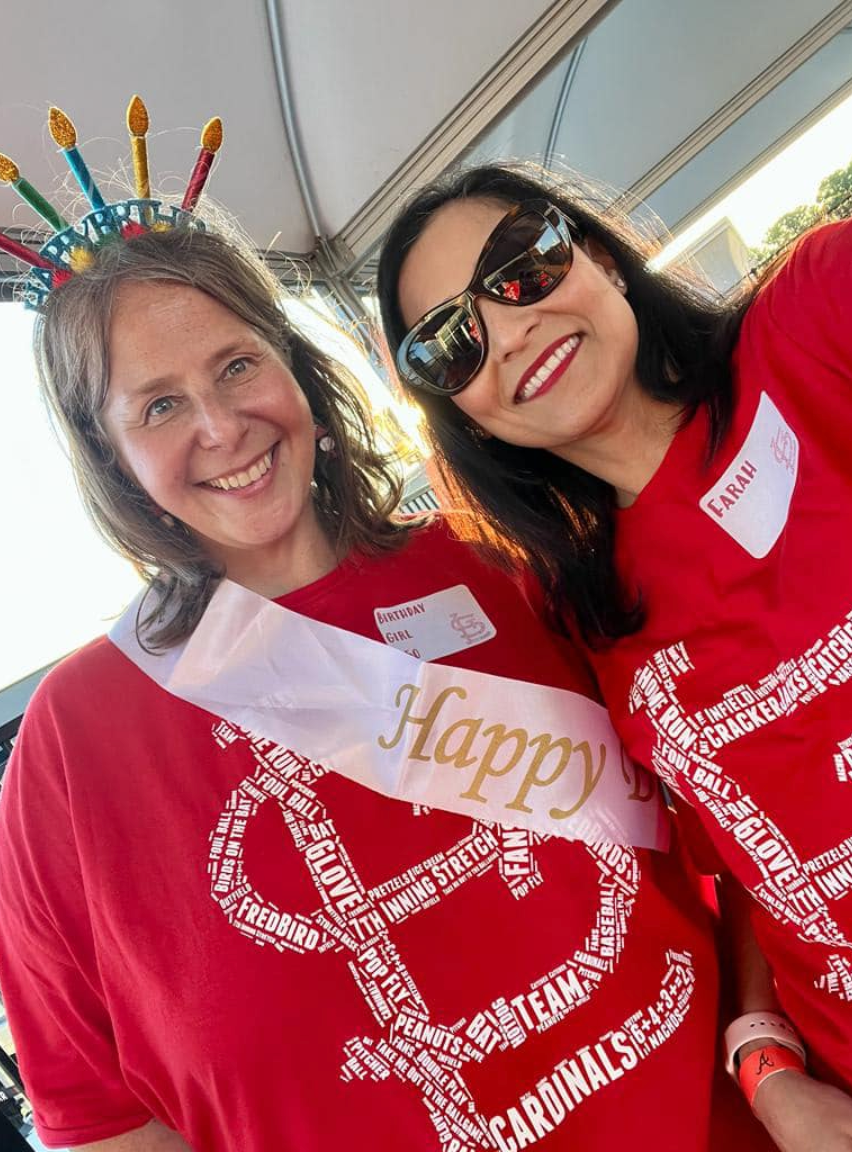
At some point a few years ago, I was reflecting that I while I often made ally statements about Muslims (vigorously opposing a certain former president’s proposal for a Muslim registry or his attempt to ban entry from some Muslim countries), I actually didn’t know any Muslims as an acquaintance or friend. So I sought out the Sisterhood of Salaam Shalom (SoSS). SoSS gave me the opportunity to see the beautiful connections between Islam and Judaism, and gain so much new knowledge about Islam as a faith and Muslims as a people. Most importantly, it afforded me the gift of having Muslim friends. Those sisters from my chapter who see my humanity, respect my progressive Zionism, and appreciate my commitment to Jewish education (including teaching other Jews about Islam), are dear to me and those relationships have withstood countless tensions with the greater Muslim-Jewish world.

Shortly after I engaged in SoSS, I heard about Roots-Shorashim-Judur (an interfaith dialogue organization based in the disputed West Bank/Judea-Samaria and co-run by Muslim Palestinians and Orthodox Jewish Settlers). I remember so vividly in my first encounter with them almost 5 years ago, their adamant statement that peace will come through the people – through dialogue – and learning to see the humanity and dignity in individuals, and NOT through the governments. In a subsequent webinar they gave, Rav Yacov Nagen, a guest speaker, said, “Peace cannot come from above (ordered by government leadership), it must come from below – people to people with connection, understanding, and respect.” When Roots opened an international Muslim/Jewish text study group, I jumped at the opportunity to participate in that. We would alternate leading the studies … one session a Jew would lead on a specific topic (everything from Story of Abraham to beliefs in Free Will/Pre-Determination) and the next session, a Muslim would lead on the same topic. Once again, I was energized by the learning (and particularly when similarities in words/themes were exposed) and valued the human connections I made from those whose faith isn’t my own. [Note: One of the Muslim participants is an orthopedic doctor in London and when word of my shattered ankle (Oct 22) got out, he reached out more than once to check on me, asked to see doctors’ notes and x-rays and insisted that I elevate my ankle as high as I could possible tolerate!]
Fast forward to October 2023 when I attended the Repair the World Jewish Service Summit in NYC. I chose a session on Democracy and Civic Engagement as Service Learning and it was here that I met two staff people from A More Perfect Union: the Jewish Partnership for Democracy. They were two of the panelists in the session and I was immediately piqued by their transpartisan mission and their work to promote civic engagement throughout the American Jewish community. I asked a question about curriculum for Jewish environments (a combination of curiosity on behalf of clients and a little self-promotion). This question has now led to an emerging relationship with A More Perfect Union.
My first step was to explore their organization’s website and understand their work more thoroughly. It was there I discovered the opportunity to become a Community Network Partner (it’s free) where I was asked to make a commitment statement as part of their work.
JewishGPS commits to promoting civic learning through a Jewish lens via methods including: curriculum development, educator training, content referrals, and direct education to teens and adults, with a goal of elevating a meaningful Jewish connection and a sense of Jewish obligation to civic engagement.
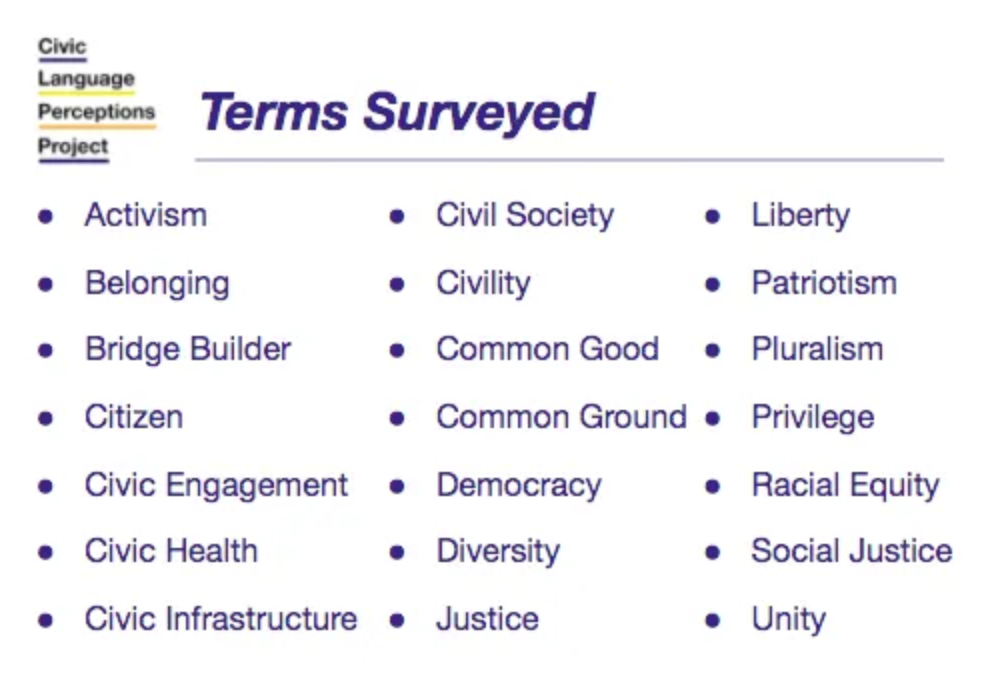
I had an opportunity to set a meeting with the founder and executive director, Aaron Dorfman, to discuss their work and where I could see some potential partnership opportunities. It was during this call that Aaron opened my eyes to what it truly means to represent transpartisan work. He shared that one of their pathways to what I call “difficult and dialogue” is to remain neutral in their approach to Civic Engagement and Civic Education. But what does this mean? For example, Aaron shared with me this fascinating piece on people’s perceptions of language often used in civic education, civic engagement and democracy work and how the gleanings from this piece influence the words A More Perfect Union uses (or doesn’t use).
In a quest to learn even more about A More Perfect Union’s work, I began to participate in virtual learning opportunities. During one such event, speakers from Resetting the Table (whose tagline is Courageous Communication Across Divides) and One America Movement spoke about their work. Rabbi Fred Revees serves as the Director of Jewish Programs for One America Movement and happens to be an old colleague of mine from his days as a pulpit rabbi in Atlanta. I was very curious how he approaches transpartisan work with rabbis and congregations where Judaism is very clear (or mostly clear) on a lot of political platform topics (i.e. abortion, immigration, social services and distribution of community dollars to take care of the needy, health care, etc.) which tend to have left-leanings. He suggested that clergy and educators don’t deviate from presenting the texts that frame current topics but that they strive to include commentaries from thought leaders who represent different viewpoints. He also told me that he encourages congregations to have subsequent dialogue options (like a lunch and learn, a zoom gathering, a table at an oneg/kiddush) were the leader who presented the learning invites those with alternative opinions to engage further. This has stuck with me particularly given the previous blog on a similar thought.
I am about to embark on a trip to Washington D.C. with A More Perfect Union to participate in their Jewish Summit on Civics which a part of the National Civic Learning Week. I will also be launching a nationwide survey as part of my client work with A More Perfect Union. Our goal is to map assets of Civic Engagement and Civic Education within American Jewish organizations and to understand how American Jewish leadership defines these two concepts.
At the recent 20th anniversary celebration of Etgar, Billy (a predominately left-leaning person) joined two of his well-known right-leaning speakers on stage for a panel discussion. The moderator, Rabbi Peter Berg of The Temple in Atlanta, asked the three of them about being in dialogue with those who are so different. Here is a bit of that discussion:
Berg: Why do you put yourselves out there year after year to meet with the Etgar groups knowing most of the participants come with drastically different perspectives?
Jim Pfaff: If you have never been challenged, you can’t own your own ideas. Being in difficult discussions is a polishing process [for your thoughts]. We (Billy and I) meet on the need to talk to people even if you disagree.
Billy: In order to fully act like a human being, you have to engage with others. And spend time with others. My concern is people who do think like me, are they going to get out and vote and talk to others about getting out to vote.
Jim: You have to look at your self critically if you can only be friends with people like you.
Berg: What does success look like in these difficult discussions?
Clark Aposhian: (it is success when we have) a new understanding, enlightening and enlarging of the discussion. When [someone] trusts me enough to try and get me to understand them, that’s success.
Jim: Teaching [the Etgar participants] to care, to engage, for the rest of their lives. And when they come back to me and tell me about something I said that they remember.
Billy: I want [the participants] to not be afraid of different voices. And to understand they will have to engage in critical thinking and difficult conversations in their lives.

Collectively, these stories, these experiences, paint the picture that we cannot live in our own echo chambers, but that we have to WANT to learn from others who are different from us. We have to WANT to be able to shift folks from “the other” to “another” (I think Billy said that more than a few times during our 18-year friendship). We have to WANT to live in a better country, and in order to do that we have to WANT to be better citizens of America. And, in order to do that, we have to WANT to sit in the discomfort. I try and be super congruent and I think my history going all the way back to college demonstrates that I have respect for what is “difficult and dialogue” and that I strive to learn from those hard conversations.

 JewishGPS
Leave a reply to My Holy Tent of Dialogue – JewishGPS Cancel reply