
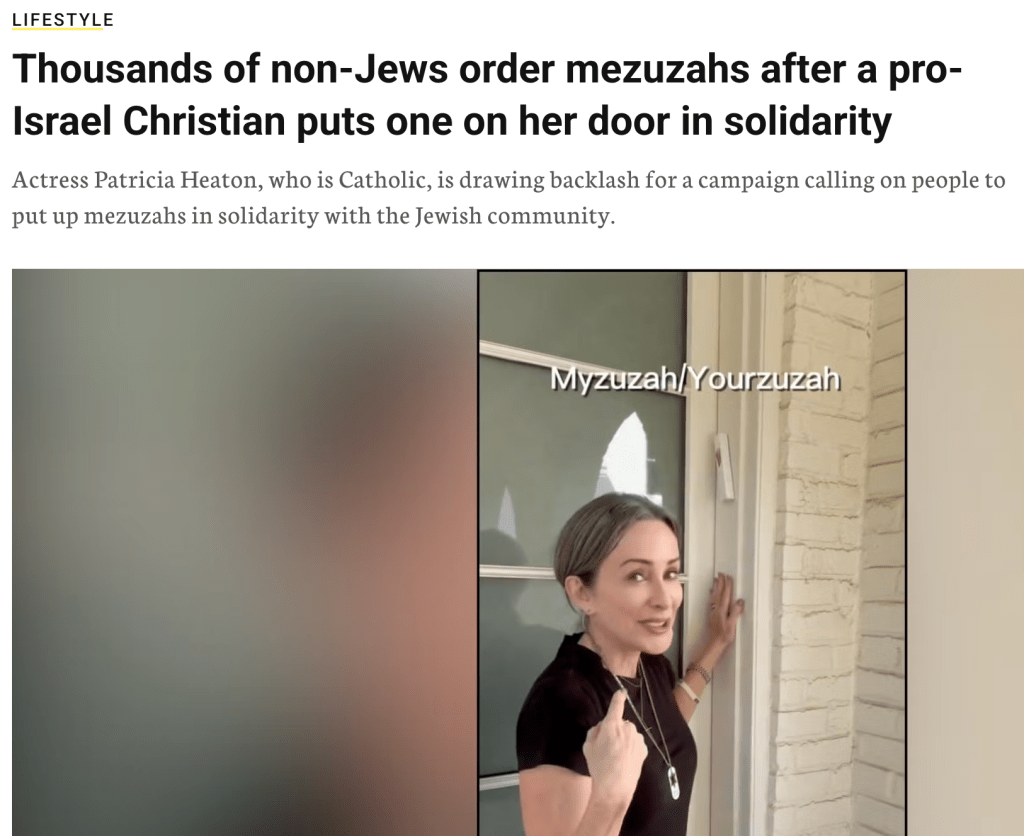
Thousands of non-Jews order mezuzahs after
a pro-Israel Christian puts one on her door in solidarity
There is a huge debate this week among Jewish professionals (primarily clergy and educators) on if we are okay with the implications of this headline or if we are really disturbed by it.
The headline and screenshot above come from this article in the JTA published earlier this week. Debates circle around the benefit of advocacy and the negative feelings and discomfort regarding ritual/cultural/faith appropriation. In my learning with M², I came to recognize when two values are in tension with each other and ways to hold both at the same time (or at least acknowledge they both have merit even if I don’t agree with one). Here are some excerpts/summaries of both points of view on this current debate (curated using ChatGPT for time efficiency):
❗ Jewish Law & Tradition Emphasizes Jewish-Only Obligation
- Chabad.org and other halachic commentators pointed out that the mezuzah is a mitzvah (commandment) specifically commanded to Jews — not to non-Jews — and that non-Jews putting up a mezuzah may not be appropriate because it’s a practice rooted in Jewish covenantal observance. Chabad
❗ Some Rabbis Say Solidarity Can Be Expressed Another Way
- Rabbi Shlomo Litvin (Chabad rabbi in Kentucky) tweeted that this was “not the move” and that there are “far better ways for allies to show their support” than affixing mezuzot. Jewish Telegraphic Agency
- Chabad.org’s own guidance similarly urges appreciation for the support but suggests finding other ways to show it, since the mezuzah itself isn’t simply a symbol but a religious obligation with sacred requirements. Chabad
❗ Concerns About Appropriation
- Some Jewish commentators on social media described the trend as a form of cultural appropriation — especially if non-Jews don’t fully understand the religious and halachic significance of the object. Reddit
- Many have pointed out that while thousands are ordering mezuzot, that has sparked debate among rabbis about the propriety of non-Jews using a ritual object that’s deeply rooted in Jewish law and identity.
❤️ Solidarity Viewed as Meaningful
- Eylon Levy, a former Israeli government spokesman, tweeted that the gesture was “a really beautiful gesture of solidarity” and that critics may be missing the urgency of showing public support for Jews in a time of rising antisemitism. Jewish Telegraphic Agency
🤝 MyZuzah Organization’s Position
- MyZuzah’s program director, Alex Shapero, emphasized that when non-Jews order cases only, that can be a meaningful show of support — and that the organization clearly explains that the religious obligation to have a kosher mezuzah scroll inside is specifically for Jews. Jewish Telegraphic Agency Shapero also noted he doesn’t personally share cultural-appropriation concerns in this context, as long as those ordering and displaying the mezuzah treat it with respect.
In looking for some solution to the debate, there were suggestions based on Jewish voices that place value on the intent behind the gesture while not offending those who believe this is a covenantal mitzvah. They suggested non-Jews putting up an empty mezuzah case with an explanation of solidarity can be appropriate, whereas putting up a full, kosher mezuzah scroll might cross into territory that Jewish law reserves for Jews.
However, I struggle with this suggestion. Here’s why:
- When you walk up to a home that has a mezuzah on the door, you KNOW (assume) the folks in it are Jewish (or at least some of them are.
- Guests will have no idea what is inside the case, so it will still feel like appropriation.
- The cases themselves are often artful expressions of Jewish life and/or Israel. (Although my nephews have Star Wars Lego ones on their bedroom doors.). I am uncomfortable with people putting up ritual artifacts when they likely know nothing about the meaning of the art itself.
So here is my solution:

And what if the scroll inside contained these computer printed texts instead of the traditional kosher klaf:
- Ve’ahavta le’reyakha kamokha (וְאָהַבְתָּ לְרֵעֲךָ כָּמוֹךָ). This fundamental mitzvah, or commandment, from the Torah (Leviticus 19:18) tells us to love our neighbors as ourselves.
- Lo ta’amod al dam re’echa (לֹא תַעֲמֹד עַל דַּם רֵעֶךָ). This phrase is a commandment from the Book of Leviticus 19:16 and translates to “You shall not stand idly by the blood of your neighbor.” The verse commands a person not to refrain from saving a fellow human being when they see them in danger and are able to intervene but is often extrapolated to obligate us to be UpStanders, not ByStanders, when we see injustices in action.
I believe this approach solves the tensions of solidarity vs. appropriation and it emphasizes the intent of caring community neighbors. It clears up any confusion about who lives in the house, and it educates passersby and guests.
This situation reminds me of a old Chanukkah story out of Billings, Montana where 10,000 non-Jewish households in the community put a menorah in their windows to help defeat hate.

And since 10/7, and the rise of JewHate, so many of us had expressed a renewed concern as Chanukkah was approaching. In an effort to address the concerns of many, I posted this blog in November 2023 about the safety of lighting a Chanukkiah in the window as a way to “advertise the miracle” and what our sages would advise us to do (and what my plan was).
And as a nod to the Billings story, in December 2023, Project Menorah launched (here’s that story) encouraging folks to put up/light a Chanukkiah in their windows or print and color poster images of a menorah and hang those in the window. Project Menorah also encouraged folks to take to social media and share photos of their windows with notes of solidarity. Once again, the debates over allyship vs. taking a Jewish ritual (a mitzvah) and having non-Jews participate arose. Many felt the posters (rather than an actual Channukiah) where the solution to this conundrum.
Summary:
I think it is imperative to acknowledge our allies and find ways for them to stand with us, while also creating a “fence” around our rituals and artifacts of our faith. There are solutions if we just get creative … from posters to specific tangible items created for our allies.

 JewishGPS
Leave a reply to When Terror Hits During Chanukkah – JewishGPS Cancel reply