
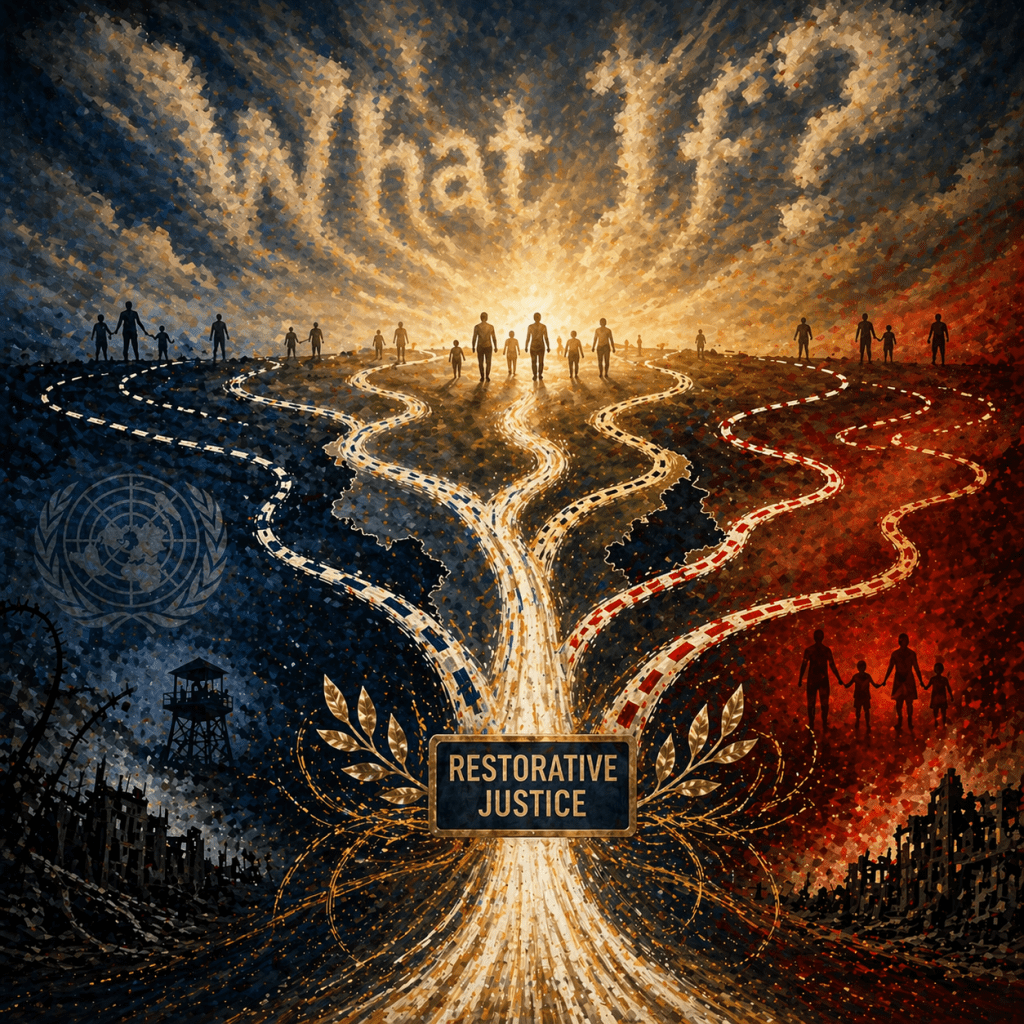
From 1947 to Today:
Reimagining Responsibility and Repair
I have spent the last few years obsessing over a series of historical pivots that are significant moments where, had the path veered even slightly, the absolute anguish and adversity of the last 70 years might never have ignited. I offer these not as definitive answers, but almost as a rhetorical framework for anyone willing to look past the modern binary of Jews vs Arabs or Israelis vs Palestinians and examine the origins of responsibility for the dignity and freedoms of those that identify as Palestinian, and for security of Israelis, and the stability of the greater SWANA region. [Note: I had not heard of the region being called anything except Middle East until the last year so if you haven’t either, SWANA stands for South West Asia and North Africa]. I am also openly admitting these are just a few of the pivotal moments to examine, however, these are the ones that keep me up at night. They aren’t just about local actors; they are about a global failure of governance.
The Abandoned Transition (1947–1948)
- The Rejection of the Map: What if, in 1947, the Arab Higher Committee and neighboring Arab states had accepted the UN Partition Plan? Could a peaceful, economic union have flourished where two peoples shared a land?
- The Great Abdication: What if, as the Mandate was expiring, Britain and the UN hadn’t “washed their hands” of the situation? The British military in the territory focused solely on their own exit strategy, while the UN drew a map but refused to authorize a single soldier to defend it. They created a legal revolution and then left a power vacuum in its wake.
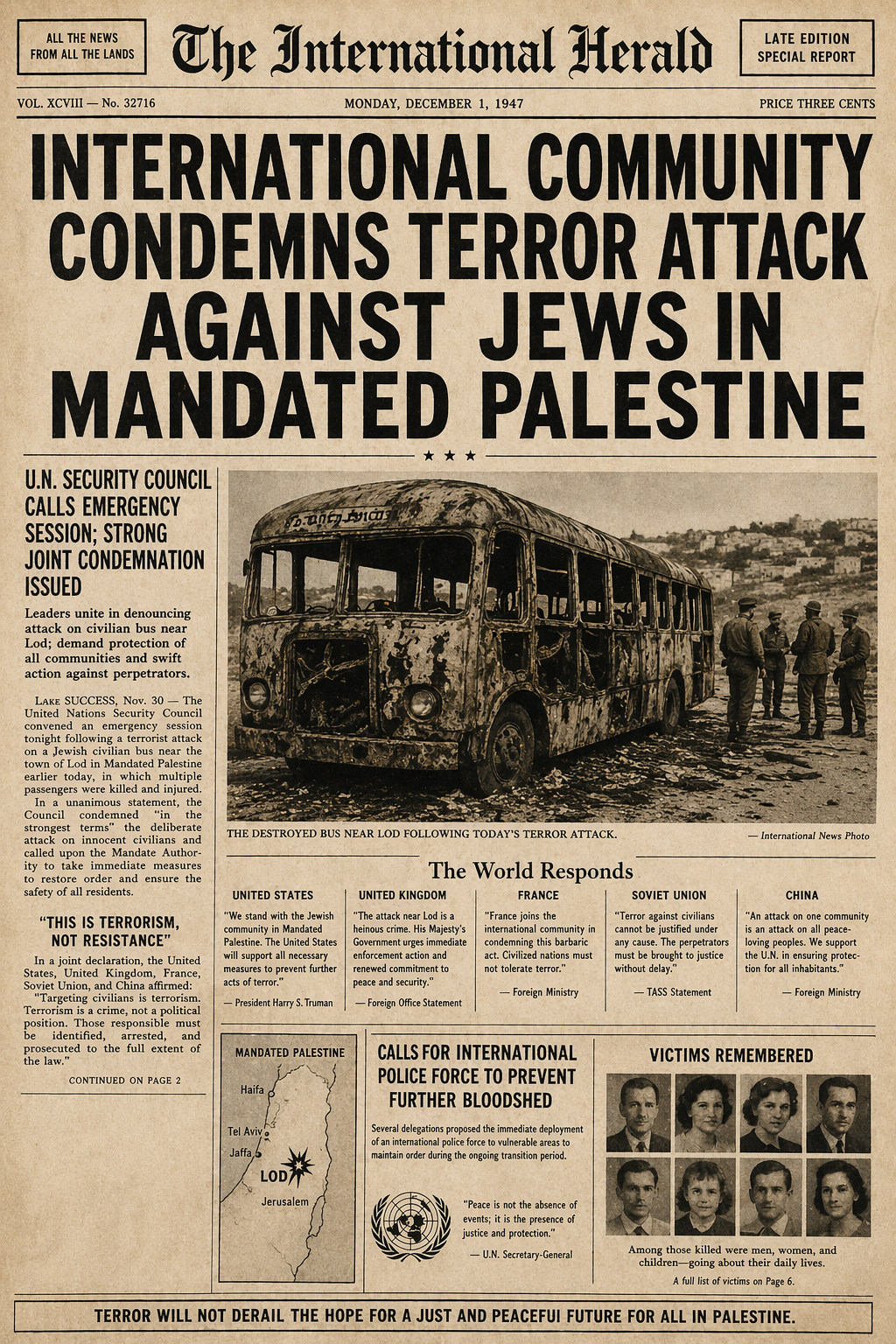
- The Spark of the Civil War: What if the bus ambush by Arab militants on November 30, 1947, near Lod hadn’t happened? Or, more importantly, what if the international community had responded to that first drop of blood not as “inevitable war,” but as a criminal act of terrorism? If the response had been swift, significant, and handled by an international police force, and condemned internationally, would the “internal” war have ever spiraled out of control?
- The Stranded Pilgrims: What if Britain hadn’t blocked the “Commission of Five” (the Five Lonely Pilgrims) from entering the territory to oversee the transition? If these UN representatives had been on the ground in January 1948, would the systematic displacement of Palestinians ever have happened under the eyes of the world?
- The Burden of Leadership: What if Ben-Gurion had been able to maintain a different kind of control, preventing the escalation into an all-out communal war before the state was even born?
- The External Intervention: What if, instead of five Arab nations—Egypt, Syria, TransJordan, Iraq, and Saudi Arabia—launching an invasion on May 15, 1948, they had channeled that energy into a diplomatic “Marshall Plan” for the region?
Redefining the “Catastrophe”
While the Palestinian community refers to the displacement of 700,000+ people as the Nakba (Catastrophe), and some extend that term to the very founding of Israel itself, my perspective has shifted.
For me, the founding of Israel isn’t the catastrophe. The catastrophe was the ill-managed disaster of the transition. The disaster we continue to see today is the ripple effect of the UK and the UN’s original negligence. They provided the birth certificate for the State of Israel, but they abandoned the infant in the cradle.
Restorative Practice and Restorative Justice
Restorative Practice is an umbrella term used for strategies that help us to proactively build community and relationships and manage conflict and tensions in ways that treat humans with dignity and respect. It is the transition to “What Now.” Restorative Justice aims to manage conflict and tensions by repairing harm and restoring relationships. Restorative Justice holds offenders accountable for their crimes
Restorative Justice:
Ownership for the Failed Transition
The “Nuremberg Trials” of Diplomacy: A Strategy for Truth
If we are to move from managing this conflict to actually resolving it, we have to move toward an interrogation of its origins. This isn’t just a job for historians; it’s a job for the world’s conscience. As an educator, I know that for a narrative to truly stick, it cannot be a dry line in a textbook. It needs the weight of human testimony. We need a “Living Archive“ of the 1948 transition.
1. The “Confessional” Documentary: Witnessing the Abandonment
The first “win” would be a global media event which would be a project on the scale of the Shoah Foundation, but focused on the Mandate Transition. We are in a race against time to record the few remaining voices: British soldiers, UN junior staffers, and local residents who lived through that winter of 1947–48.
Imagine the impact of a 98-year-old former British officer admitting on camera: “We had orders to stand down while the buses were being shot at.” Or a retired UN clerk confessing: “We knew the Commission was a ghost mission, but we sent them anyway.” These aren’t just stories; they are the “smoking guns” that break the modern binary. They prove that the chaos of 1948 wasn’t an accident but rather a policy of abandonment.
2. “Ownership vs. Blame”: The Messaging Campaign
This is not about “attacking” the UK or the UN. It is about liberating the current generation from the “Jew hate” and “Arab hate” that the 1948 failure fueled. We need an international campaign — perhaps under the banner of “Reparations for The Abandoned Mandate” — to shift the narrative.
When the “authority” (the UK/UN) finally admits fault, it changes the internal logic for the “Everyday Joe.” It becomes much harder to use Israel as a convenient scapegoat for personal biases when the global community acknowledges: “We drew the lines, we promised the peace, and we walked away. The blood since then is our debt to pay.” This complicates the story in a way that demands thought rather than anger.
3. Financial Reparations: The Settlement of the Original Debt
While we can never truly compensate for the loss of life, restorative justice requires a tangible acknowledgment of the material and systemic damage caused by the 1948 abandonment. If the international community admits it provided the “birth certificate” but abandoned the “cradle,” the UN and Britain must lead a sovereign settlement to address the resulting financial toll.
- Palestinian Property Loss: The UN and UK should establish an international fund to compensate Palestinian families for property and land lost during the 1948 transition. This is not a concession by local parties, but a reparation by the powers that failed to oversee a peaceful transfer of assets, providing the capital necessary for families to move from refugee status to permanent economic stability.
- The Israeli Security Debt: A reparation payment should be made to the State of Israel to acknowledge the staggering financial and social burden of defending a map the world drew and then deserted. This settles the “security debt” incurred by seventy-five years of having to function as a country consumed by military realities which diverted resources that would have been spent on regional innovation had the promised international guardrails been enforced.
The “What Ifs” of Gaza and the West Bank
and the Path Not Taken
If we accept that the international community failed the “cradle” in 1948, we must then examine the pivots that followed. Israel survived major attacks in 1948, 1967, and 1973. While holding territory gained during a defensive war is a recognized reality of international history, just because a nation has the right to hold land for security does not mean the way it is managed reflects its highest values.
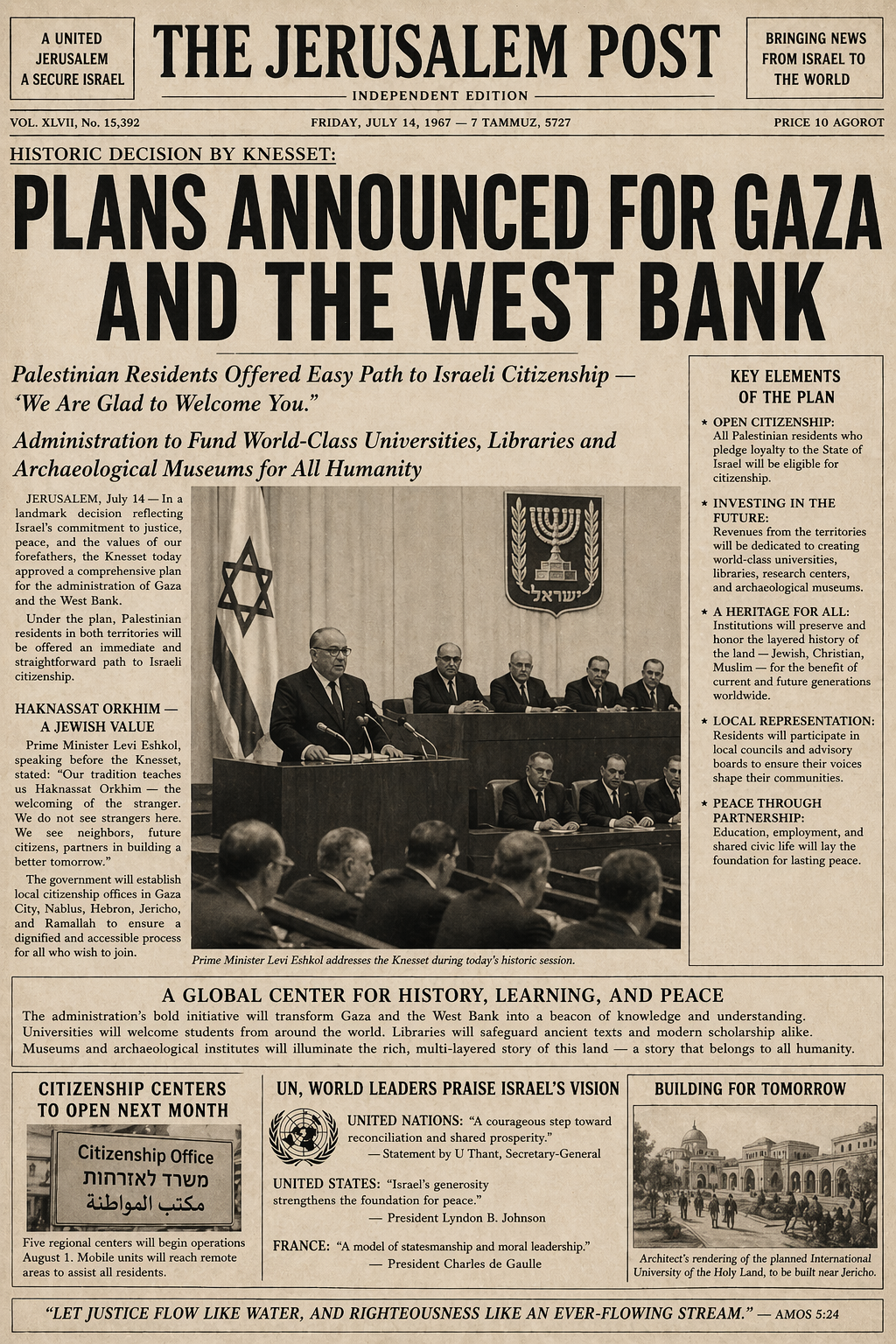
- The Intellectual Landscape: What if Israel, instead of aiming to settle Jewish communities there, had used its administration of the West Bank and Gaza to fund world-class universities, libraries, and archaeological museums? Imagine if these territories had been established as the global center for preserving the multi-layered history of the land, acknowledging both the Jewish indigenous heritage and the deep roots of Palestinian residents.
- The Global Hub of Healing: What if these territories had become the international base for conflict resolution and refugee absorption? Imagine Gaza as a “Switzerland” with an internationally recognized campus for conflict resolution and the West Bank as a global sanctuary, absorbing not just Jewish refugees from Ethiopia or Russia, but those displaced from Sudan and Eritrea and other war-torn and poverty stricken lands. This would have turned the “refugee” narrative into a shared mission of global restoration.
- Dignity through Infrastructure: What if Jewish connection to the land had been facilitated through integrated coexistence cities? Instead of isolated outposts, offering for sale property to anyone regardless of faith and ancestry and then establishing high-end infrastructure such as environmentally sustainable shared power, water, and transport throughout all of the towns, elevating the daily environment for everyone.
- The Integration Model: What if Palestinian residents in both Gaza and the West Bank had been offered a path to Israeli citizenship early on, mirroring the 21% of Israeli citizens who are Arabs today? [Read accurate history of citizenship paths and realities here and here and here.]
- The Failed Handshake: What if Yasser Arafat had said “Yes” at the Camp David Accords in 2000? What if the leadership in these territories had abandoned “Pay for Slay” and instead invested that capital into building a transparent, peaceful civil society?
- The Ethical Guardrail: What if Israel had strictly avoided the use of eminent domain to demolish homes in the disputed West Bank and never engaged in “punitive home demolitions”? This would have ensured that the response to terror remained focused on the individual perpetrator rather than the entire family or community.
Restorative Justice:
A different relationship with the disputed territories
1. Scaling Grassroots Coexistence
We no longer have to wonder if coexistence is possible because groups are doing it today despite the turmoil of the region. [Note my blog from June 2025 highlighting a number of organizations doing critical co-existence work]. Some examples include:
- Roots-Shorashim-Judur: The Israeli government officially adopts and implements the work of groups like Roots, which fosters a local, human-to-human connection between Israelis and Palestinians in the West Bank, and embeds it throughout Israeli society.
- The Givat Haviva Model: We must take the model of Givat Haviva (the oldest center for a shared society) and scale it so that shared campuses and joint leadership are the standard, not the exception.
2. The Classroom of Truth
To ensure the next generation of residents has accurate history and context, there must be implementation of an international “Classroom of Truth.” Education in Gaza and the West Bank must be arbitrated by a trusted, neutral broker (clearly not Israel nor the UN) that removes incitement and misinformation and replaces it with a curriculum of mutual belonging and historical authenticity. [Note: for more about the current issues in the curriculum, see here and here.]
3. Elevating the Resident
There must be a massive investment in the dignity of the people living in these territories. This means ending the “Blind Eye” toward systemic issues and ensuring that the high-end infrastructure and civil rights enjoyed in the rest of the region are extended to every resident. It is the move from “managing a population” to “elevating a community.” The current government must harshly punish the violence that extremist settlers perpetrate on Palestinians and their lands and must reverse the recent unbalanced death penalty ruling.
The “What Ifs” of the current UN, NATO, and the Global Double Standard
If the first “What If” was about the abandonment of the cradle in 1948, the final “What If” is about the abuse of the child. We have to look at the role the United Nations and NATO have played in institutionalizing the conflict rather than resolving it.
- The Standard of One: What if the UN had never shifted to holding Israel to a different standard than any other sovereign nation? What if the “birth certificate” given in 1947 had come with the same protections and diplomatic norms afforded to every other state born in that era?
- The Ignored Warnings: What if the UN had actually listened to Hillel Neuer and UN Watch years ago? Imagine if the documented evidence of Hamas stealing aid, building tunnels, using human shields, militarizing schools, and the systemic corruption within UNRWA had been treated as an urgent crisis of integrity instead of being swept under the rug.
- The Bias of the Arbiter: What if the international community had remained a trusted arbiter instead of becoming a biased actor in the media and messaging landscape?
- The Influence of Proxies: What if UN peacekeeping forces were reliable and never (allegedly) compromised by the influence or payroll of IRGC proxies? Imagine a neutral, effective force that actually held the lines it was assigned to protect.
- The Hypocrisy of Defense: What if the UN didn’t attempt to tie Israel’s hands from defense as rockets from Hamas and Hezbollah continued to rain down?
- The Regional Threat: What if NATO and the UN had dealt with the IRGC as a collective global threat from the beginning, rather than leaving the burden of containment almost exclusively to the United States and Israel?
Restorative Justice:
A Reformation of Global Governance
Restorative justice at the international level is perhaps the hardest to envision because it requires the UN (as we know it) to acknowledge its own neglect in its current form. It requires a “Nuremberg of Diplomacy” to clear the path for a new generation.
1. Expanding The Living Archive: Adding Global Leader Testimonies
Once again, restorative justice begins with expanding the “Living Archive.” We need recorded testimonies from within the halls of the UN and NATO, especially from those who are willing to admit to the systemic bias, the ignoring of Neuer’s warnings, and the application of double standards. This is the evidence required to move from the status quo to an authentic ownership and reckoning.
2. The Pedagogy of Accountability: A “German Model” for 1948
As an educator, I believe the first reparation is narrative. Following the Second World War, Germany underwent a profound process of national reckoning known as Vergangenheitsbewältigung, or “struggle to overcome the past.” This was not merely a political shift but a total educational and cultural overhaul designed to uproot the foundations of antisemitism. The German state took full institutional ownership of its history, implementing a rigorous national curriculum that mandated the study of the Holocaust, established memorial sites as centers of mandatory learning, and passed strict laws against the denial of Nazi crimes. This “pedagogy of accountability” focused on moving the citizens (especially future generations) from a state of denial or dismissal to one of collective responsibility, ensuring that every German student understood the systemic structures that led to the attempted destruction of the Jewish people. We see the seeds of this same strategy emerging in the United States today through movements to end the “white washing” of school-based curricula and museum education, and establish a more authentic history of the systemic displacement of Native Americans and the foundational role of slavery in the Black American experience.
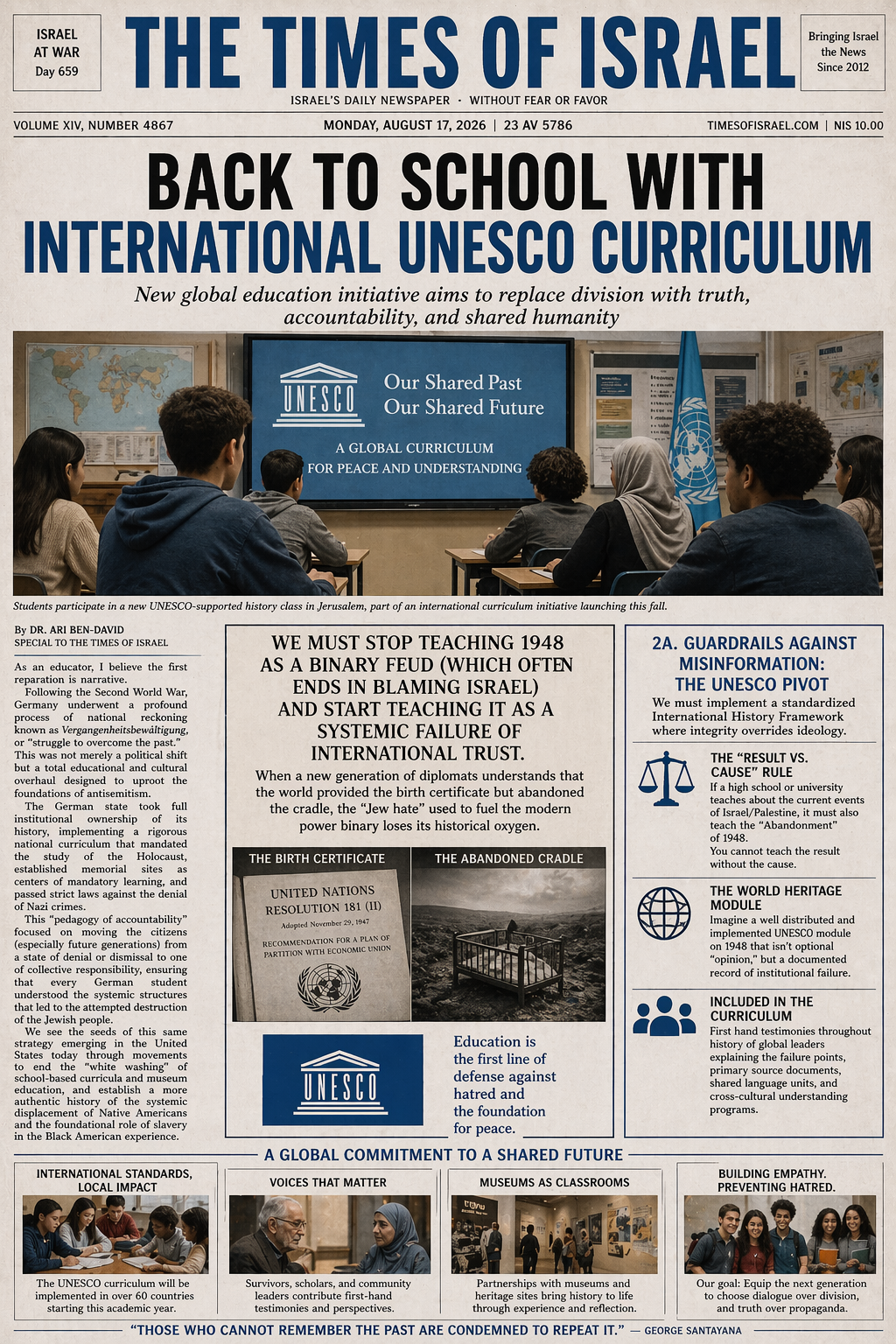
We (starting with NATO countries) must stop teaching 1948 as a binary feud (which often ends in blaming Israel) and start teaching it as a Systemic Failure of International Trust. When a new generation of diplomats understands that the world provided the birth certificate but abandoned the cradle, the “Jew hate” used to fuel the modern power binary loses its historical oxygen.
2a. Guardrails Against Misinformation: The UNESCO Pivot
We must implement a standardized International History Framework where integrity overrides ideology.
- The “Result vs. Cause” Rule: If a high school or university teaches about the current events of Israel/Palestine, it must also teach the “Abandonment” of 1948. You cannot teach the result without the cause.
- The World Heritage Module: Imagine a well distributed and implemented UNESCO module on 1948 that isn’t optional “opinion,” but a documented record of institutional failure.
3. Authenticity: Extreme Measure
In order to move forward, this moment requires a mea culpa that is so authentic it is jaw-dropping. An official UN “Day of Atonement” for the failure of Resolution 181 would stop the world in its tracks. It replaces the ongoing finger pointing and blame with a moment of global silence and ownership.
4. Collective Action: Ending the Burden of Containment
The global community must stop being a spectator (or an over-critical commentator) and start being a stakeholder. For decades, the burden of containing the IRGC and its proxies has been foisted almost exclusively onto the United States and Israel. The last few months have been a horrific testament to the failure of this isolationist strategy. Restorative justice means NATO and the UN takes a unified, decisive action against the IRGC. It means an international commitment to dismantling the infrastructure of terror that the world’s own negligence allowed to grow. True justice means that Israel is no longer forced to choose between international condemnation and its own survival because the international community finally recognizes that regional stability is a global obligation.
The “Utopia” is a Long-Term Project
This vision is not an unrealistic pipe dream but rather a long-term pedagogy of change and reset. It is a series of concrete steps that move us from a “What If” to a “What Now”:
- Step 1: The Documentaries and The Official Apology (The Evidence of Abandonment and Bias; The Institutional Ownership)
- Step 2: A New Approach (A reset with the disputed West Bank)
- Step 3: The Educational Pivot (The Correction & Prevention of Misinformation)
We may not be able to put the “Jew hate” back in Pandora’s box overnight, but by changing the foundational elements of how this history is taught, we ensure the next generation does not inherit our blindness. We owe them a history that is whole, authentic, and finally, honest. The ultimate win is an international commitment to a global curriculum of accurate, unbiased, restorative content. This teaches that Israel is a shared home that requires shared maintenance, individual accountability, and a global heart.
If we implement every piece of this restorative practice: if we record the testimonies, if we install the educational guardrails, if we rebuild the infrastructure of dignity, the world settles its “original debt,” and the IRGC is destroyed by a global cooperative effort, then, and only then, will we be ready for the final chapter.
Step 4 : A Land for All — Two States, One Homeland
A generation from now, a new breed of diplomats and citizens will emerge. They will be people who grew up with the truth. They will not inherit the “Jew hate” or the “Arab hate” of their predecessors because they were taught the history of institutional failure rather than ethnic villainy.
It is this generation that will finally be ready for A Land for All. This model has actively been promoted since 2021 and offers a future where two peoples share a single, open land under a confederated system of mutual security and shared sovereignty. It is the natural endpoint of a restorative process. It is the version of the 1947 plan that includes the “Economic Union” and “Human Rights” the UN promised but failed to defend.
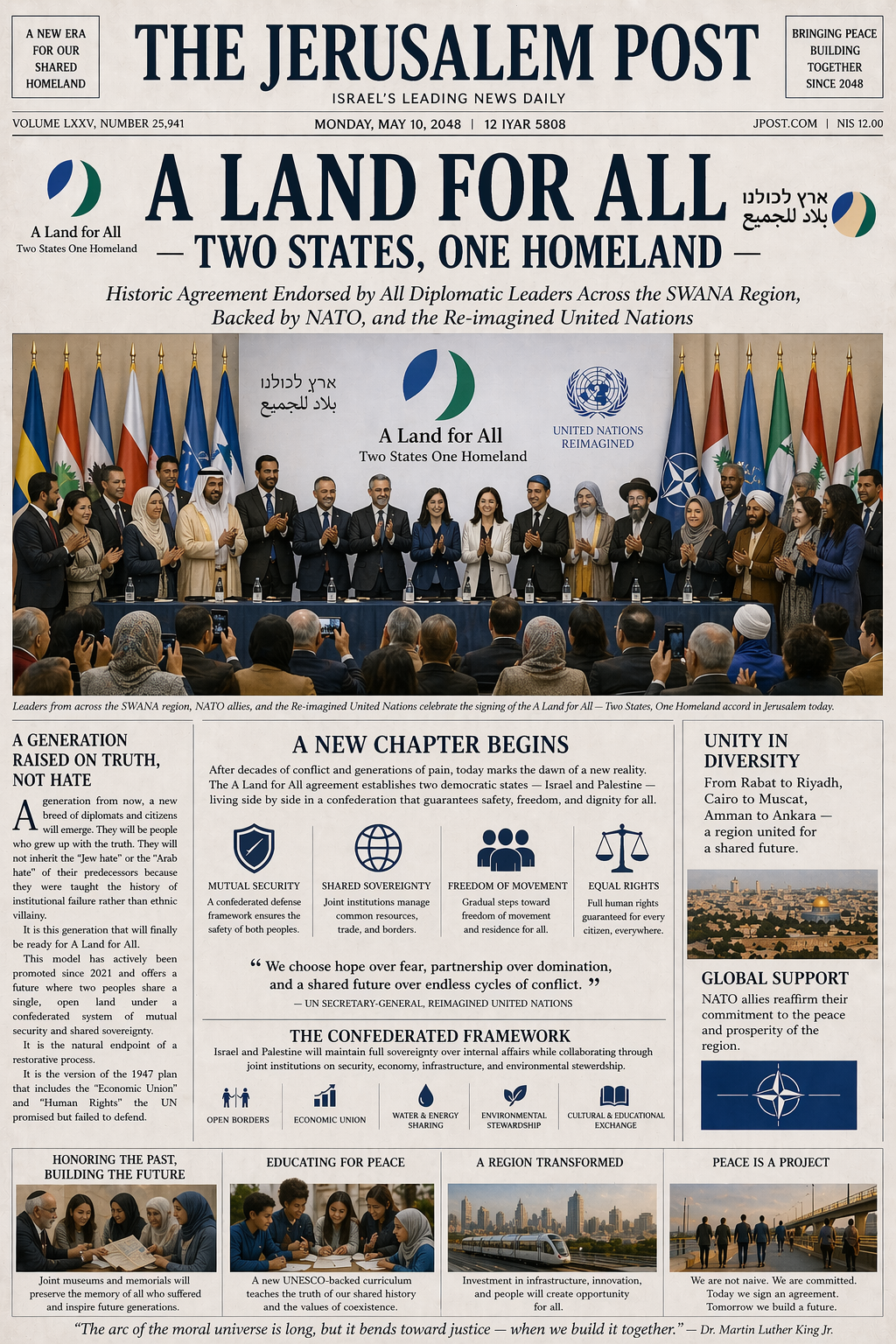
We are currently living in a period of time that can appropriately be labeled as “hell.” But by changing the approach of how we teach and how we hold the world accountable, we are building the bridge to that future. It’s not a Utopia; it’s a project. And it’s one we must start today.
Sidebar: The Bullet That Changed History
What if Yitzhak Rabin hadn’t been murdered?
On November 4, 1995, a single act of domestic terrorism — the assassination of Yitzhak Rabin — altered the trajectory of the entire region. Rabin was a soldier-turned-statesman who had the unique credibility to bridge the gap between Israel’s security needs and the requirements of peace.
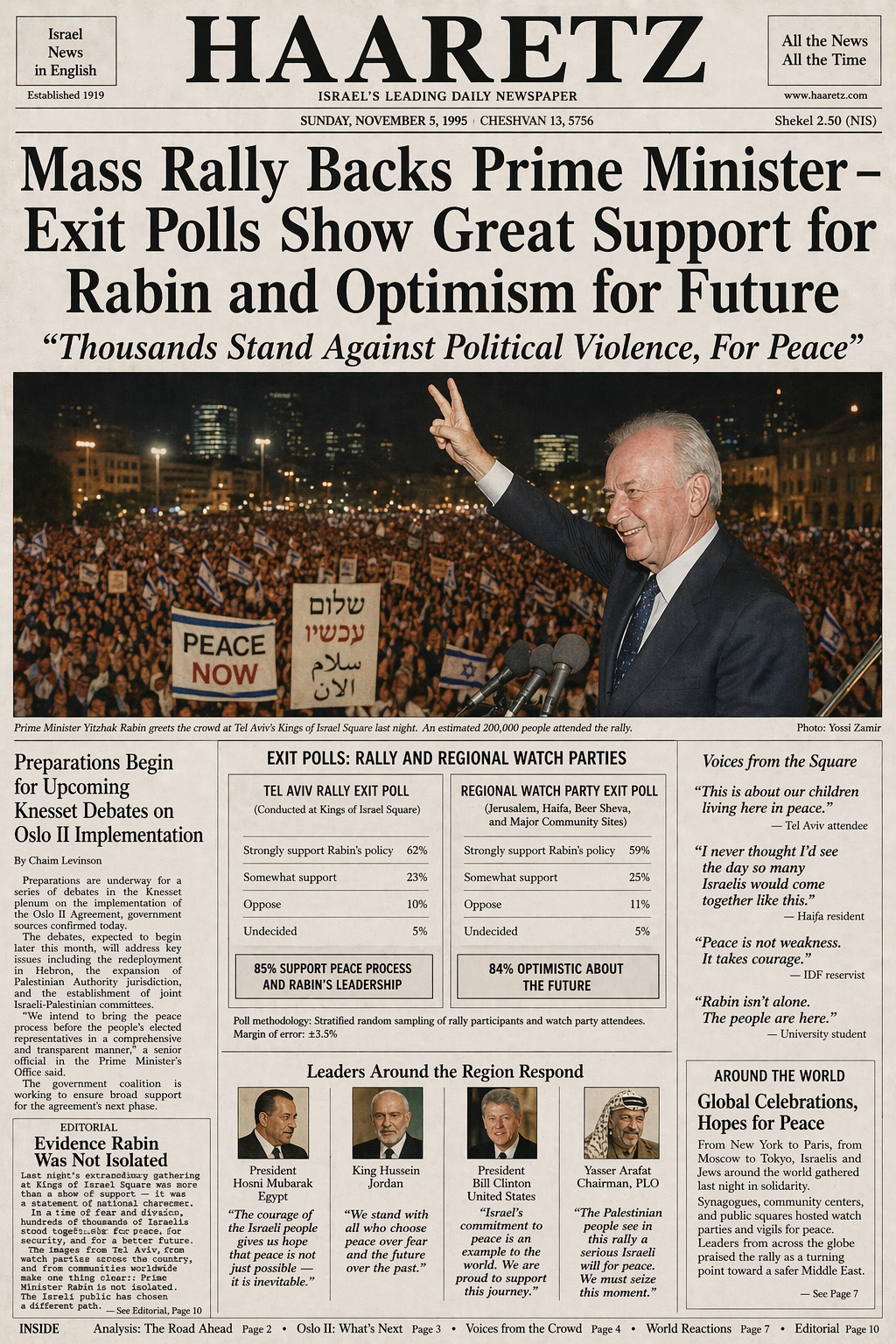
What might Restorative Justice be for the murder of Rabin? Justice here means a commitment to protecting the democratic process from political violence. It means ensuring that no single extremist bullet can ever again veto the collective will of a people seeking a shared future.
- The Legitimacy of the General: What if a leader with Rabin’s military prestige had remained at the helm to implement the Oslo Accords? Rabin had the trust of the Israeli “security establishment,” which is often the missing ingredient in peace negotiations.
- The Psychology of Hope: What if the momentum of the “Peace Square” rally had been allowed to flourish? The assassination didn’t just kill a man; it wounded the collective psyche of a generation that was beginning to believe coexistence was possible.
- A Different 2000: If Rabin had been the one sitting across from Arafat at Camp David, would the “Failed Handshake” have ever happened?
- The Second Intifada: What if the Second Intifada had never been launched in the wake of that diplomatic vacuum? If the “hell” of the early 2000s—the suicide bombings and the subsequent hardening of the physical and psychological barriers—had been avoided, where would the peace process stand today?


Leave a Reply