
Tamrurim (Guideposts) are brief thoughts about Israel.
Check back for updates!
-
When the Storm Comes
This blog is best viewed on desktop/laptop.
Imagine this:
A storm is coming.
Not abstract. Not theoretical. A real, dangerous storm that threatens your safety, your family, your future, your ability to remain who you are.
In front of you are three options. You can choose only one:
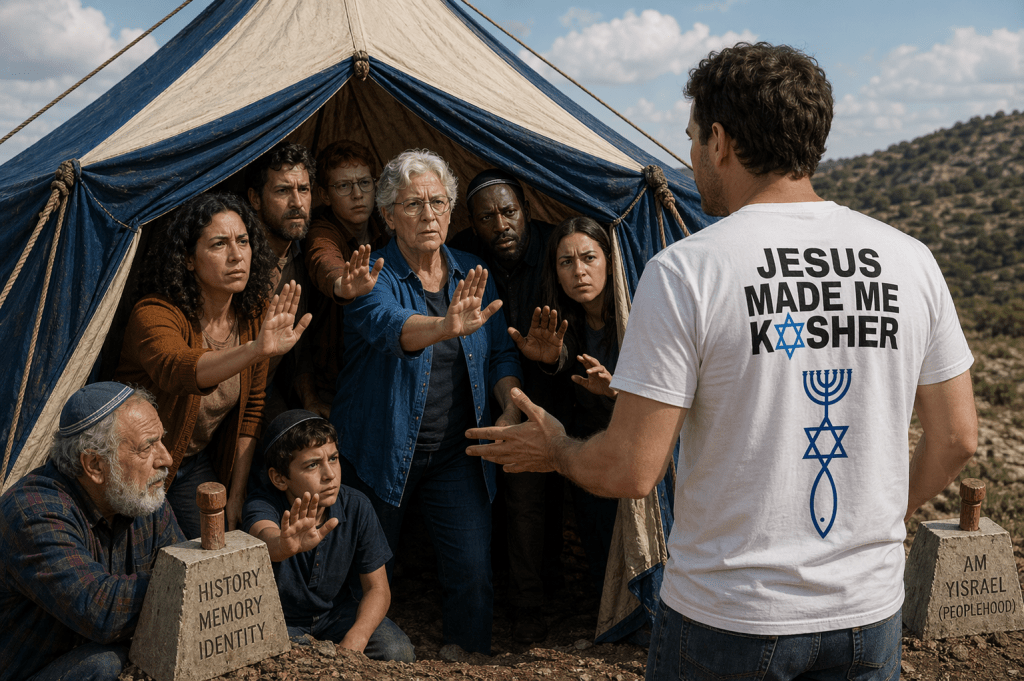
Umbrella? Lean-to? Tent?

No brick house is offered.
The umbrella gives minimal coverage but no boundaries.
The lean-to gives partial shelter but leaves you exposed and could dangerously collapse on you.
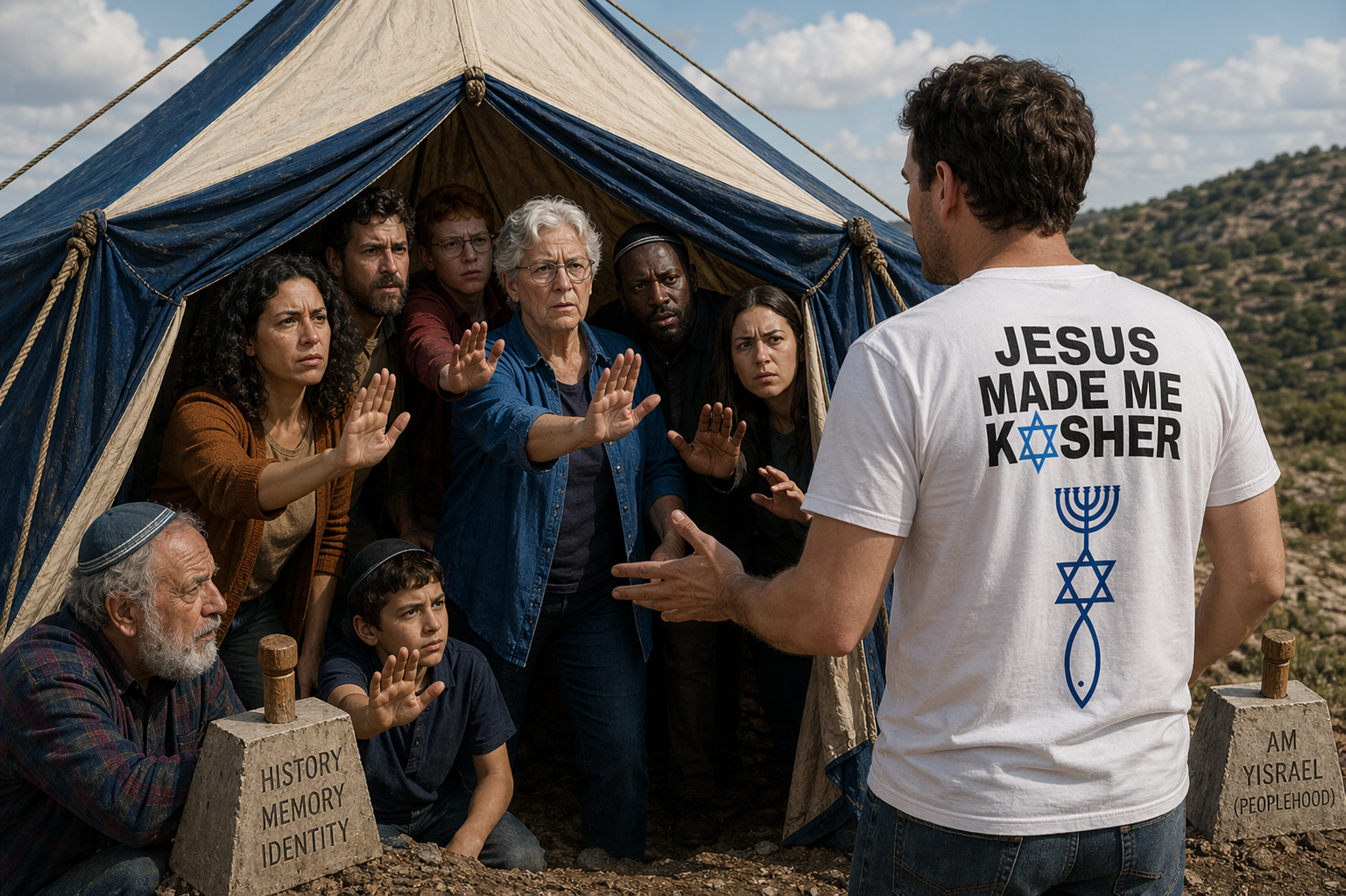
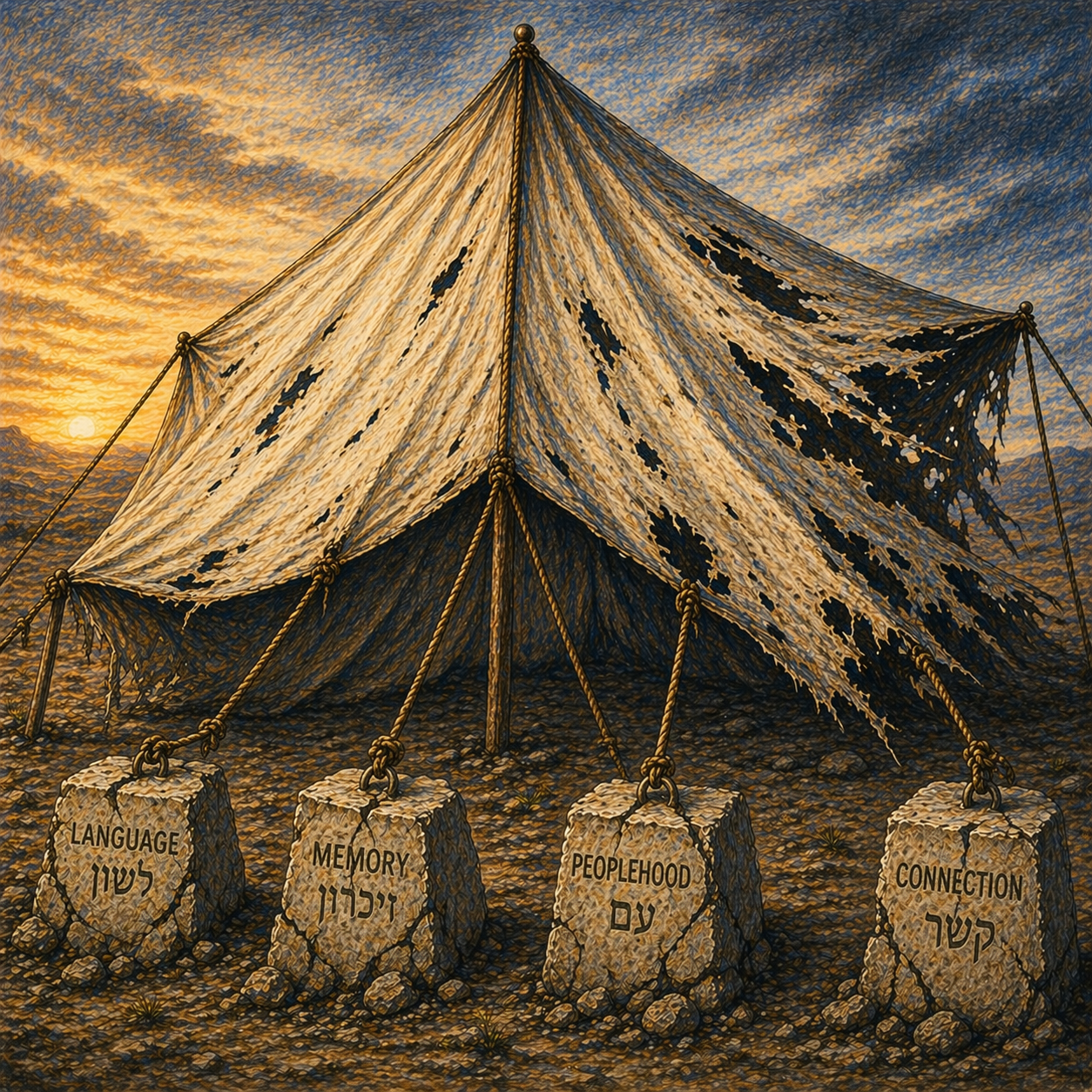
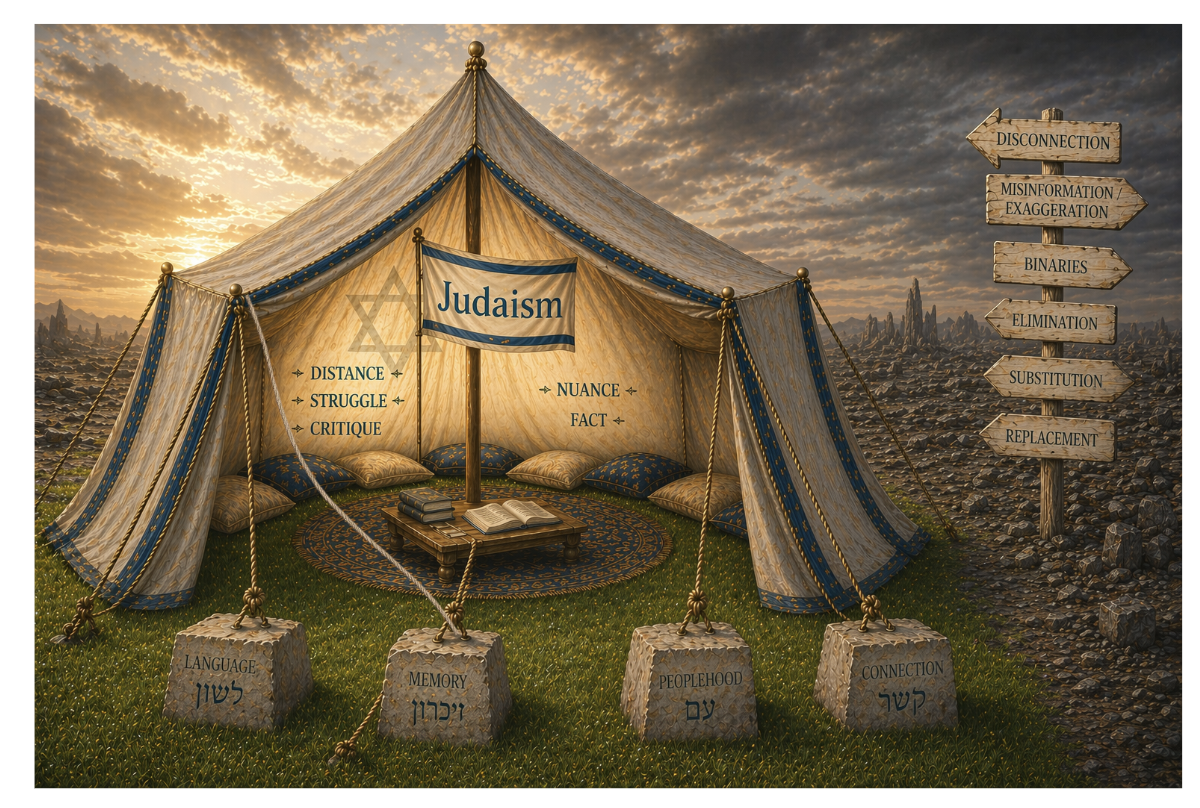
The tent has walls. Flexible, but real. It has edges you can see and sides you can close and use weights to anchor it down for additional safety.In a storm, no one chooses the umbrella. No one chooses the lean-to.
You choose the tent because protection requires structure. Shelter requires boundaries.
But there is one more part of the image that matters.A tent only works if it is maintained.
If someone pokes a hole in the side of the tent and we do nothing, the problem is not only the hole. The storm gets in. The structure weakens. Over time, the tent stops functioning as a shelter at all. So we patch the hole and rebuke the behavior. That is part of what it means to rely on a tent. We maintain its integrity because we depend on it.
But there is a harder question: What if the same kinds of holes keep appearing, and we choose not to name where they came from or the danger those leaks cause? What if we allow the tent to gradually fall apart to the point it is only an umbrella? What if we allow people to chip away at the anchors to the point the tent can be swept away?
At some point, the issue is no longer a single opening. It is the loss of the structure itself. We are exposed and can no longer call it shelter.
That is the metaphor underlying everything that follows.
The Tent of Judaism
We often describe Judaism as a “big tent.” That metaphor matters, but it is often misunderstood.
A tent is not boundless. A tent is not an open field.
A tent has open walls, edges, a defined shape, and critical ground anchors.
Those walls may stretch. At times we roll the sides up to welcome people in. But when the storm comes, we pull them down and securely tie them down.
Without the walls, there is no safe shelter.
The Tent Wall We Already Recognize
There is at least one place where the mainstream Jewish community has long been clear on where the sides of the tent exist and why: God.
Inside the tent, a Jew can:
- struggle with God
- doubt God
- reject belief in Adonai entirely
- (You can read my blog on the lack of requirement for a God-belief in Judaism to understand more.)
But there is a line. Across denominations, Jewish leadership has been consistent that belief in the divinity of Jesus is incompatible with Judaism (summarized here). Reconstructionist Rabbi Carol Harris-Shapiro writes in her book Messianic Judaism: A Rabbi’s Journey through Religious Change in America, “A Jew can believe almost anything but Jesus as Lord.” She also asserts:
“a Jewish embrace of Jesus
amounts over time to
an act of ethnocultural suicide.”In Jesus for Jews: The Unique Problem of Messianic Judaism by Faydra Shapiro, she posits: “… is activism against Messianic Judaism actually about these Jews’ faith in Jesus … Is it simply that these people have violated a fundamental group expectation?”
The work of Harris-Shapiro and Shapiro make it clear that Jewish communities have historically tolerated a wide range of belief, including non-belief, but draw a boundary where the framework itself is restructured rather than interpreted. They are clear that this integration of Judaism and Jesus is a violation of, and a threat to, Jewish peoplehood.
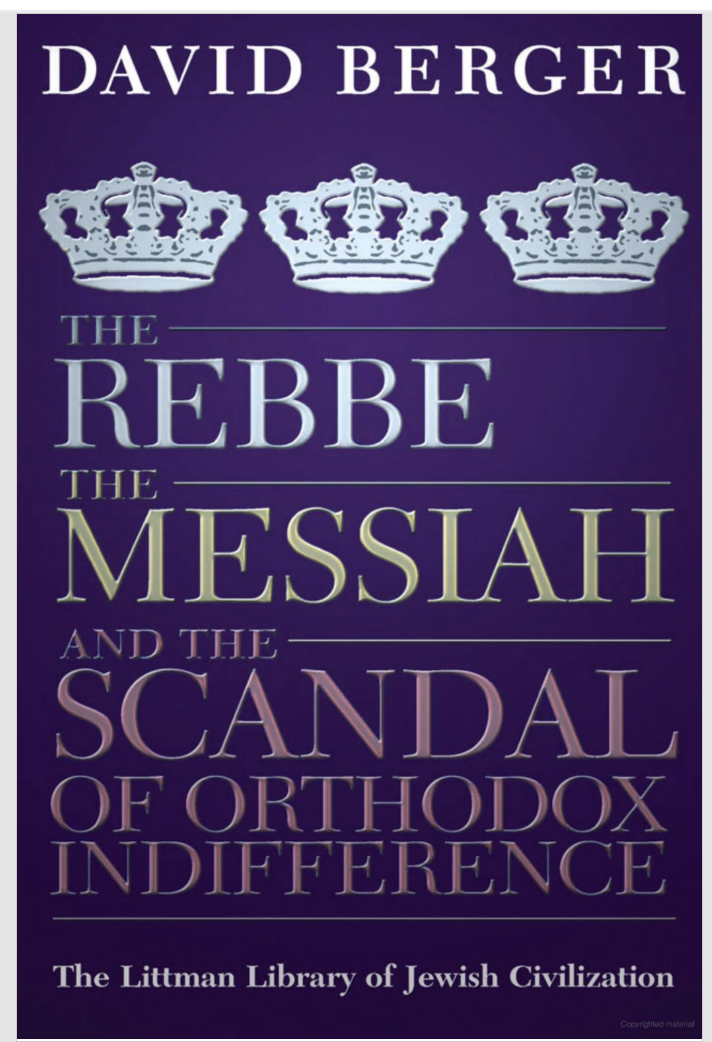
But messianic belief in Jesus isn’t the only departure from Jewish boundaries that has been challenged. Orthodox scholar Rabbi David Berger, author of The Rebbe, the Messiah, and the Scandal of Orthodox Indifference, similarly argues that beliefs such as divine incarnation within Lubavitch Orthodox Judaism (re: the Rebbe) are not simply outside Jewish tradition, but incompatible with its core theological structure. As a result, he not only wrote this book, but went on to sponsor a Rabbinical Council of America (RCA) resolution “excluding this belief from authentic Judaism.”
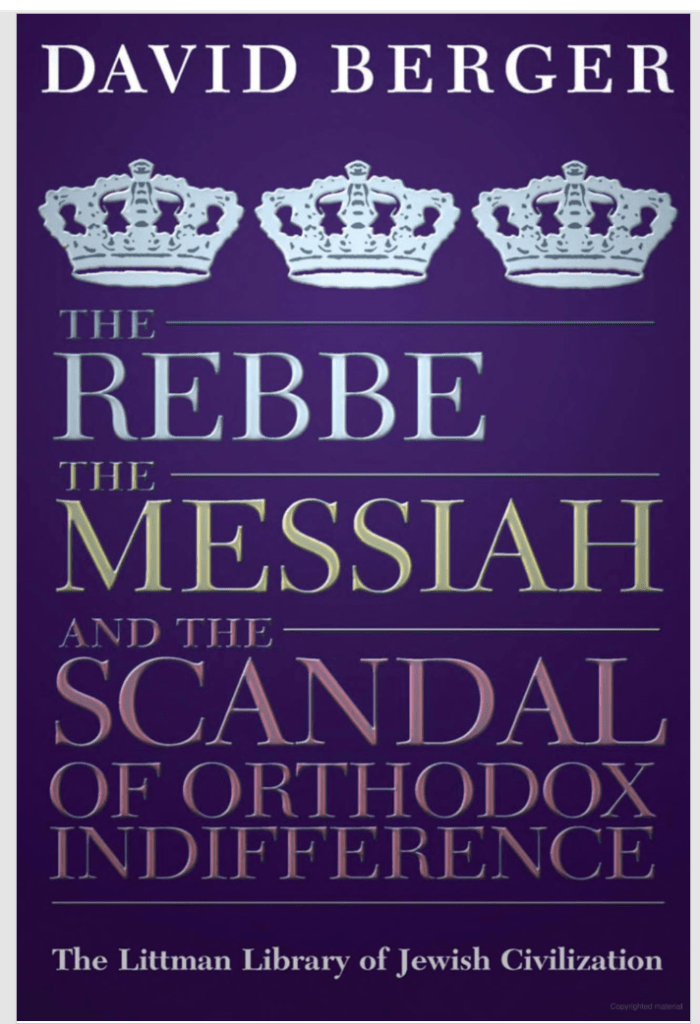
He writes that allowing a messianic belief to stand within the Jewish community is a, “dramatic abandonment of the age-old Jewish resistance to a quintessentially Christian belief is a development of striking importance for the history of religions, an earthquake in the history of Judaism.”
This is not a language of disagreement. It is the language of rupture.
Berger also explains that his book, “assesses the threat posed by the messianists of Lubavitch and points to the consequences, ranging from undermining a fundamental argument against the Christian mission.”
And importantly, the concern is not only about proselytizing.
Jewish organizations have repeatedly emphasized the danger of misrepresentation. When a Jesus-centered framework is presented in Jewish language, symbols, or institutions, it blurs the boundary of what Judaism is.
The outcome of Berger’s work and sponsored resolution was The Rabbinical Council of America’s adopted resolution rejects any attribution of divinity to a human being. This was not a response to external pressure, but to a perceived breach within the framework itself. In other words, Jewish leadership has not only defended the tent from the outside. It has patched holes from within. When this boundary was blurred, the response was not to widen the tent, but to reinforce its walls.
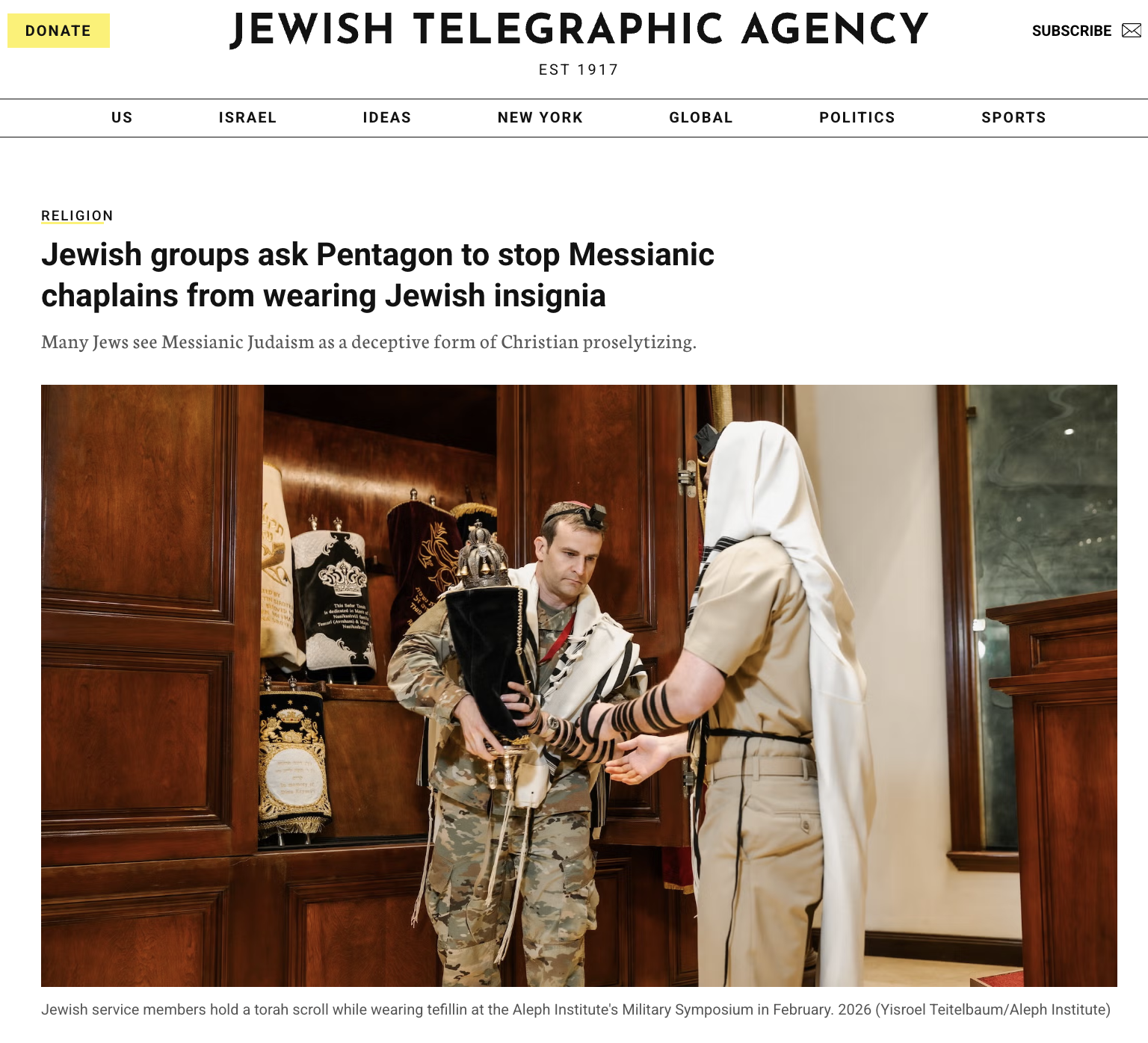
A similar concern about misrepresentation surfaced in the debate over Messianic chaplains wearing Jewish insignia. Jewish groups warned that this creates confusion and falsely signals Jewish authenticity. The JTA article covering this issue is an important read, and sheds significant insight including a rabbi saying, “The Messianics are a very dangerous group.”
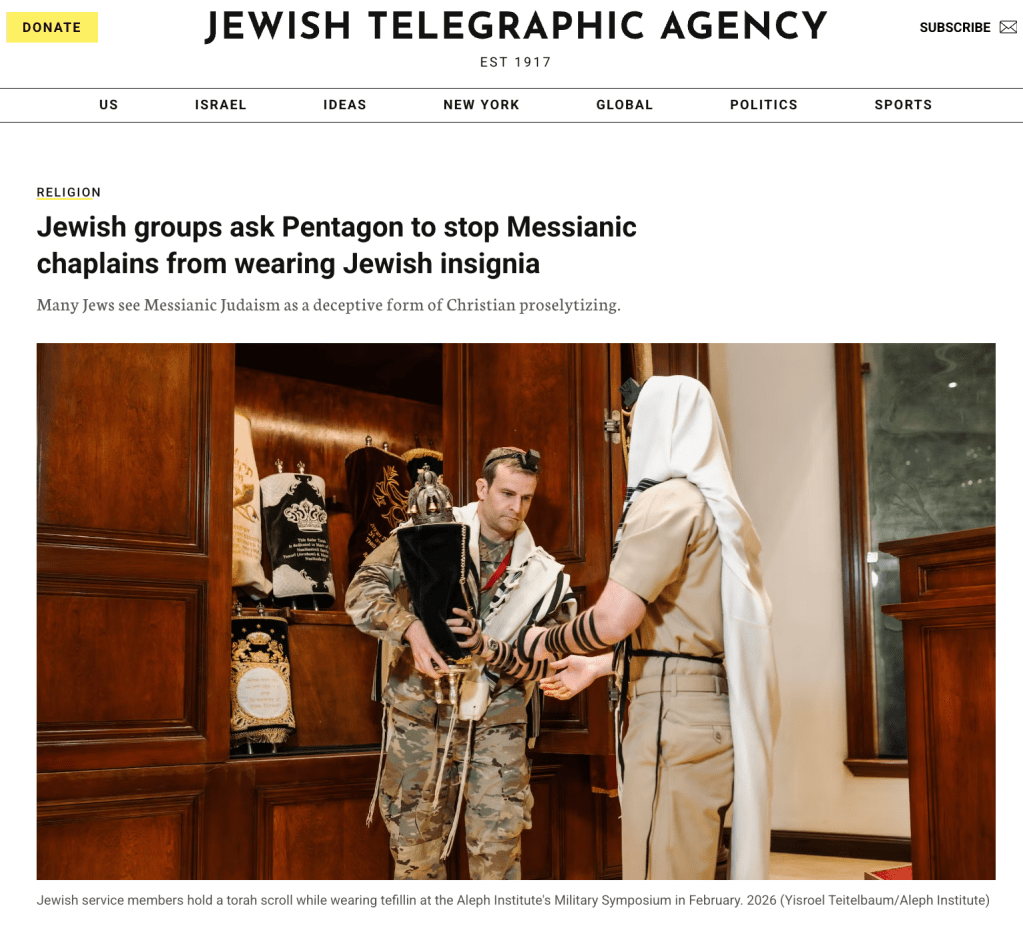
The letter to the Pentagon summarizes: “This is not a theological dispute … [rather] the protection of religious freedom for a minority faith community that depends on clear institutional signals.”
The issue is not only what someone believes. It is what that belief communicates about Judaism itself and what people misrepresent and who they confuse when they are communicating with others about what Judaism is or isn’t.
In the eyes of many Jewish leaders, even private or quiet expressions of this belief raise concern, not because of individual intent, but because they embody a claim that the boundary itself does not exist. I have seen this boundary maintained in very real ways.
Story 1:
The Invisible BoundaryIn the early 2000s, while working for a congregation in Dallas, I enrolled in a synchronous video-conference Master’s program through a partnership with the Siegal College of Judaic Studies. It was there I met a man who was brilliant, funny, and deeply versed in Jewish text. He was of Mexican descent, and given his profound literacy in liturgy and history, I simply assumed he was a fellow Jew.
The Inclusion
We became fast friends. We began to spend time together outside of class. I invited him to my synagogue for the High Holy Days, and eventually, he decided to join the congregation. On his membership form, he listed me as the person who recruited him.
The trouble began when his name appeared in the monthly newsletter welcoming new members. Within days, the senior rabbi called me into his office, visibly upset. A congregant who knew the man through other experiences had reached out to the rabbi to alert him to an issue. The rabbi showed me an article from a Jewish newspaper published a few years prior. It revealed that my friend had co-owned a Messianic bookstore. I was shaken to the core. To me, he was a peer who prayed with fervor and knew the texts better than most.
The Confrontation
When I confronted him (explaining that we could no longer socialize and that he was being asked to leave the congregation) he was devastated. He offered a perspective I had never heard: that while movements like “Jews for Jesus” are known for aggressive proselytizing, there are individuals who view their Messianic identity as a private reconciliation of history. His family were Conversos from Monterrey, Mexico. For him, this was the only way to honor his ancestral Jewish roots without abandoning the Christianity his family had held for generations. “Who I pray to in my heart is not public knowledge,” he told me, describing the profound loneliness of being rejected by the Jewish community while no longer identifying as Christian.
The Community Guardrails
The fallout was swift and systemic. Because the local Jewish Federation subsidized the degree program specifically for the Jewish community, his scholarship was revoked. The Federation and the college leadership had to wrestle with a difficult question: Could he even remain in the program? Ultimately, he was allowed to stay, but only if he paid his own way.
The tension reached a breaking point during a class visit to an Orthodox synagogue. He was wearing a kippah and tallit and praying beautifully. The service leaders, assuming he was a halakhic Jew, called him up for a Torah honor. He accepted. To me, this was a height of deception. To him, it was an expression of an identity he felt he rightfully possessed.
The Lingering Question
At the time, he challenged me by asking why an ultra-Orthodox Jew who believes their Rebbe is the Messiah is still considered a Jew, but he was not. It was not until years later, while researching for this blog, that I found David Berger’s work addressing that very distinction.
This experience forced me to look at the guardrails we build. We did not exclude him because he was proselytizing; he was not. We excluded him because his very presence challenged the boundaries of where “Jewish” ends and “Other” begins.Story 2:
The Database and
the DoorstepBy 2007, I was working as a Jewish communal professional in Atlanta. Under my direction, my team and I developed a mifgash exchange program in funding partnership with the Jewish Federation of Greater Atlanta that brought ten Israeli teenagers to Atlanta for two weeks. The Israeli teens were paired with local host families, and both groups had undergone months of preparation. The teens learned about cultural differences, hosting etiquette for foreign visitors, and the nuances of American versus Israeli Jewish life.
The Red Flag
Literally the day before the Israeli delegation was set to arrive, while the teens were already in the air, I received a frantic phone call from a member of the Federation staff. They had been cross-referencing our list of host families with their donor database.
When they reached one particular family, a “red flag” popped up in the system. The family was Messianic. The Federation staff was clear that they could not host and that this was a major problem.
The Conflict
I was caught in an impossible position. The teens had already been communicating via email and video, so the relationships were already forming. The host family’s daughter was active in the local JCC and had been nominated for the program by a department of the community center. To the outside world, they were involved members of the Jewish community.
We had only hours to debate the implications. Could we, in good conscience, place an Israeli teen in a home where they might be told that Jesus is part of Judaism? Or in a home where Messianic symbols, art, and books may be present? This was not about an interfaith family dynamic (which was something the Israeli teens learned about during their preparation classes). This was a fundamental shift in the definition of Jewish identity.
The Exclusion
The conversation with the father was agonizing. He was born Jewish but had embraced Messianic beliefs later in life. He insisted that he was still a Jew.
We had to deliver a hard truth. We told him that while he has Jewish heritage, by centering Jesus, he had moved outside the tent of mainstream Jewish life. Therefore, we could not place an Israeli teen in his home.
The fallout for the daughter was heartbreaking. To mitigate the trauma, we allowed her to participate in secular activities, like our trip to the World of Coca-Cola, but she was barred from any religious programming. The line that we drew was public and immediate.
The Institutional Memory
What struck me most was the role of the system. The Federation knew this family was Messianic because of a recorded encounter from years prior. That institutional memory acted as a silent gatekeeper.
Even though the family was not proselytizing, their lived “Judaism” was viewed as a threat to the integrity of a program about Jewish people and Jewish identity. Once again, we chose the safety of the communal boundary over the inclusion of the individual. This proved just how firm the wall around Jesus remains in Jewish life.These are not acts of exclusion for their own sake. They are acts of protecting the integrity of the framework.
They are how we patch the holes.
The Assertion I’m Making Now
Which brings me to a second domain that I believe is an equal “ethnoreligious suicide” and a ripping of holes in the safety of our tent — anti-Zionism within the Jewish community.
Judaism is not only a theology; it is a civilizational system that depends on our relationship to Eretz Yisrael — it depends on Zionism.
The World Zionist Organization (WZO) currently uses the Jerusalem Program (last updated in 2004) as its official platform. It defines Zionism through several pillars:
- The unity of the Jewish people and the centrality of Israel in Jewish life.
- The gathering of the Jewish people in its historic homeland, Eretz Yisrael, through Aliyah (immigration) from all countries.
- The strengthening of the State of Israel as a democratic, Jewish state.
- The preservation of the identity of the Jewish people through the fostering of Jewish, Hebrew, and Zionist education and the cultivation of Jewish spiritual and cultural values.
That definition and the extrapolated system is built around:
- a land that binds people
- a collective identity originated in the land
- a narrative of exile and return
- a calendar of festivals and holidays rooted in the land
- prayers oriented toward Jerusalem
- laws tied to the land (ie shmita)
This is not peripheral. It is structural.
The Law of Return (1950) and the extrapolated system is the expression of Zionism within the State of Israel.
Why This Matters Now
While major Jewish organizations describe Israel as a central expression of Jewish self-determination and also align on what the accepted definition of Zionism is, there are far too many Jews (and a few Jewish organizations) that are rejecting this.
We are living in a moment of real pressure on Jewish life.
In that environment, anti-Zionism often functions not only as political critique, but as a challenge to Jewish legitimacy, belonging anywhere, and connection to the land. Here are a few examples from influential non-Jewish anti-Zionists that elevate this rhetoric:
- Rashid Khalidi, the Edward Said Professor of Modern Arab Studies at Columbia University, in his work The Hundred Years’ War on Palestine: A History of Settler Colonialism and Resistance, 1917–2017, frames Zionism not as a national liberation movement but as a European colonial endeavor that replaces indigenous history with a “biblical coat.” He says Israel is, “A late-nineteenth-century colonial-national movement thus adorned itself with a biblical coat that was powerfully attractive to Bible-reading Protestants… blinding them to the modernity of Zionism and to its colonial nature.”
- Joseph Massad, a professor of Middle Eastern Politics at Columbia University, describes the Jewish presence in Israel as a “right of conquest” rather than a return to a homeland, categorizing Jews as “settler-colonists.” He says in a 2018 article called Against Self-Determination, “As in the rest of the settler-colonies, the ‘right of conquest’ of land in Palestine continues to be safeguarded as a ‘right of self-determination’ for the Jewish settler colonists and their descendants.”
If It is hard enough when that critique comes from outside of the community, but these claims coming from Jews (even knowledgeable ones) is deeply problematic:
- Shlomo Sand, an emeritus professor at Tel Aviv University, is a prominent voice in the “post-Zionist” movement. In his work, The Invention of the Land of Israel: From Holy Land to Homeland, he argues that the Jewish people are a “constructed” nation with no ancestral right to the territory: “It is entirely illegitimate to identify the Jewish links with the ancestral land of Israel… with the desire to gather all Jews into a modern territorial state situated on the ancient Holy Land.”
- Ilan Pappé, an expatriate Israeli historian, argues that Jews do not constitute a “nation” with the right to self-determination, but rather a religious group, thereby delegitimizing the foundation of a Jewish state. Pappé has stated that while national movements deserve a state of their own, this principle does not extend to Jews because they constitute a religious group rather than a nation. His work, Ten Myths About Israel, is frequently cited and summarized by educational resources like the Zinn Education Project.
These beliefs are a challenge to a core Jewish framework. And when that challenge is presented as fully within the tent of Judaism, without communal response, it risks normalizing the erosion of that framework. It risks leaving the hole unpatched. (Read further to understand the impact of misrepresentation.)
There is another aspect of Jewish anti-Zionism that rips at the fabric of the tent, and that’s when Jews use terminology that is not based on nuance, honest history, nor fact. Accusations of genocide and ethnic cleansing are two of the sharpest examples of this. Claiming that Israelis and Jews are colonizers is another and insisting that Israel as a whole is an apartheid-state, both function as misinformation when used without precision. [NOTE: see sidebar at the bottom on terminology and definitional nuance.]
One such case of this happening is with groups like Rabbis for Ceasefire. One of its most prominent members is Rabbi Abby Chava Stein. She was interviewed on The Marc Steiner Show, and in his introduction he summarizes her as “a fierce opponent of Zionism and Israel’s Occupation and ethnic cleansing of Palestinians.” During the show, she makes a distinction, “Religious anti-Zionism is very different than what I call social justice anti-Zionism, injustice-based anti-Zionism” and considers herself the latter but was raised in the former (Stein grew up in an ultra-Orthodox Hasidic Jewish enclave).
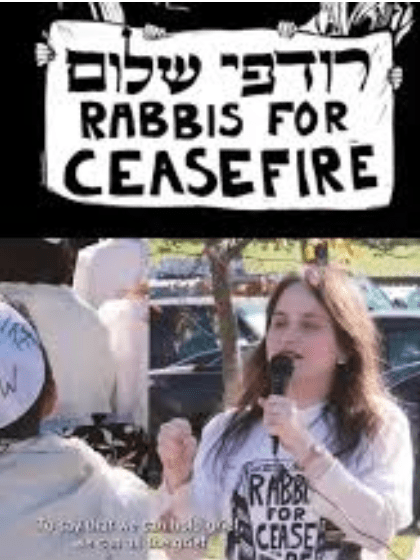
Stein also sits on the rabbinic board of JVP (Jewish Voice for Peace) where their vision and position on Zionism statements explicitly uses this language: “Zionism… is a movement that emerged in the context of European colonialism and has functioned as a colonial project by displacing the indigenous Palestinian people.”
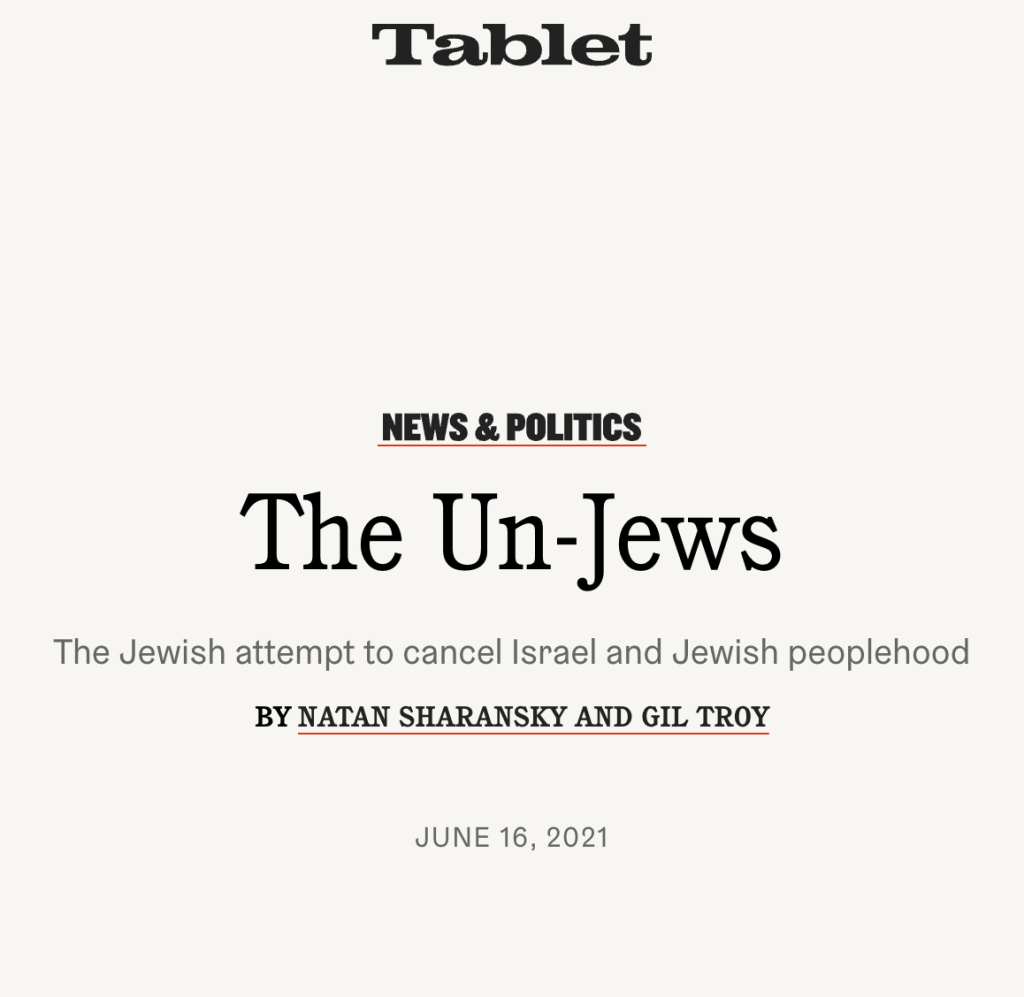
Just like the military chaplains who identify as Messianic Jews, these anti-Zionist Jewish leaders are mis-communicating about the indigenous nature of Judaism, misrepresenting Jewish and Zionist history, and confusing outsiders about the nuance of Jewish peoplehood vs. Judaism solely as a religion. The dangers of this, the threat of attempting to disassociate Judaism and Zionism, led prominent leaders Natan Sharansky and Gil Troy, in a Tablet Magazine article, to define anti-Zionist Jews as “the un-Jew.”
And, similar to the condemnation of the Lubavitch movement by Berger and RCA for their messianic beliefs, mainstream Jewish leaders also strongly oppose the religious anti-Zionism that Stein was raised under in groups such as the Satmars, Edah HaChareidis, and Neturei Karta. Mainstream Orthodox leaders, refer to their beliefs and behaviors as Hillul Hashem (an affront to God) and have actually put them in herem (excommunicated them). The RCA said, in response to these groups engaging with anti-Zionist terror groups: “Their actions constitute a monstrous Hillul Hashem… By embracing those who seek the destruction of the Jewish people, these individuals have placed themselves outside the boundaries of the Jewish community.” Religious scholar Rabbi Joseph B. Soloveitchik wrote in his work, Kol Dodi Dofek:
“A Jew who participates in the suffering of his nation and its fate, but does not join in its destiny, which is expressed in a life of Torah and mitzvot, destroys the essence of Judaism … a Jew who is observant but does not feel the hurt of the nation, and who attempts to distance himself from Jewish fate, desecrates his Jewishness.”
In an ADL backgrounder on the dangers of this extremism, they write: “… the more mainstream ultra-Orthodox community to join the broader Jewish community, to disavow and repudiate Neturei Karta. Indeed, Neturei Karta’s views are not in any way representative of the vast majority of the Jewish community. While these denouncements are important, it is still likely that the average passer-by [sic] who witnesses Neturei Karta’s participation at an anti-Israel protest surmises that many Jews who dress similarly agree with this position. And, while it is true that the ultra-Orthodox community largely disapproves of Israel’s secular government and liberal policies, the vast majority thoroughly abhors and rejects Neturei Karta’s ideology.”
It is because of the dangers that come from both the “Jewish social justice anti-Zionists” and the “religious anti-Zionists” that there is strong condemnation of these voices. William Daroff, as the CEO of the Conference of Presidents, has publicly denounced them saying:
“The loudest fringes, amplified far beyond their size or influence, do not define Jewish mainstream or its future. The defense of Israel is not a partisan cause. It is a moral one… Attacks on Israel’s legitimacy mirror older attacks on Jewish identity because the right of Jews to self-determination in our ancestral homeland lies at the heart of Jewish peoplehood.”
What Is Lost:
Jewish Continuity, Collective Memory, and SafetyThe Risk of Losing Judaism
If Judaism is detached from Eretz Yisrael, something more than geography is lost.
- Holidays lose their native landscape
(see post on “anti-Zionist Seders) - Prayers lose their direction
- The language of return becomes metaphor instead of memory
- Historical continuity becomes easier to deny
If we treat that connection as optional, others will as well. This is not only about internal meaning. It is about external legitimacy. Rejecting Israel and Zionism (not its policies but its legitimacy) raises a real question: What replaces it?
Jewish life has always depended on shared anchors. When a core anchor is removed, not reinterpreted but replaced, the system begins to thin: shared language fragments, collective memory weakens, and common identity becomes unstable.
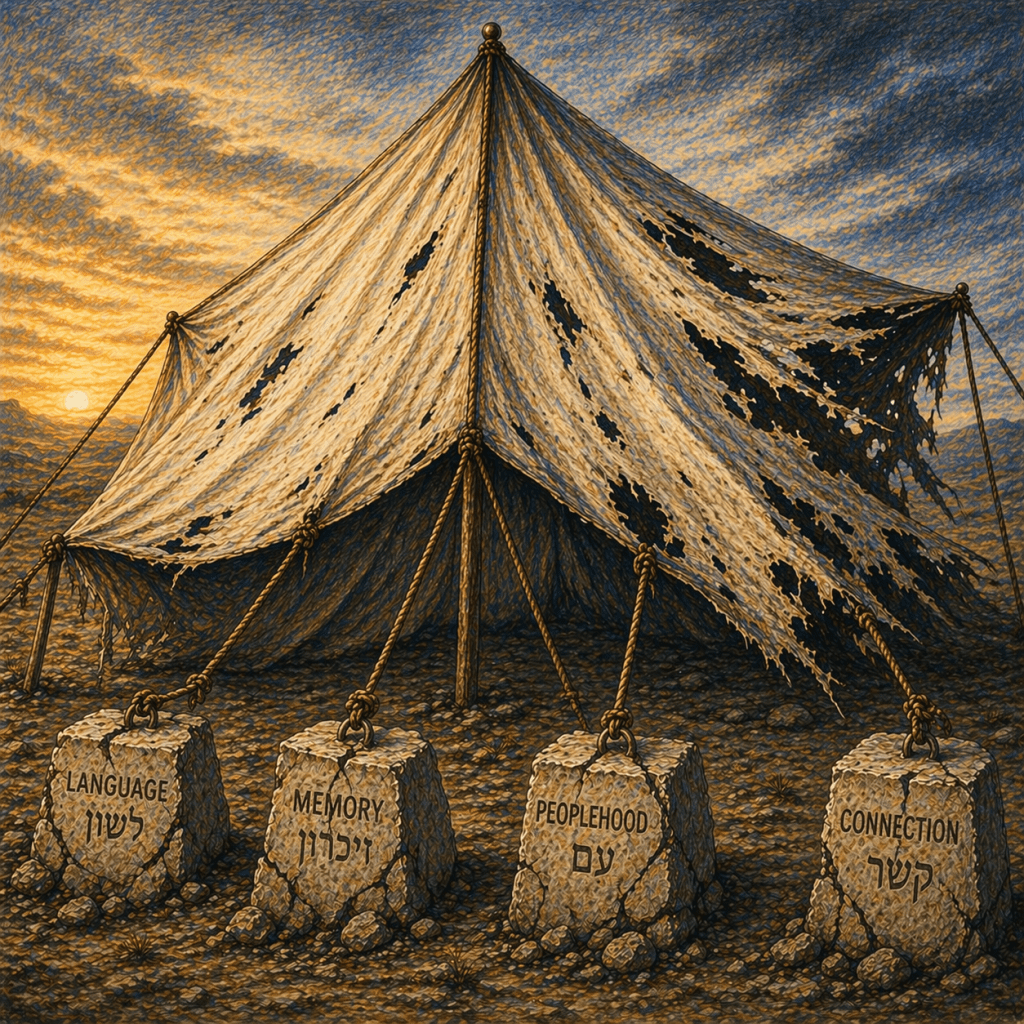
Israel is widely understood within Jewish life not only as a country, but as a realized vision that has existed for millennia. In a 2024 AJC resource called 5 Facts About the Jewish People’s Ancestral Connection to the Land of Israel they write:
“The establishment of the State of Israel in 1948 realized the long-held dream of a Jewish homeland, and it has since become the center of Jewish identity and culture for millions of Jews worldwide. Israel is seen as a place of refuge, a cultural renaissance, and a symbol of Jewish self-determination.”
The Risk of Losing History
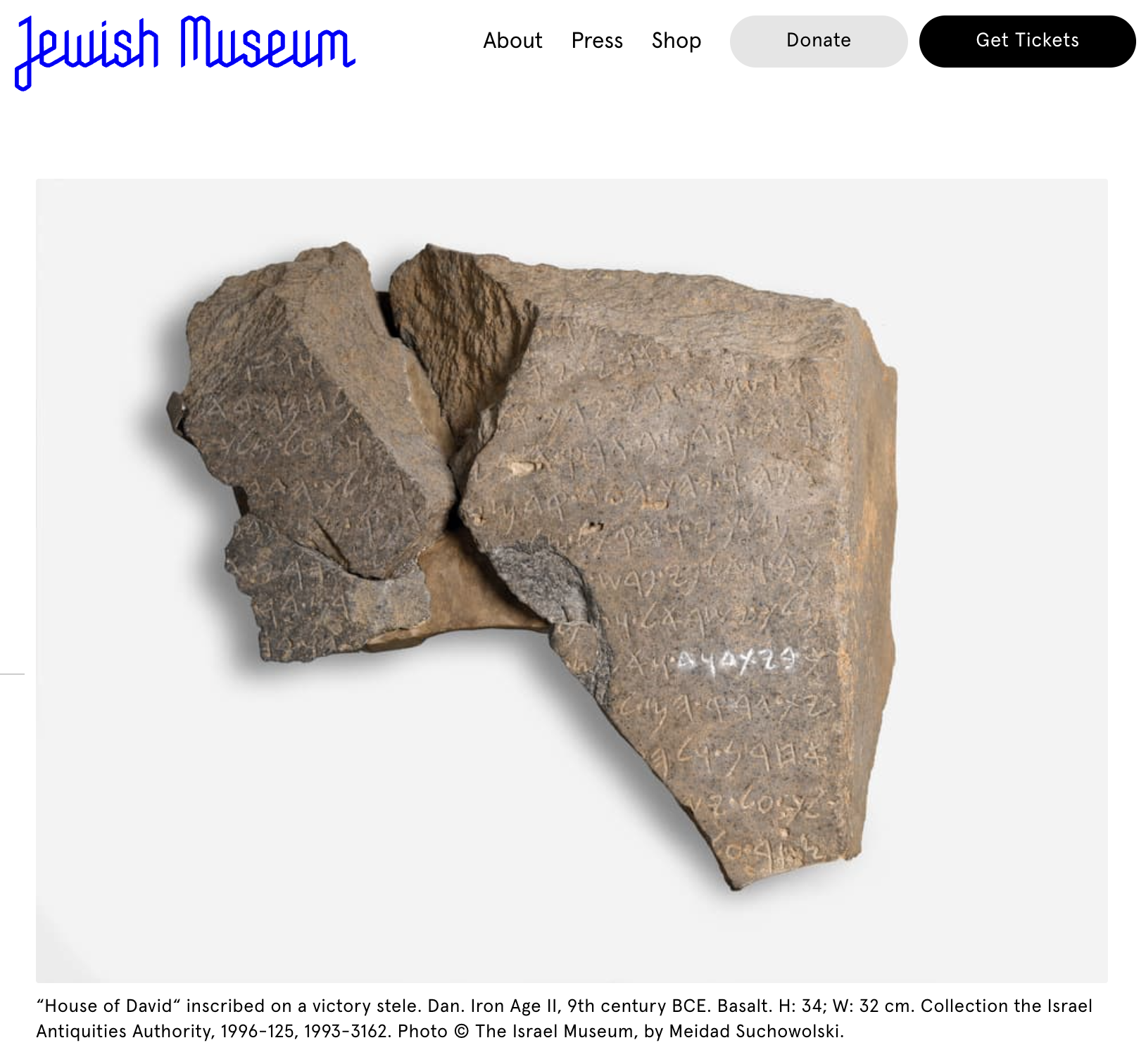
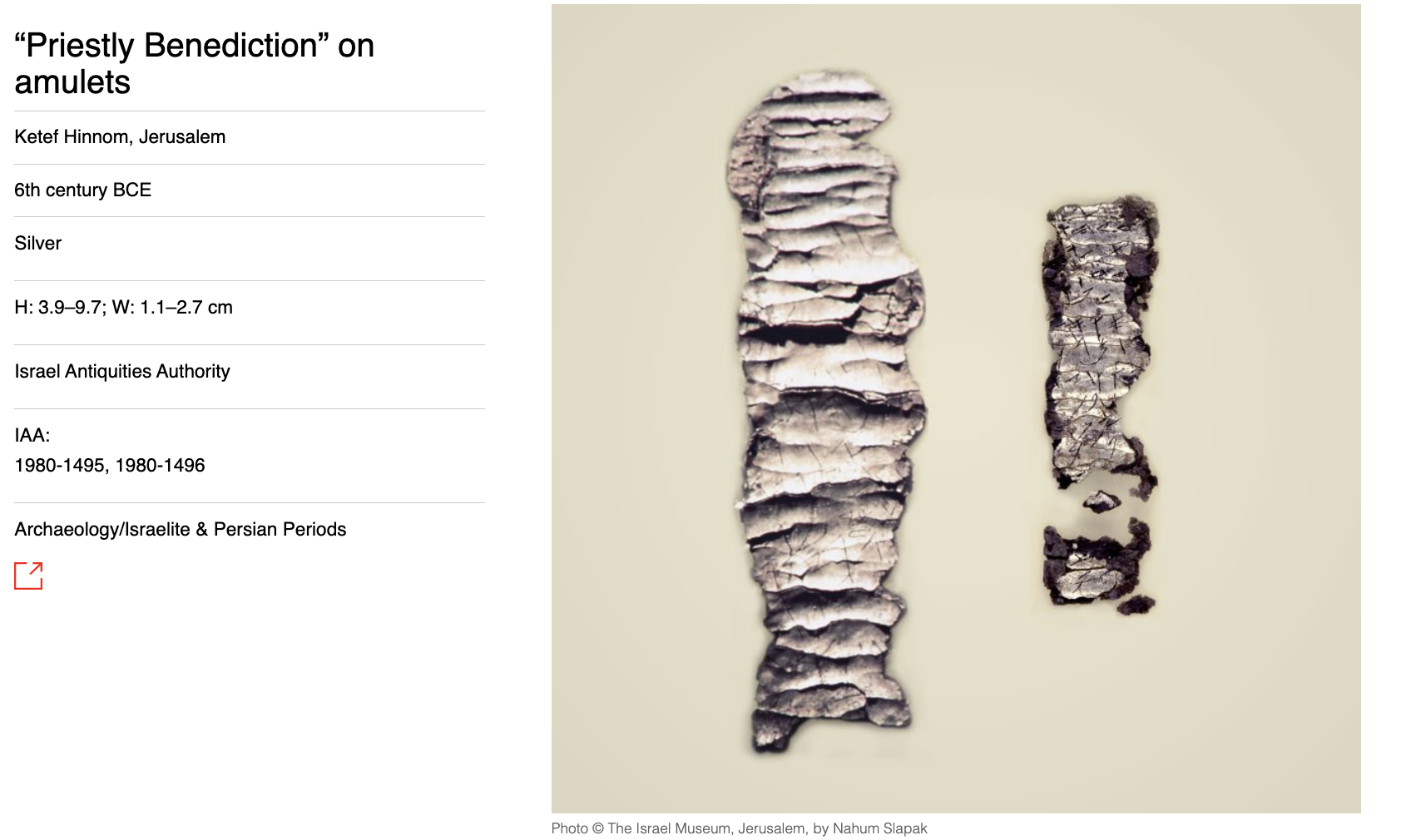
There is more at risk than physical human safety. Jewish connection to the land is not only textual, but it is also historical and physical as repeatedly proven with archaeological evidence . Major Jewish organizations, academic scholars, and rabbinic leadership point to both artifacts which affirm long-standing Jewish presence, such as these two pieces:
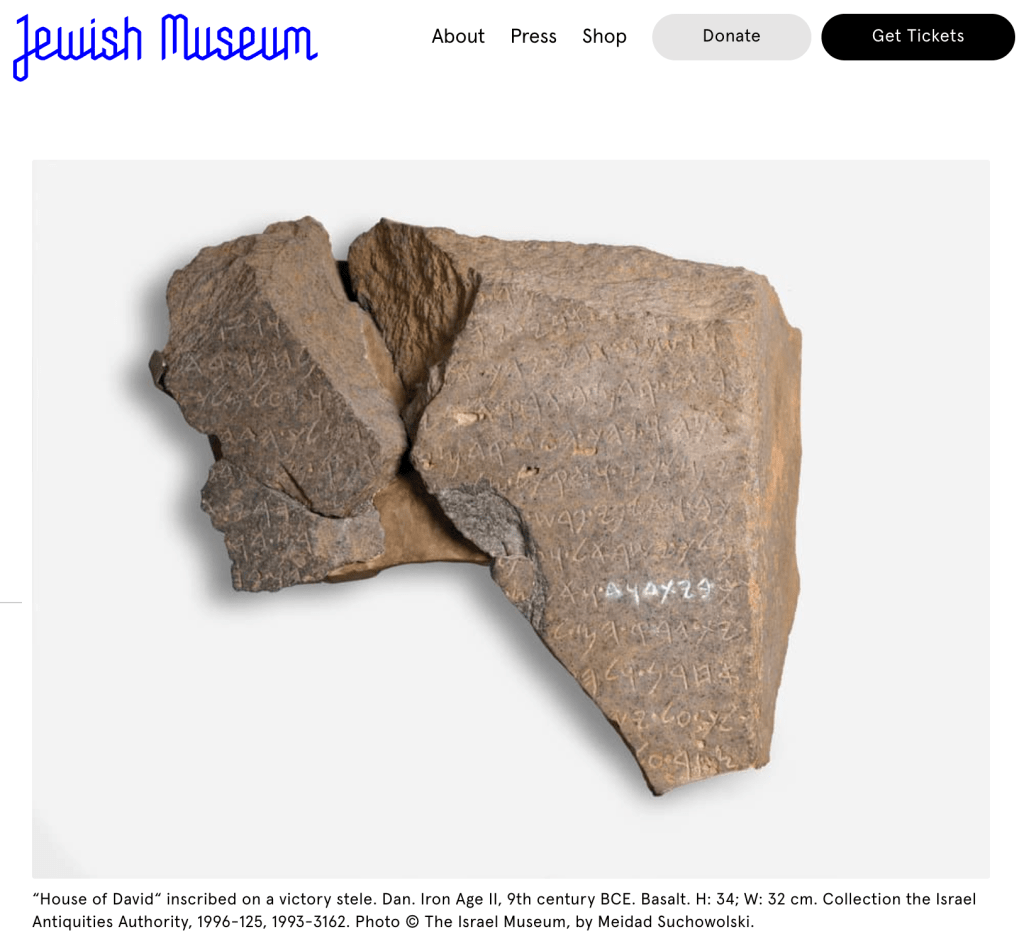
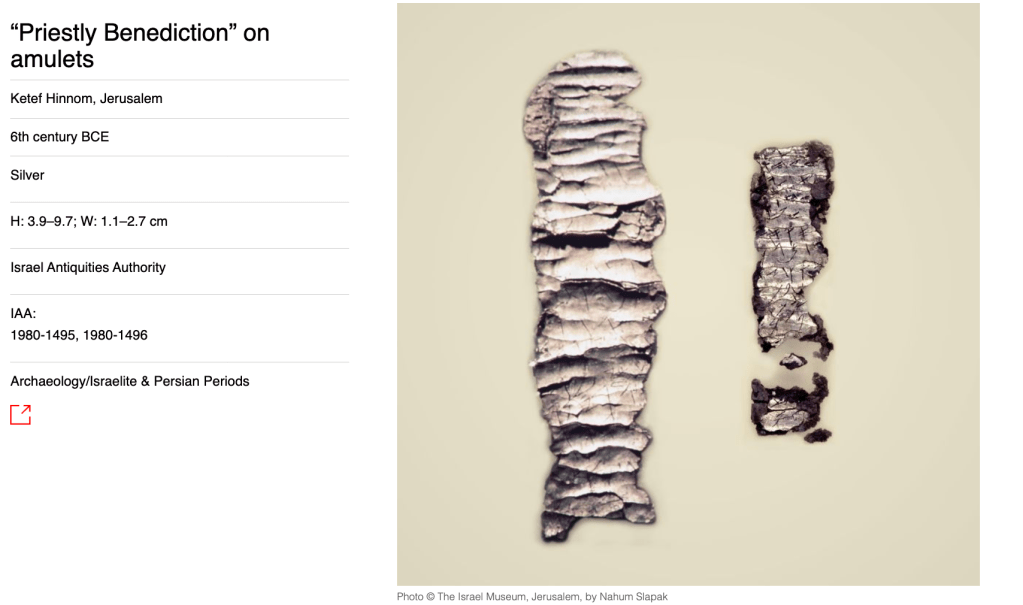
amulet image used with museum permission It is well known that Israeli society holds archaeological artifacts of supremely high importance. So much so, that no construction in Israel can be conducted — whether in a Jewish, Muslim, or Christian neighborhood — must be preceded by an archaeological survey. If significant remains of any period (Ottoman, Byzantine, Roman, etc.) are found, the state must document or preserve them. This work is supervised by the Israel Antiquities Authority (IAA). In an interview with IAA Head Archaeologist, Gideon Avni, he shares about the Salvage Excavation policies: “If you have antiquities on your property — whether you own a house or you are a municipality or the government — any discovered sites and artifacts are owned by the State of Israel, through the IAA, which is the governmental agency that has a duty to protect antiquities.”
It is not only Jewish archeological treasures that Israel protects. In the article, The Preservation and Exhibition of Christian Church Sites in Israel, Mayumi Okada writes, “it has not been discussed enough how non- Jewish sites, such as those of Christians, Muslims and other religious groups, have been treated from the standpoint of heritage management.”
If IRGC and their proxies should succeed in their goals of wiping out Israel (see Hezbollah Charter’s language: “entity is obliterated” and Hamas Charter “There is no solution for the Palestinian question except through Jihad”) the safekeeping of archeology is also at risk. Their lack of respect and concern for heritage sites and artifacts is well-documented.
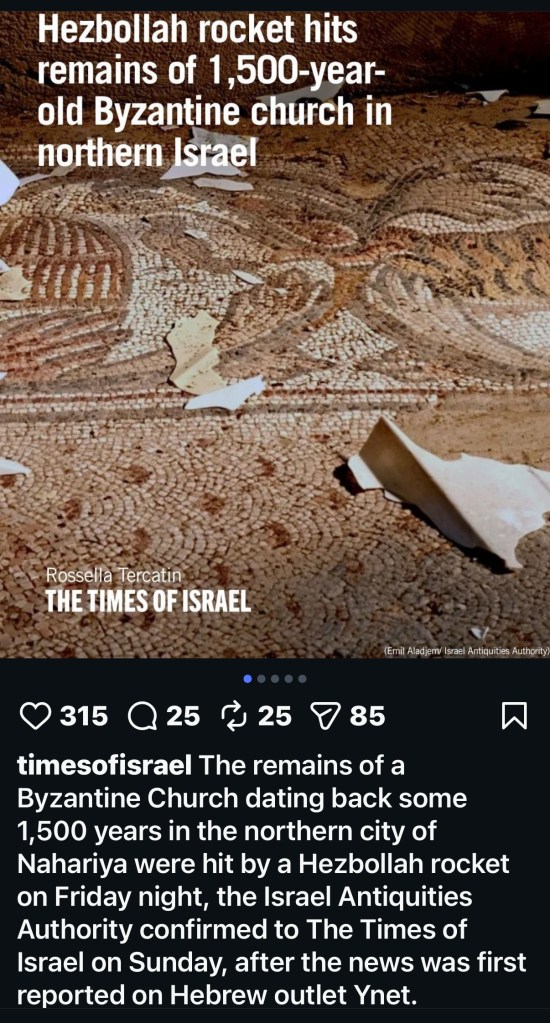
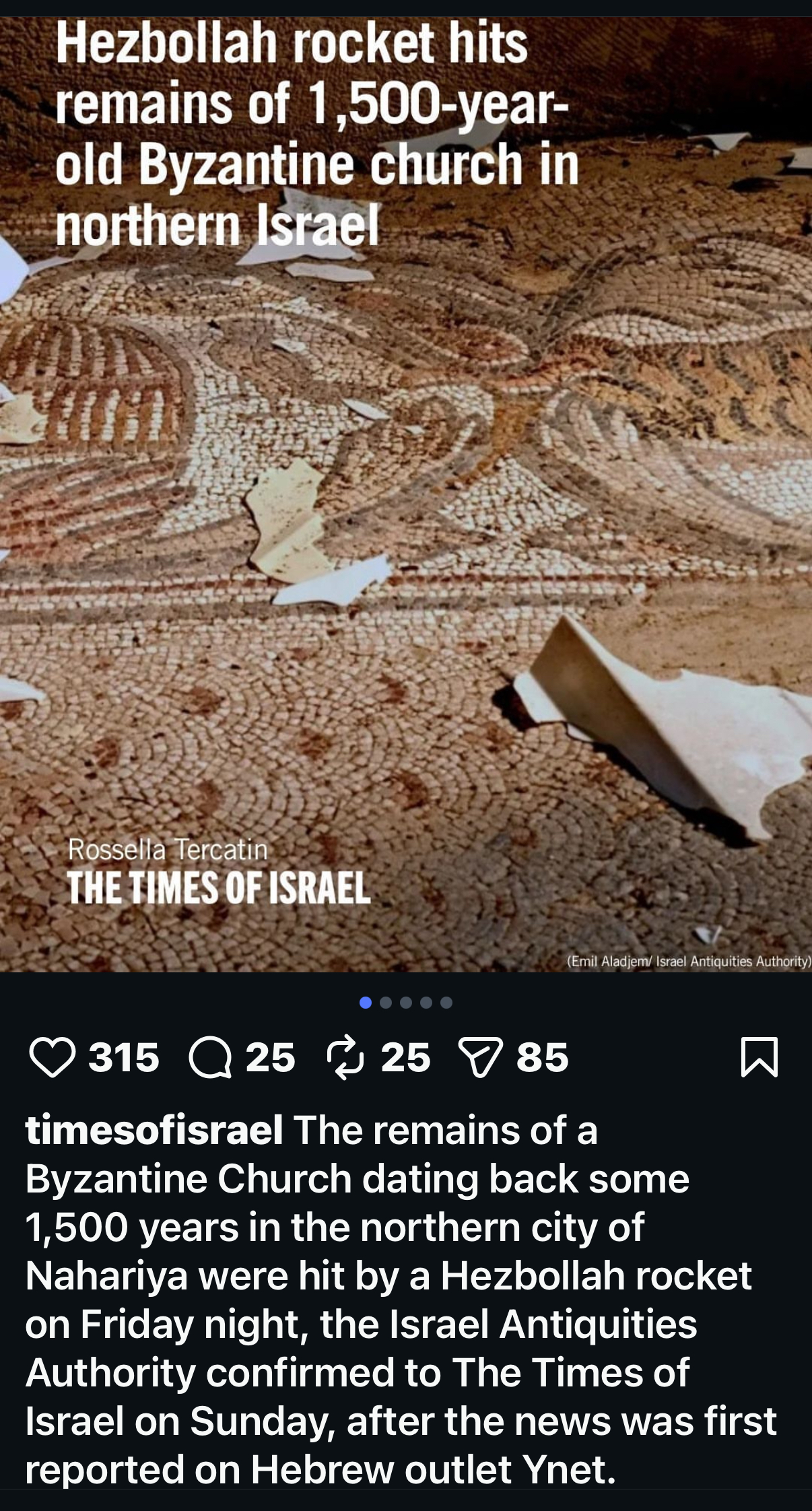
In April 2026, multiple news outlets reported that “the remains of a Byzantine Church dating back some 1,500 years in the northern city of Nahariya were hit by a Hezbollah rocket on Friday night, the Israel Antiquities Authority confirmed to The Times of Israel on Sunday, after the news was first reported on Hebrew outlet Ynet.
The rocket hit a modern structure inaugurated in 2022 to preserve an impressive mosaic floor spanning over 500 square meters (nearly 5,400 square feet) and make it accessible to the public.” (Times of Israel) Here are other examples over time of IRGC and proxy disregard for archeological sites:
- A major report by the Combating Terrorism Center (CTC) at West Point, titled “Digging In and Trafficking Out,“ identifies that Shia militias and proxies have been involved in the illicit antiquities trade. The report notes that “antiquities markets in Lebanon are flush with freshly looted artifacts” from Syria, often moving through Hezbollah-controlled areas like the Bekaa Valley.
- Similarly, in “Tearing the Historic Fabric: The Destruction of Yemen’s Cultural Heritage” (Published by the Antiquities Coalition in collaboration with the General Organization for the Preservation of Historic Cities of Yemen), the AC has documented how Houthi forces (an IRGC proxy) have used ancient sites, including the UNESCO World Heritage city of Sana’a, as military barracks or weapons depots, effectively turning “protected history into a legitimate military target.”
- In April 2013, one of the military wings of Hamas, seized 3,000 year old ruins to use as a training camp. The ruins, which were discovered in 1997 but never fully excavated due to the political instability and violence in the Gaza Strip, boast exquisite mosaics and ancient pillars. “It is devastating, very devastating to hear this site is under threat after all the efforts we made to have it recognised by Unesco,” said one Palestinian official based in the West Bank. “It makes us look bad, the Palestinians, that we cannot preserve our own sites.” In contrast, Muhammad Khela, a Deputy Minister of Tourism in the Gaza Strip, told the Al-Monitor news site that his ministry had agreed to the area being used to train militants. “We can’t stand as an obstacle in the way of Palestinian resistance…”
- In a May 2018 report to the UN, Ambassador Dr. Ahmed Awad Binmubarak, said, “Terrorists and extremists alike, also destroy cultural heritage sites for ideological or propaganda reasons, while looting and trafficking antiquities to finance additional brutalities. Yemen is especially vulnerable to this cultural racketeering. Organized criminals, armed insurgents, and violent groups are plundering our treasures and are smuggling them overseas. Let us combat this crime against civilization and work together for long-term solutions to protecting our cultural heritage and in a manner writ large.”
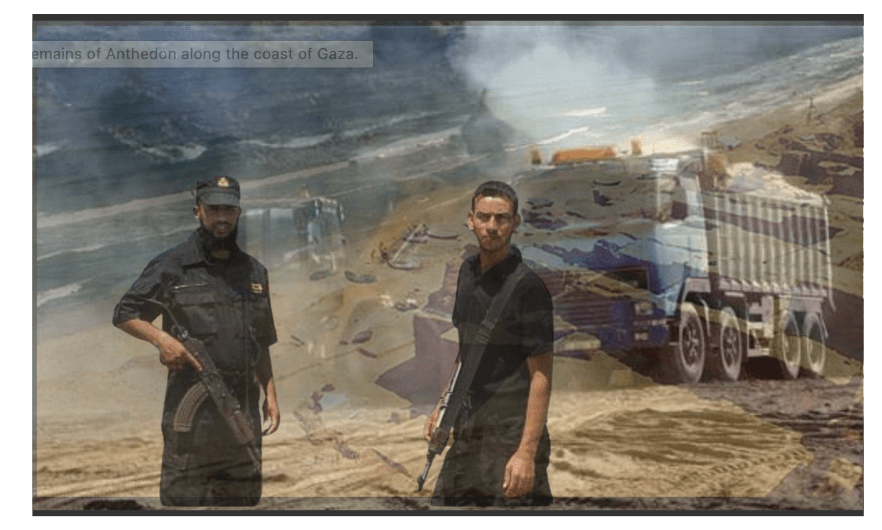
Three layered images from Hamas destruction of archeological sites
- In 2017, archeologists lamented the destruction Gaza’s earliest archaeological site — a rare 4,500-year-old Bronze Age settlement. “There is a clear destruction of a very important archaeological site,” said Palestinian archaeology and history professor Mouin Sadeq, who led three excavations at the site along with French archaeologist Pierre de Miroschedji after its accidental discovery in 1998. “I don’t know why the destruction of the site was approved.” The linked article asserts: “Hamas officials say they have no choice but to develop the area, making archaeology a low priority.”
space
The Risk of Losing Safety
This Law of Return, as mentioned above, codifies the Zionist principle that Israel serves as a refuge and national home for all Jews globally.
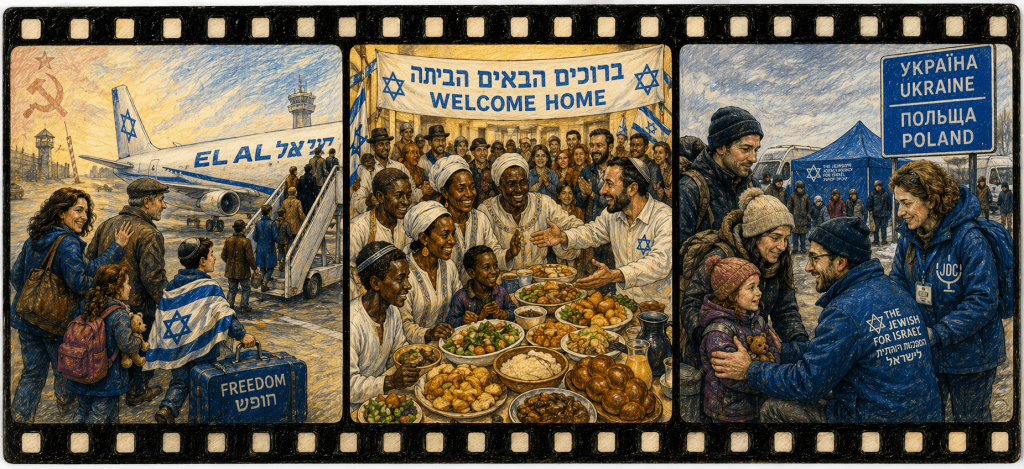
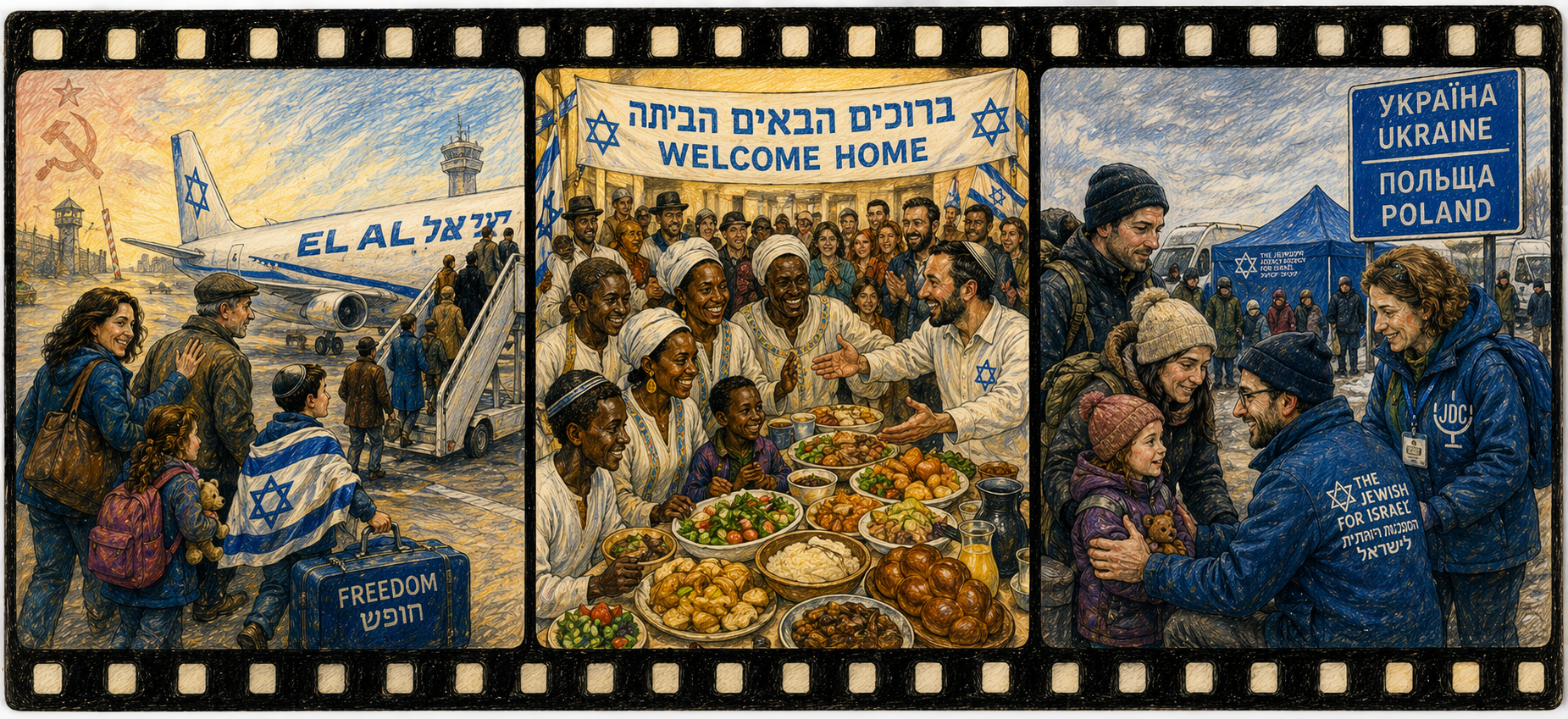
The reality that we need a place of refuge is one we cannot ignore. For most of Jewish history, Jews did not control the conditions of their own safety. The existence of a sovereign Jewish state has changed that. Medinat Yisrael is structured to protect:
- Jews being persecuted elsewhere [i.e. Soviet Jewry]
- Jews in danger of outside threats in the diaspora [i.e. Ethiopia and Ukraine]
- Jewish history via archaeological preservation
(see below for more detailed information on this issue)
In her book, As a Jew: Reclaiming Our Story from Those Who Blame, Shame, and Try to Erase Us, Sarah Hurwitz writes, “… while they offered detailed analyses of Israel’s flaws, some of which I agreed with, I was struck by how uninterested they seemed in thinking through the details of what would happen if Jews were stripped of power in Israel. They never provided a convincing answer to the obvious question of how, exactly, Jews without a state of their own would be safe in a part of the world where so many people wish to annihilate them.”
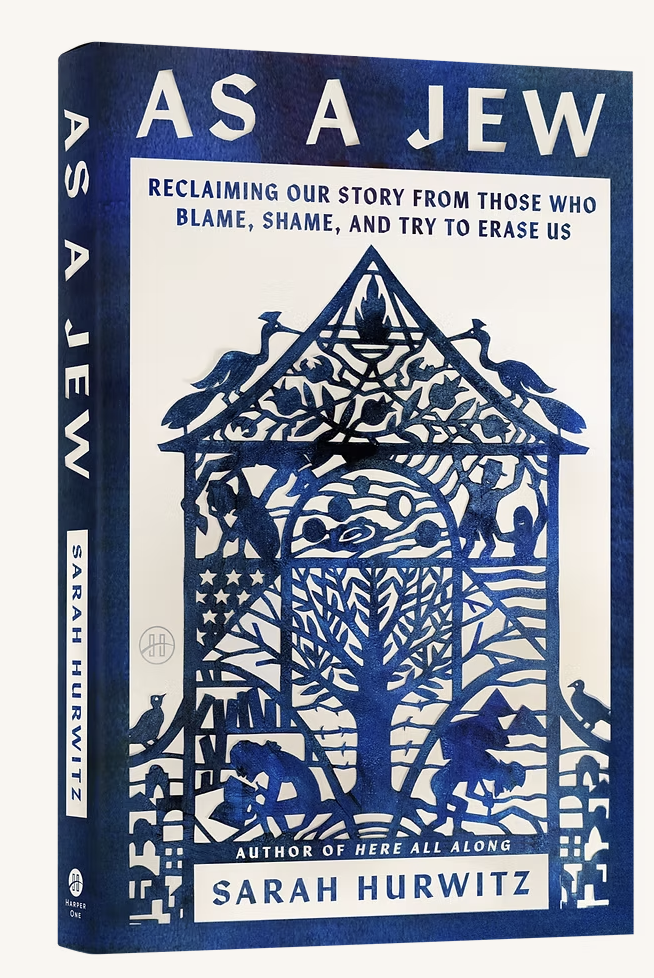
She also asserts, “When Jews lack a state of their own and have nowhere to go when persecuted, millions of them can be murdered by their fellow citizens while hundreds of millions of people worldwide do nothing to help.”
So while a Jew can live fully in the diaspora, and feel ambivalent about Israel, even strongly critiquing the policies of the State of Israel and still sit within the tent, we have a different challenge when the relationship itself is rejected. Not wrestled with. Not critiqued. But replaced or simply eliminated.
There is also a broader context that cannot be ignored.
In policy and security discussions, Israel is not only understood as a national home, but as part of a wider system of regional stability. U.S. congressional testimony notes that Israel’s efforts to constrain Iranian activity and counter proxy networks help advance shared security interests and limit the spread of destabilizing forces. The report says, “today the threats to Israel’s existence come from a broad array of forces with a diverse set of weapons — conventional and unconventional, symmetrical and asymmetrical — that are largely aimed at Israel’s civilian population. It is in America’s vital interest for Israel — our sole reliable democratic ally in the region — to have the military capabilities it needs to decisively defeat these enemies.”
Israel operates within a broader regional system in which states and alliances respond to shared security challenges. Within that system, it plays a role in constraining Iranian regional expansion, disrupting proxy networks such as Hezbollah and Hamas, and contributing to deterrence across an increasingly unstable landscape.
Analysts have documented how Iran relies on proxy forces to project power and destabilize the region, and how regional actors, including Israel, work to counter and contain those efforts. (See, for example, the Center for Strategic and International Studies on Iran’s proxy networks, the Washington Institute for Near East Policy on Israel’s “campaign between wars,” and Brookings on Iran’s regional proxy strategy.) This framing does not position Israel as acting alone, but as part of a wider system that shapes regional balance and the capacity to respond to destabilizing forces.
Taken together, these dynamics do not position Israel as acting alone, but as part of a wider system in which the containment of destabilizing forces has implications beyond the immediate region. When Iranian influence expands through proxy networks, its effects are not confined to a single border. And when that expansion is constrained, the resulting stability is likewise not confined to a single state.
This is not a claim that Israel “protects the world” in simple terms. It is a recognition that its role within this system shapes what becomes more or less possible, not only in its immediate surroundings, but across a broader network of allied societies.
It is that Israel exists within a system where its presence affects: regional balance, the projection of power by actors such as Iran, and the capacity of allied societies to respond to shared threats. Remove that structure, and the system does not remain neutral. It shifts. A very dangerous shift.
Misrepresentation in a Second Domain
This brings me back to misrepresentation.
When a Jew presents a Jesus-centered belief as fully compatible with Judaism, it reshapes how Judaism is understood. I believe something similar happens when Jewish connection to Eretz Yisrael is denied while still being presented as fully within Judaism.
That claim communicates that:
- the land is optional
- the relationship is interchangeable
- Jewish peoplehood can be detached from its historical center
Over time, that reshapes both internal identity and external perception.
The issue is not disagreement. It is recasting the framework. It is, in its own way, another kind of hole in the tent.
Patching the Holes
Judaism can hold: argument about HOW Medinat Yisrael was established. It can hold significant critique of the current government, the handling of the war with Hamas, the treatment of Palestinians in the disputed West Bank, the ongoing systemic microaggressions and oppressions of non-Jewish Israelis. It can hold a lot of “what ifs” (see my recent blog on this). It can hold people at the edges. But it cannot hold everything without losing its shape. There is a difference between:
- distance and disconnection
- struggle and substitution
- critique and elimination or replacement
- nuance and binaries
- fact and misinformation/exaggeration
(again, reminder to see the sidebar at the bottom)
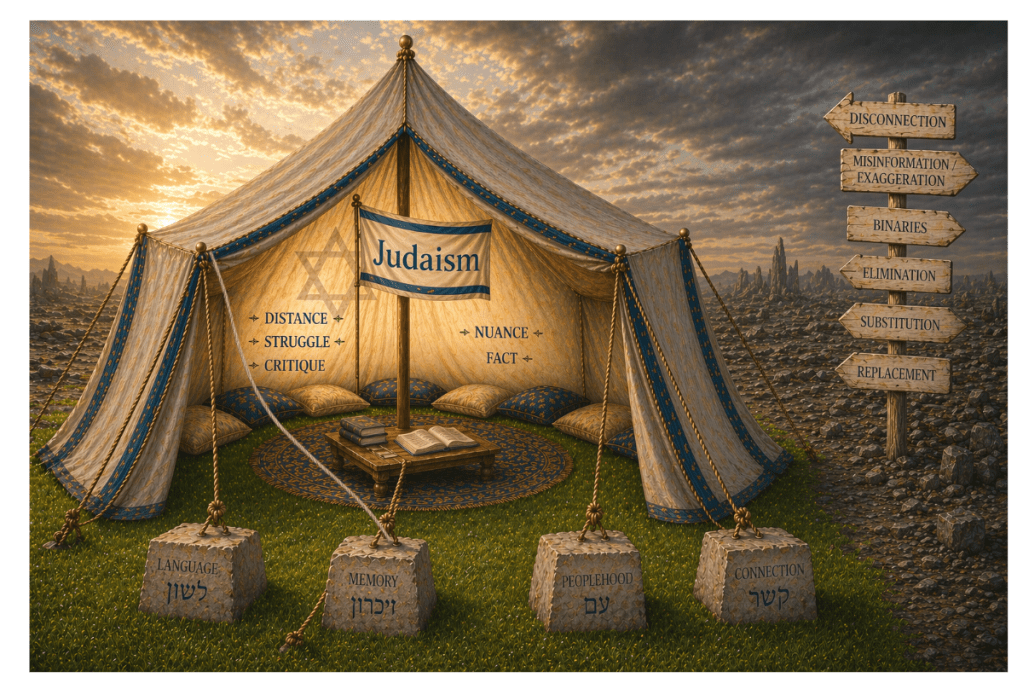
We have been willing to clearly name that difference and boundary in the domain of messianism. I am asking why we are so reluctant to name it in another.
Berger’s work and his book propose “a strategy to protect authentic Judaism from this assault” and in many ways, I am writing this as a way to advocate for the same as it relates to protecting authentic Judaism and the future of Jewish life as we know it from this internal assault of anti-Zionism.
When the storm comes, no one chooses the umbrella. We choose the structure with walls. Because without boundaries, there is no shelter.
And a tent does not fail all at once. It fails when the holes go unpatched.
spacer
spacer
Sidebar on Terminology:
Genocide, Ethnic Cleansing, Colonialism, and ApartheidTerms like genocide, ethnic cleansing, colonialism, and apartheid are not casual descriptors. They are legal and historical categories with specific meanings. When used imprecisely, they shift from analytic tools to rhetorical propaganda claims.
Under International Criminal Court (ICC), the crime of genocide is characterized by the specific intent to destroy in whole or in part a national, ethnic, racial or religious group by killing its members or by other means: causing serious bodily or mental harm to members of the group; deliberately inflicting on the group conditions of life calculated to bring about its physical destruction in whole or in part; imposing measures intended to prevent births within the group; or forcibly transferring children of the group to another group. That threshold is historically and legally specific and has NOT been met despite allegations.
Ethnic cleansing generally refers to the systematic removal of a population from a territory. It is not synonymous with war, displacement during conflict, or humanitarian crisis, even when those realities are severe and heartbreaking. Much blame has been placed on Israel for the human suffering in Gaza, however groups like the Center for Strategic and International Studies (CSIS), a non-partisan think tank that focuses on the logistics of humanitarianism in war zones, often address the “dual-threat” to aid: the external (Israeli military checkpoints, closure of crossings like Zikim for security) and the internal (Hamas’s interference, the collapse of civil order, and the emergence of gangs/militias that loot convoys).
Colonialism, in its classical form, describes a foreign power extracting resources from a distant land while maintaining control from a metropole. Zionism, whether one supports or critiques it, does not map cleanly onto that model, given its grounding in an indigenous historical and cultural connection to the land alongside modern political developments. Territorial changes that occur through war (however contested) are analytically distinct from systems built on external imperial extraction. Likewise, movements grounded in a people’s historical connection to a land, including return after exile or displacement, do not fit neatly within classical colonial frameworks. Treating these categories as interchangeable obscures more than it clarifies.
Apartheid, in international law, refers to a system of institutionalized racial segregation and domination. There are ongoing debates about whether specific policies in the disputed West Bank meet elements of that definition. Applying the term to all of Israel without distinction collapses materially different legal and political contexts. Within Israel’s primary borders, non-Jewish have equal rights and they hold signifiant positions within government.
Critique of Israel is both valid and necessary. But critique depends on precision. When language disregards definition, context, or scale, it does not sharpen understanding. It distorts it. -
What If(s)
From 1947 to Today:
Reimagining Responsibility and RepairI have spent the last few years obsessing over a series of historical pivots that are significant moments where, had the path veered even slightly, the absolute anguish and adversity of the last 70 years might never have ignited. I offer these not as definitive answers, but almost as a rhetorical framework for anyone willing to look past the modern binary of Jews vs Arabs or Israelis vs Palestinians and examine the origins of responsibility for the dignity and freedoms of those that identify as Palestinian, and for security of Israelis, and the stability of the greater SWANA region. [Note: I had not heard of the region being called anything except Middle East until the last year so if you haven’t either, SWANA stands for South West Asia and North Africa]. I am also openly admitting these are just a few of the pivotal moments to examine, however, these are the ones that keep me up at night. They aren’t just about local actors; they are about a global failure of governance.
The Abandoned Transition (1947–1948)
- The Rejection of the Map: What if, in 1947, the Arab Higher Committee and neighboring Arab states had accepted the UN Partition Plan? Could a peaceful, economic union have flourished where two peoples shared a land?
- The Great Abdication: What if, as the Mandate was expiring, Britain and the UN hadn’t “washed their hands” of the situation? The British military in the territory focused solely on their own exit strategy, while the UN drew a map but refused to authorize a single soldier to defend it. They created a legal revolution and then left a power vacuum in its wake.
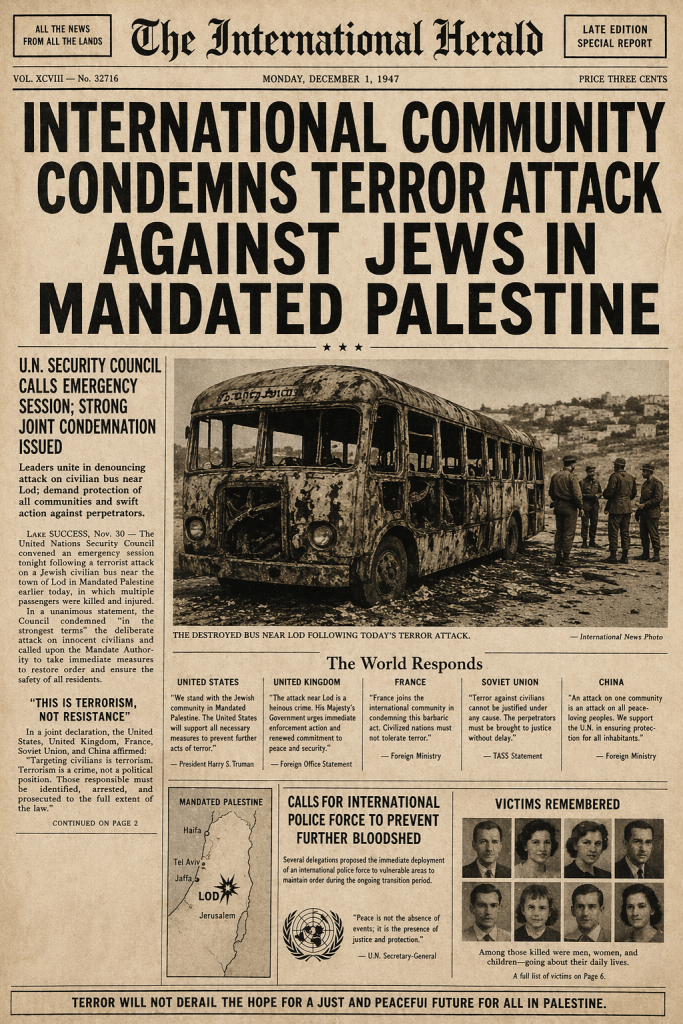
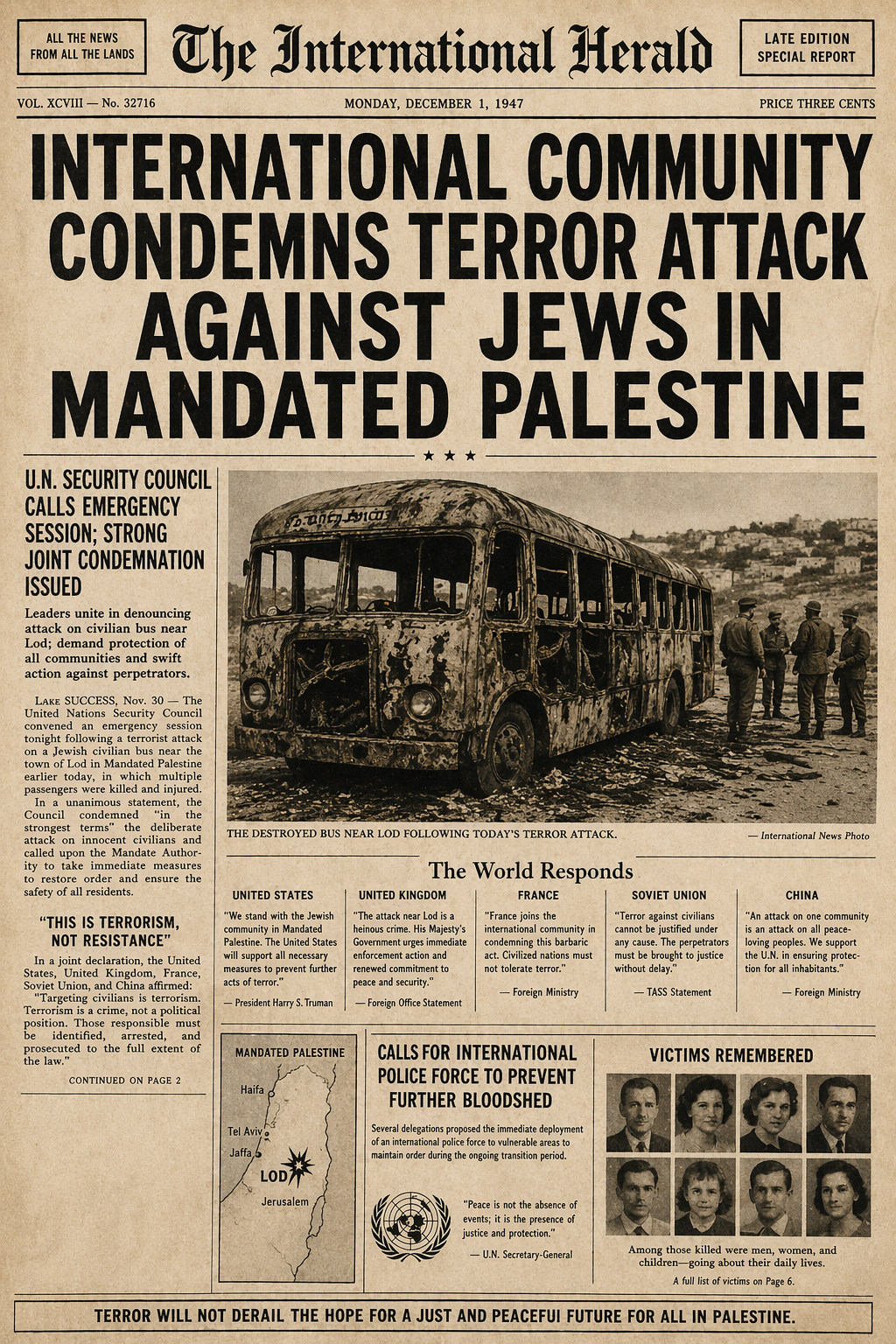
- The Spark of the Civil War: What if the bus ambush by Arab militants on November 30, 1947, near Lod hadn’t happened? Or, more importantly, what if the international community had responded to that first drop of blood not as “inevitable war,” but as a criminal act of terrorism? If the response had been swift, significant, and handled by an international police force, and condemned internationally, would the “internal” war have ever spiraled out of control?
- The Stranded Pilgrims: What if Britain hadn’t blocked the “Commission of Five” (the Five Lonely Pilgrims) from entering the territory to oversee the transition? If these UN representatives had been on the ground in January 1948, would the systematic displacement of Palestinians ever have happened under the eyes of the world?
- The Burden of Leadership: What if Ben-Gurion had been able to maintain a different kind of control, preventing the escalation into an all-out communal war before the state was even born?
- The External Intervention: What if, instead of five Arab nations—Egypt, Syria, TransJordan, Iraq, and Saudi Arabia—launching an invasion on May 15, 1948, they had channeled that energy into a diplomatic “Marshall Plan” for the region?
Redefining the “Catastrophe”
While the Palestinian community refers to the displacement of 700,000+ people as the Nakba (Catastrophe), and some extend that term to the very founding of Israel itself, my perspective has shifted.
For me, the founding of Israel isn’t the catastrophe. The catastrophe was the ill-managed disaster of the transition. The disaster we continue to see today is the ripple effect of the UK and the UN’s original negligence. They provided the birth certificate for the State of Israel, but they abandoned the infant in the cradle.
Restorative Practice and Restorative Justice
Restorative Practice is an umbrella term used for strategies that help us to proactively build community and relationships and manage conflict and tensions in ways that treat humans with dignity and respect. It is the transition to “What Now.” Restorative Justice aims to manage conflict and tensions by repairing harm and restoring relationships. Restorative Justice holds offenders accountable for their crimes
Restorative Justice:
Ownership for the Failed TransitionThe “Nuremberg Trials” of Diplomacy: A Strategy for Truth
If we are to move from managing this conflict to actually resolving it, we have to move toward an interrogation of its origins. This isn’t just a job for historians; it’s a job for the world’s conscience. As an educator, I know that for a narrative to truly stick, it cannot be a dry line in a textbook. It needs the weight of human testimony. We need a “Living Archive“ of the 1948 transition.
1. The “Confessional” Documentary: Witnessing the Abandonment
The first “win” would be a global media event which would be a project on the scale of the Shoah Foundation, but focused on the Mandate Transition. We are in a race against time to record the few remaining voices: British soldiers, UN junior staffers, and local residents who lived through that winter of 1947–48.
Imagine the impact of a 98-year-old former British officer admitting on camera: “We had orders to stand down while the buses were being shot at.” Or a retired UN clerk confessing: “We knew the Commission was a ghost mission, but we sent them anyway.” These aren’t just stories; they are the “smoking guns” that break the modern binary. They prove that the chaos of 1948 wasn’t an accident but rather a policy of abandonment.
2. “Ownership vs. Blame”: The Messaging Campaign
This is not about “attacking” the UK or the UN. It is about liberating the current generation from the “Jew hate” and “Arab hate” that the 1948 failure fueled. We need an international campaign — perhaps under the banner of “Reparations for The Abandoned Mandate” — to shift the narrative.
When the “authority” (the UK/UN) finally admits fault, it changes the internal logic for the “Everyday Joe.” It becomes much harder to use Israel as a convenient scapegoat for personal biases when the global community acknowledges: “We drew the lines, we promised the peace, and we walked away. The blood since then is our debt to pay.” This complicates the story in a way that demands thought rather than anger.
3. Financial Reparations: The Settlement of the Original Debt
While we can never truly compensate for the loss of life, restorative justice requires a tangible acknowledgment of the material and systemic damage caused by the 1948 abandonment. If the international community admits it provided the “birth certificate” but abandoned the “cradle,” the UN and Britain must lead a sovereign settlement to address the resulting financial toll.
- Palestinian Property Loss: The UN and UK should establish an international fund to compensate Palestinian families for property and land lost during the 1948 transition. This is not a concession by local parties, but a reparation by the powers that failed to oversee a peaceful transfer of assets, providing the capital necessary for families to move from refugee status to permanent economic stability.
- The Israeli Security Debt: A reparation payment should be made to the State of Israel to acknowledge the staggering financial and social burden of defending a map the world drew and then deserted. This settles the “security debt” incurred by seventy-five years of having to function as a country consumed by military realities which diverted resources that would have been spent on regional innovation had the promised international guardrails been enforced.
The “What Ifs” of Gaza and the West Bank
and the Path Not TakenIf we accept that the international community failed the “cradle” in 1948, we must then examine the pivots that followed. Israel survived major attacks in 1948, 1967, and 1973. While holding territory gained during a defensive war is a recognized reality of international history, just because a nation has the right to hold land for security does not mean the way it is managed reflects its highest values.
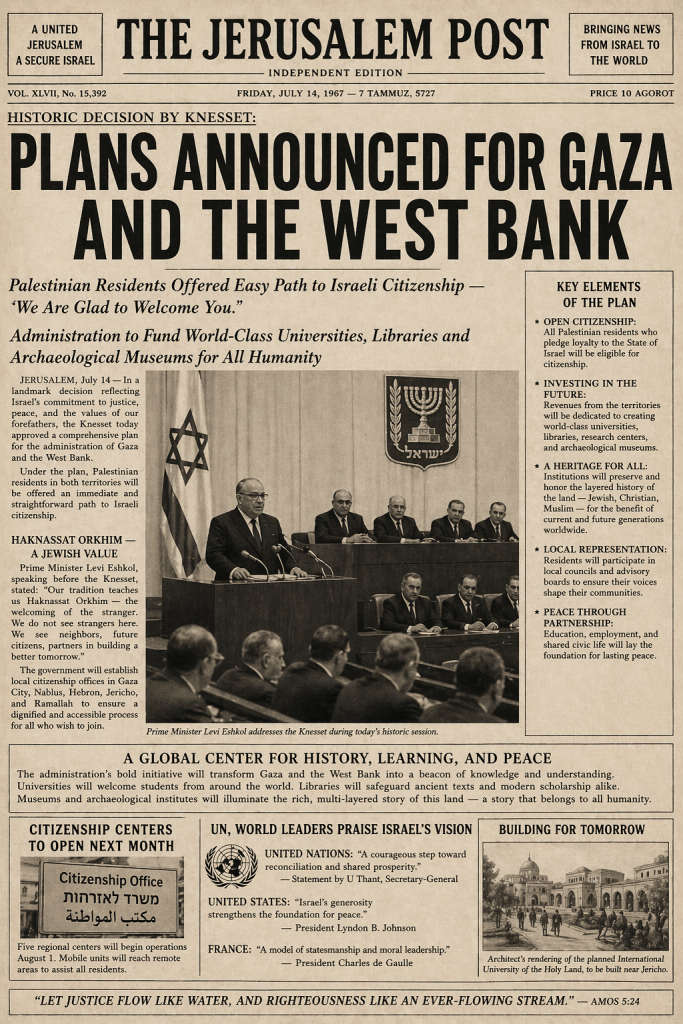
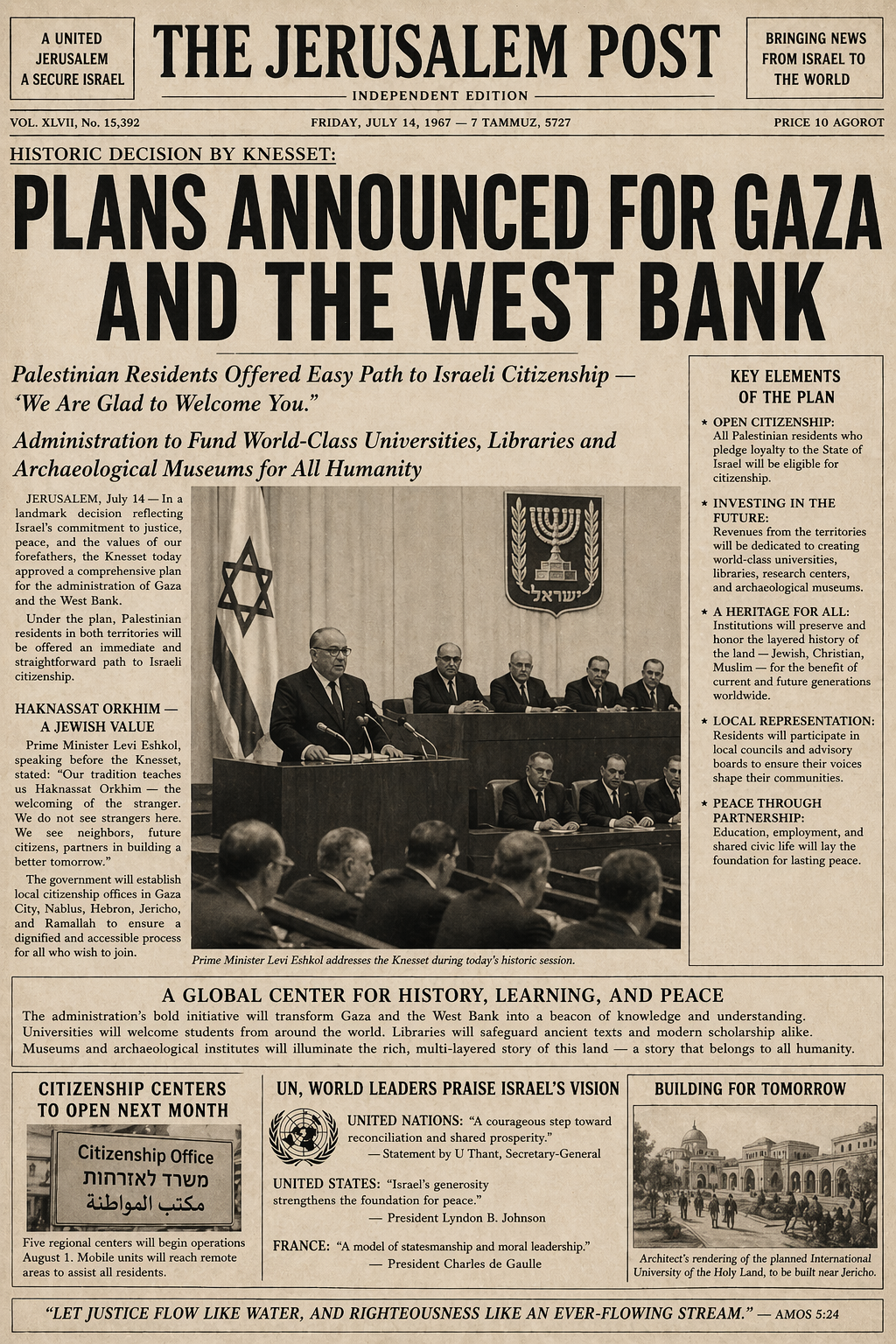
- The Intellectual Landscape: What if Israel, instead of aiming to settle Jewish communities there, had used its administration of the West Bank and Gaza to fund world-class universities, libraries, and archaeological museums? Imagine if these territories had been established as the global center for preserving the multi-layered history of the land, acknowledging both the Jewish indigenous heritage and the deep roots of Palestinian residents.
- The Global Hub of Healing: What if these territories had become the international base for conflict resolution and refugee absorption? Imagine Gaza as a “Switzerland” with an internationally recognized campus for conflict resolution and the West Bank as a global sanctuary, absorbing not just Jewish refugees from Ethiopia or Russia, but those displaced from Sudan and Eritrea and other war-torn and poverty stricken lands. This would have turned the “refugee” narrative into a shared mission of global restoration.
- Dignity through Infrastructure: What if Jewish connection to the land had been facilitated through integrated coexistence cities? Instead of isolated outposts, offering for sale property to anyone regardless of faith and ancestry and then establishing high-end infrastructure such as environmentally sustainable shared power, water, and transport throughout all of the towns, elevating the daily environment for everyone.
- The Integration Model: What if Palestinian residents in both Gaza and the West Bank had been offered a path to Israeli citizenship early on, mirroring the 21% of Israeli citizens who are Arabs today? [Read accurate history of citizenship paths and realities here and here and here.]
- The Failed Handshake: What if Yasser Arafat had said “Yes” at the Camp David Accords in 2000? What if the leadership in these territories had abandoned “Pay for Slay” and instead invested that capital into building a transparent, peaceful civil society?
- The Ethical Guardrail: What if Israel had strictly avoided the use of eminent domain to demolish homes in the disputed West Bank and never engaged in “punitive home demolitions”? This would have ensured that the response to terror remained focused on the individual perpetrator rather than the entire family or community.
Restorative Justice:
A different relationship with the disputed territories1. Scaling Grassroots Coexistence
We no longer have to wonder if coexistence is possible because groups are doing it today despite the turmoil of the region. [Note my blog from June 2025 highlighting a number of organizations doing critical co-existence work]. Some examples include:
- Roots-Shorashim-Judur: The Israeli government officially adopts and implements the work of groups like Roots, which fosters a local, human-to-human connection between Israelis and Palestinians in the West Bank, and embeds it throughout Israeli society.
- The Givat Haviva Model: We must take the model of Givat Haviva (the oldest center for a shared society) and scale it so that shared campuses and joint leadership are the standard, not the exception.
2. The Classroom of Truth
To ensure the next generation of residents has accurate history and context, there must be implementation of an international “Classroom of Truth.” Education in Gaza and the West Bank must be arbitrated by a trusted, neutral broker (clearly not Israel nor the UN) that removes incitement and misinformation and replaces it with a curriculum of mutual belonging and historical authenticity. [Note: for more about the current issues in the curriculum, see here and here.]
3. Elevating the Resident
There must be a massive investment in the dignity of the people living in these territories. This means ending the “Blind Eye” toward systemic issues and ensuring that the high-end infrastructure and civil rights enjoyed in the rest of the region are extended to every resident. It is the move from “managing a population” to “elevating a community.” The current government must harshly punish the violence that extremist settlers perpetrate on Palestinians and their lands and must reverse the recent unbalanced death penalty ruling.
The “What Ifs” of the current UN, NATO, and the Global Double Standard
If the first “What If” was about the abandonment of the cradle in 1948, the final “What If” is about the abuse of the child. We have to look at the role the United Nations and NATO have played in institutionalizing the conflict rather than resolving it.
- The Standard of One: What if the UN had never shifted to holding Israel to a different standard than any other sovereign nation? What if the “birth certificate” given in 1947 had come with the same protections and diplomatic norms afforded to every other state born in that era?
- The Ignored Warnings: What if the UN had actually listened to Hillel Neuer and UN Watch years ago? Imagine if the documented evidence of Hamas stealing aid, building tunnels, using human shields, militarizing schools, and the systemic corruption within UNRWA had been treated as an urgent crisis of integrity instead of being swept under the rug.
- The Bias of the Arbiter: What if the international community had remained a trusted arbiter instead of becoming a biased actor in the media and messaging landscape?
- The Influence of Proxies: What if UN peacekeeping forces were reliable and never (allegedly) compromised by the influence or payroll of IRGC proxies? Imagine a neutral, effective force that actually held the lines it was assigned to protect.
- The Hypocrisy of Defense: What if the UN didn’t attempt to tie Israel’s hands from defense as rockets from Hamas and Hezbollah continued to rain down?
- The Regional Threat: What if NATO and the UN had dealt with the IRGC as a collective global threat from the beginning, rather than leaving the burden of containment almost exclusively to the United States and Israel?
Restorative Justice:
A Reformation of Global GovernanceRestorative justice at the international level is perhaps the hardest to envision because it requires the UN (as we know it) to acknowledge its own neglect in its current form. It requires a “Nuremberg of Diplomacy” to clear the path for a new generation.
1. Expanding The Living Archive: Adding Global Leader Testimonies
Once again, restorative justice begins with expanding the “Living Archive.” We need recorded testimonies from within the halls of the UN and NATO, especially from those who are willing to admit to the systemic bias, the ignoring of Neuer’s warnings, and the application of double standards. This is the evidence required to move from the status quo to an authentic ownership and reckoning.
2. The Pedagogy of Accountability: A “German Model” for 1948
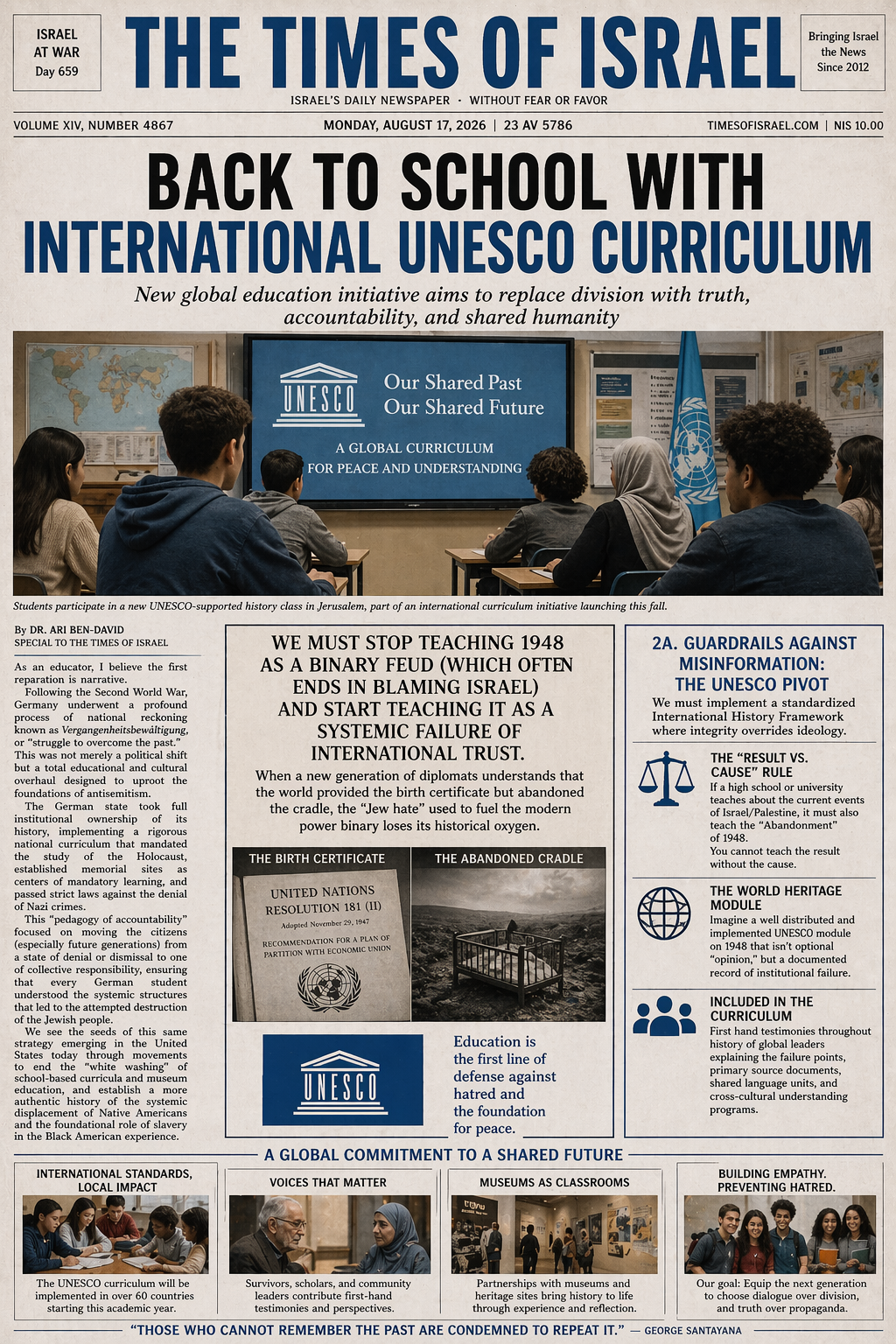
As an educator, I believe the first reparation is narrative. Following the Second World War, Germany underwent a profound process of national reckoning known as Vergangenheitsbewältigung, or “struggle to overcome the past.” This was not merely a political shift but a total educational and cultural overhaul designed to uproot the foundations of antisemitism. The German state took full institutional ownership of its history, implementing a rigorous national curriculum that mandated the study of the Holocaust, established memorial sites as centers of mandatory learning, and passed strict laws against the denial of Nazi crimes. This “pedagogy of accountability” focused on moving the citizens (especially future generations) from a state of denial or dismissal to one of collective responsibility, ensuring that every German student understood the systemic structures that led to the attempted destruction of the Jewish people. We see the seeds of this same strategy emerging in the United States today through movements to end the “white washing” of school-based curricula and museum education, and establish a more authentic history of the systemic displacement of Native Americans and the foundational role of slavery in the Black American experience.
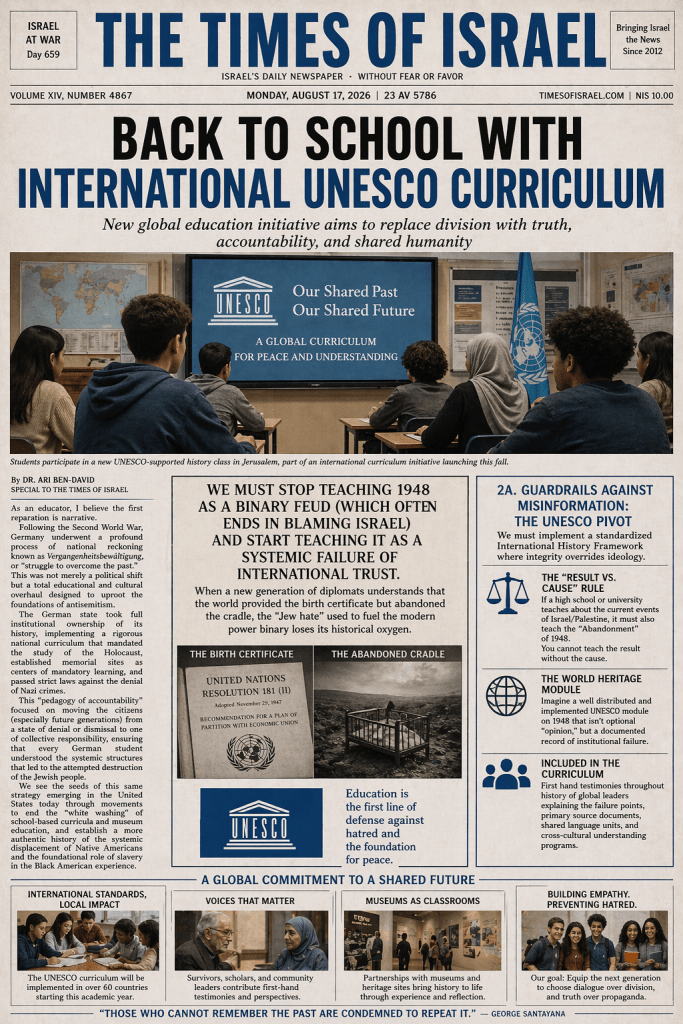
We (starting with NATO countries) must stop teaching 1948 as a binary feud (which often ends in blaming Israel) and start teaching it as a Systemic Failure of International Trust. When a new generation of diplomats understands that the world provided the birth certificate but abandoned the cradle, the “Jew hate” used to fuel the modern power binary loses its historical oxygen.
2a. Guardrails Against Misinformation: The UNESCO Pivot
We must implement a standardized International History Framework where integrity overrides ideology.
- The “Result vs. Cause” Rule: If a high school or university teaches about the current events of Israel/Palestine, it must also teach the “Abandonment” of 1948. You cannot teach the result without the cause.
- The World Heritage Module: Imagine a well distributed and implemented UNESCO module on 1948 that isn’t optional “opinion,” but a documented record of institutional failure.
3. Authenticity: Extreme Measure
In order to move forward, this moment requires a mea culpa that is so authentic it is jaw-dropping. An official UN “Day of Atonement” for the failure of Resolution 181 would stop the world in its tracks. It replaces the ongoing finger pointing and blame with a moment of global silence and ownership.
4. Collective Action: Ending the Burden of Containment
The global community must stop being a spectator (or an over-critical commentator) and start being a stakeholder. For decades, the burden of containing the IRGC and its proxies has been foisted almost exclusively onto the United States and Israel. The last few months have been a horrific testament to the failure of this isolationist strategy. Restorative justice means NATO and the UN takes a unified, decisive action against the IRGC. It means an international commitment to dismantling the infrastructure of terror that the world’s own negligence allowed to grow. True justice means that Israel is no longer forced to choose between international condemnation and its own survival because the international community finally recognizes that regional stability is a global obligation.
The “Utopia” is a Long-Term Project
This vision is not an unrealistic pipe dream but rather a long-term pedagogy of change and reset. It is a series of concrete steps that move us from a “What If” to a “What Now”:
- Step 1: The Documentaries and The Official Apology (The Evidence of Abandonment and Bias; The Institutional Ownership)
- Step 2: A New Approach (A reset with the disputed West Bank)
- Step 3: The Educational Pivot (The Correction & Prevention of Misinformation)
We may not be able to put the “Jew hate” back in Pandora’s box overnight, but by changing the foundational elements of how this history is taught, we ensure the next generation does not inherit our blindness. We owe them a history that is whole, authentic, and finally, honest. The ultimate win is an international commitment to a global curriculum of accurate, unbiased, restorative content. This teaches that Israel is a shared home that requires shared maintenance, individual accountability, and a global heart.
If we implement every piece of this restorative practice: if we record the testimonies, if we install the educational guardrails, if we rebuild the infrastructure of dignity, the world settles its “original debt,” and the IRGC is destroyed by a global cooperative effort, then, and only then, will we be ready for the final chapter.
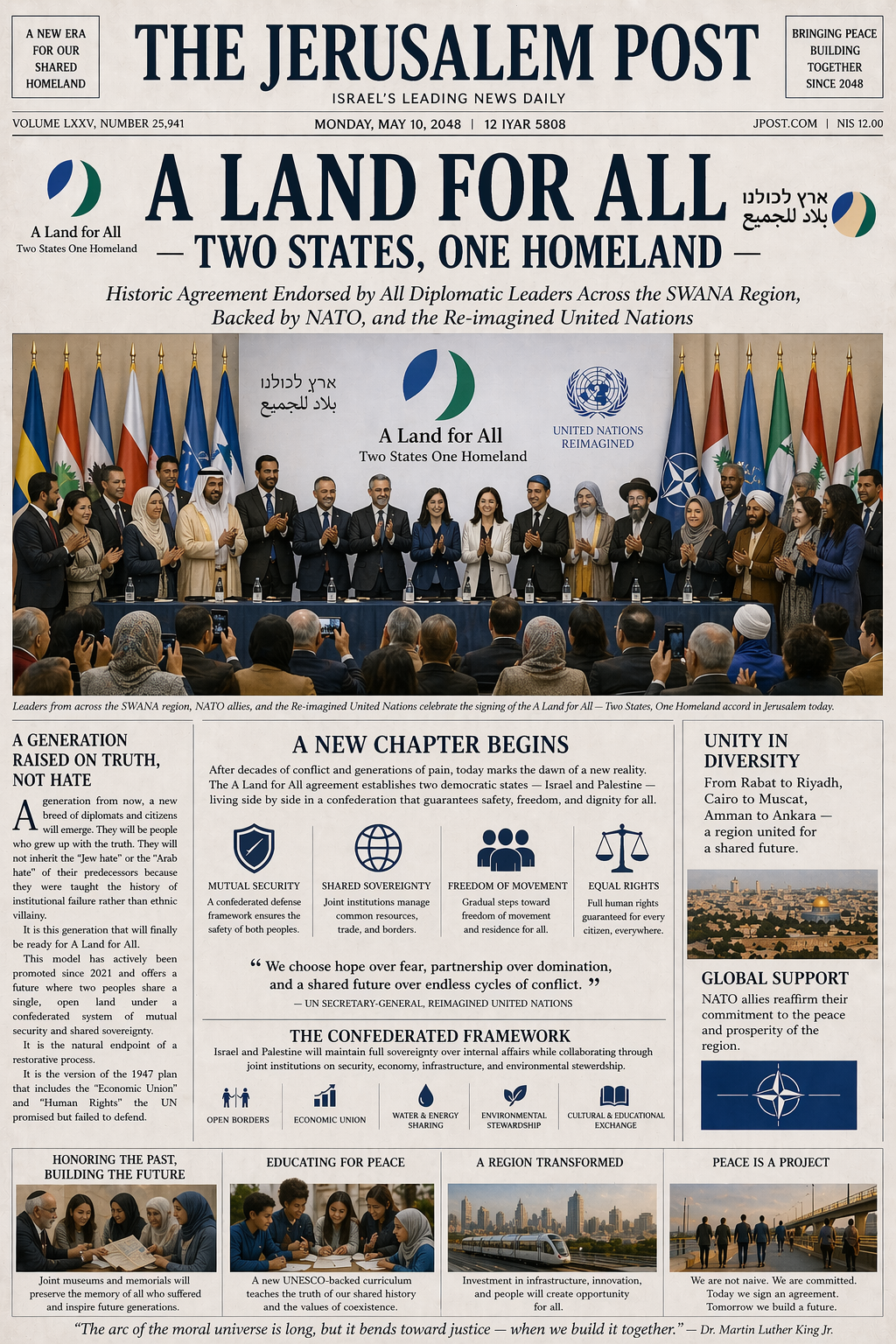
Step 4 : A Land for All — Two States, One HomelandA generation from now, a new breed of diplomats and citizens will emerge. They will be people who grew up with the truth. They will not inherit the “Jew hate” or the “Arab hate” of their predecessors because they were taught the history of institutional failure rather than ethnic villainy.
It is this generation that will finally be ready for A Land for All. This model has actively been promoted since 2021 and offers a future where two peoples share a single, open land under a confederated system of mutual security and shared sovereignty. It is the natural endpoint of a restorative process. It is the version of the 1947 plan that includes the “Economic Union” and “Human Rights” the UN promised but failed to defend.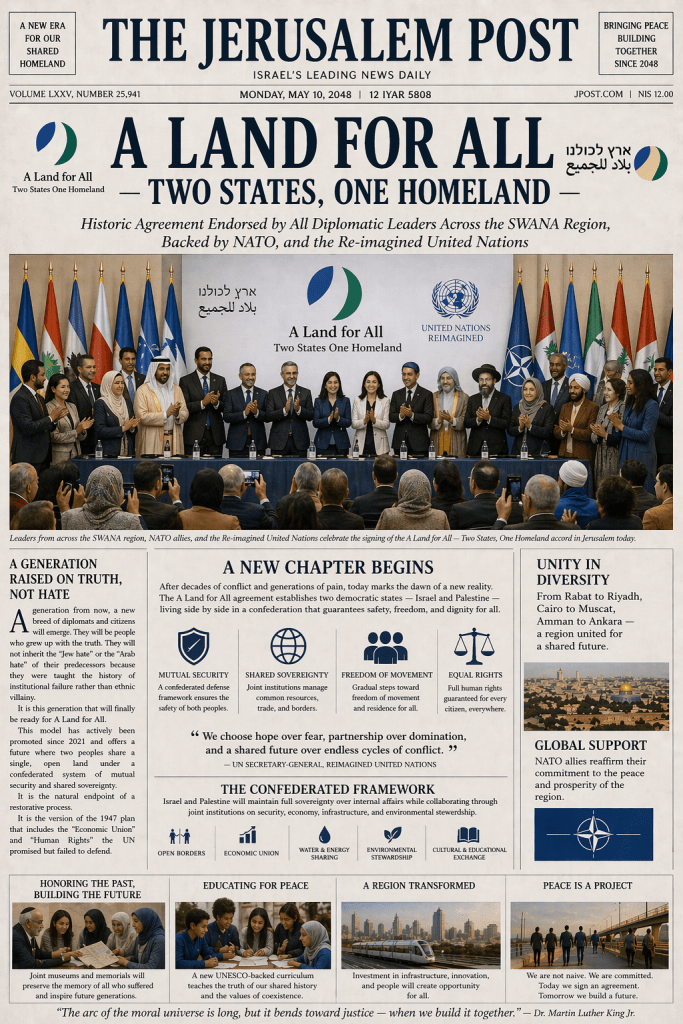
We are currently living in a period of time that can appropriately be labeled as “hell.” But by changing the approach of how we teach and how we hold the world accountable, we are building the bridge to that future. It’s not a Utopia; it’s a project. And it’s one we must start today.
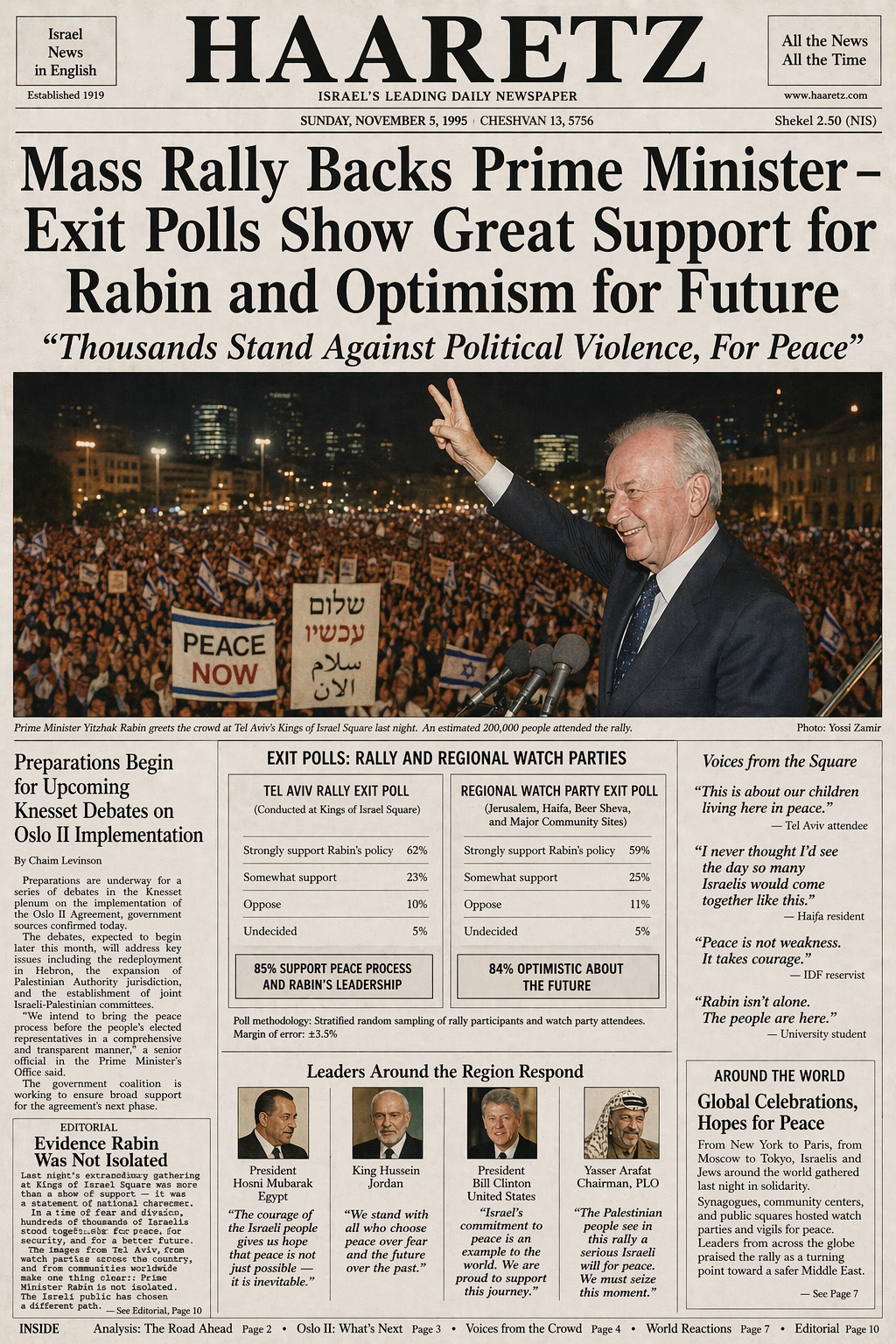
Sidebar: The Bullet That Changed History
What if Yitzhak Rabin hadn’t been murdered?
On November 4, 1995, a single act of domestic terrorism — the assassination of Yitzhak Rabin — altered the trajectory of the entire region. Rabin was a soldier-turned-statesman who had the unique credibility to bridge the gap between Israel’s security needs and the requirements of peace.
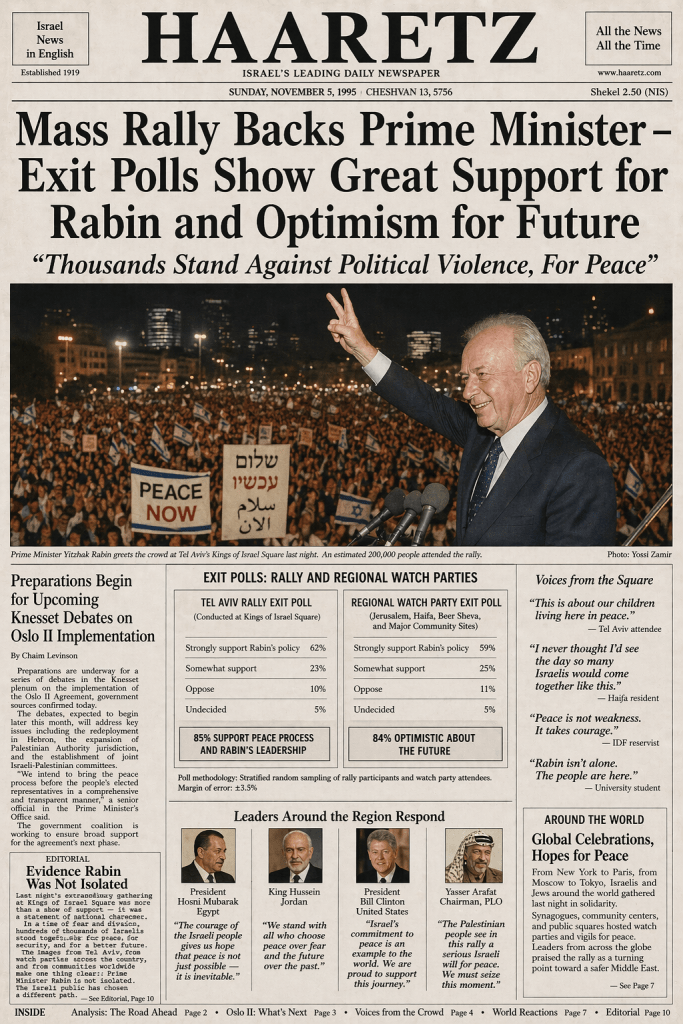
What might Restorative Justice be for the murder of Rabin? Justice here means a commitment to protecting the democratic process from political violence. It means ensuring that no single extremist bullet can ever again veto the collective will of a people seeking a shared future.
- The Legitimacy of the General: What if a leader with Rabin’s military prestige had remained at the helm to implement the Oslo Accords? Rabin had the trust of the Israeli “security establishment,” which is often the missing ingredient in peace negotiations.
- The Psychology of Hope: What if the momentum of the “Peace Square” rally had been allowed to flourish? The assassination didn’t just kill a man; it wounded the collective psyche of a generation that was beginning to believe coexistence was possible.
- A Different 2000: If Rabin had been the one sitting across from Arafat at Camp David, would the “Failed Handshake” have ever happened?
- The Second Intifada: What if the Second Intifada had never been launched in the wake of that diplomatic vacuum? If the “hell” of the early 2000s—the suicide bombings and the subsequent hardening of the physical and psychological barriers—had been avoided, where would the peace process stand today?
-
No Such Thing
“Pro-Palestinian seder” sounds like a values claim. But most often, it functions as anti-Zionism. Supporting Palestinian dignity, safety, and political rights is not inherently anti-Zionist. Many Zionists actively hold both. The false dichotomy only works if you erase real frameworks that already do this work.
There are 100+ orgs (see ALLMEP), alongside models like A Land for All and federated initiatives, built on equality, coexistence, and shared future. Progressive Zionism in the diaspora has long held both commitments. So “pro-Palestinian” does not require rejecting Jewish peoplehood or Jewish connection to land.
Clarity matters: Am/Bnei Yisrael = the people. Eretz Yisrael = the ancestral land. Medinat Yisrael = the modern state. Collapsing these terms allow critique of policy to become erasure of peoplehood. Judaism has always held people, land, and story in relationship.
Jewish identity itself carries geography. Kingdoms of Israel and Judah give rise to Judaea, and ultimately “Jew” and “Judaism.” Samaria remains tied to the northern kingdom. Jewish identity language is not abstract. It is derived from land-based history and cannot be fully separated from it.
The core narrative begins in that land. The story of Bnei Yisrael includes departure from Eretz Yisrael due to famine and descent to Egypt. That move is temporary and circumstantial, not a redefinition of identity. The story begins with connection to land, not its rejection.
Exodus is not just liberation from oppression. It is directional. The goal is return to Eretz Yisrael and the formation of a self-governing people there. In biblical language, this becomes kingdom. In modern terms, it maps onto national self-determination. That arc is central to Jewish memory.
Exile makes this even more explicit. Psalm 137 records Jews in Babylon weeping for Zion: “If I forget you, Jerusalem…” Jews did not leave their land by choice. They were exiled and preserved a continuous, recorded commitment to return to their homeland across generations.
Jerusalem is not incidental. It becomes the fixed center of prayer, pilgrimage, and memory. Jews pray toward Jerusalem. The Temple anchors ritual life. Even in exile, orientation never shifts. Jerusalem functions as a sustained axis of Jewish spiritual and national life across time.
The calendar reinforces this. Pesach, Shavuot, and Sukkot are pilgrimage festivals tied to place. Land laws like Jubilee assume national life in Eretz Yisrael. Jewish ritual time is not abstract spirituality. It is repeatedly anchored in land, agriculture, sanctuary, and collective presence.
This continuity matters. What we now call Zionism is modern language for something ancient: the sustained Jewish commitment to peoplehood in Eretz Yisrael. The term is new. The idea is not. It emerges clearly in exile literature, prayer, ritual, and historical memory across millennia.
Passover is one expression of this, not the entirety of it. The seder tells a story of movement toward land, covenant, and peoplehood, and closes with “Next year in Jerusalem.” It reflects a broader Jewish orientation, not a standalone political claim.
A Jewish framework can call for Palestinian dignity, safety, and rights. It can critique Israeli policy. But rejecting Jewish connection to Zion is not just reinterpretation. It asks Judaism to sever peoplehood from homeland in a way the tradition itself does not.



You must be logged in to post a comment.